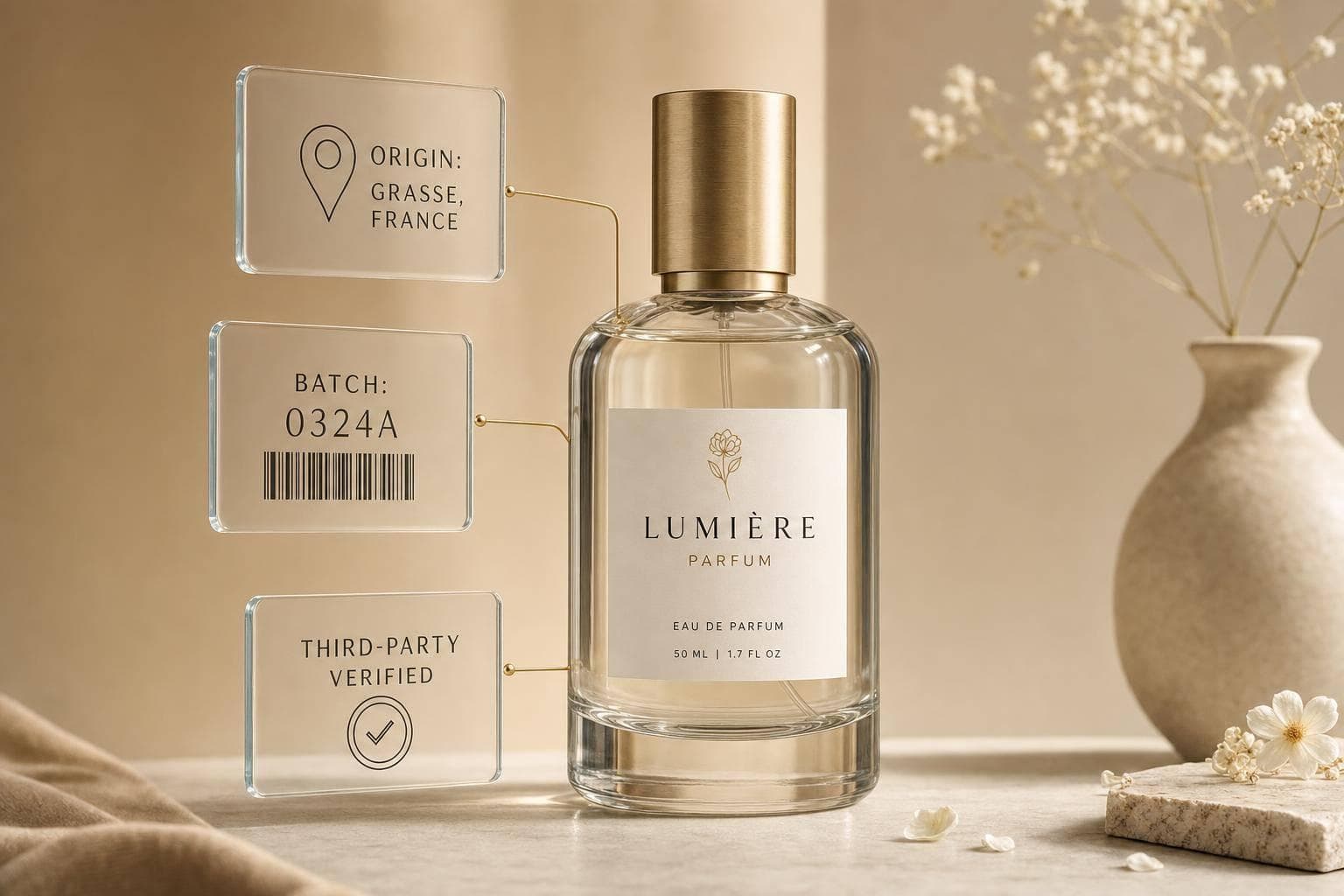
Daca platesc 100 € to 300 €+ pentru un parfum, vreau dovezi, nu doar promisiuni. In parfumerie, trasabilitatea ma ajuta sa verific trei lucruri inainte sa cumpar: de unde provin ingredientele-cheie, daca parfumul este autentic si daca afirmatiile brandului despre impact sunt sustinute de date.
Pe scurt:
- Parfumurile contrafacute sunt o problema majora. Cosmeticele si parfumurile contrafacute costa UE aproximativ €4,7 billion a year, echivalentul a 7,8 % din vanzari.
- Multi cumparatori vor mai multe detalii. Peste 60 % dintre consumatorii de produse de infrumusetare vor ca brandurile sa indice sursele ingredientelor.
- Majoritatea afirmatiilor sunt inca greu de verificat. Termeni precum provenienta responsabila sau ecologic nu inseamna mare lucru fara documente, date despre lot, detalii despre furnizori sau verificari independente.
- Cele mai bune indicii sunt simple. Caut numere de lot, coduri QR, regiuni de origine mentionate clar, detalii despre furnizori si certificate de la terti.
- Testul la cumparare este simplu: daca un brand nu poate prezenta dovezi clare, tratez afirmatia ca pe un text de pe ambalaj.
Cel mai important nu este sa existe mai multe cuvinte, ci dovezi mai bune. Un parfum poate fi autentic si totusi sa ascunda provenienta ingredientelor. Poate face si afirmatii despre clima sau conditiile de munca care suna bine, dar spun foarte putin. De aceea conteaza trasabilitatea: transforma promisiunile mari in lucruri pe care le pot verifica.
Inainte sa cumpar, ma concentrez asupra a patru lucruri:
- certificare independenta
- detalii despre ingrediente
- date despre origine si lot
- raportarea impactului masurat
Daca lipsesc, stiu mult mai putin decat ar sugera pretul.
Acest articol explica felul in care folosesc trasabilitatea pentru a face alegeri mai bune in materie de parfumuri, fara sa ghicesc.
What traceability means in fragrance
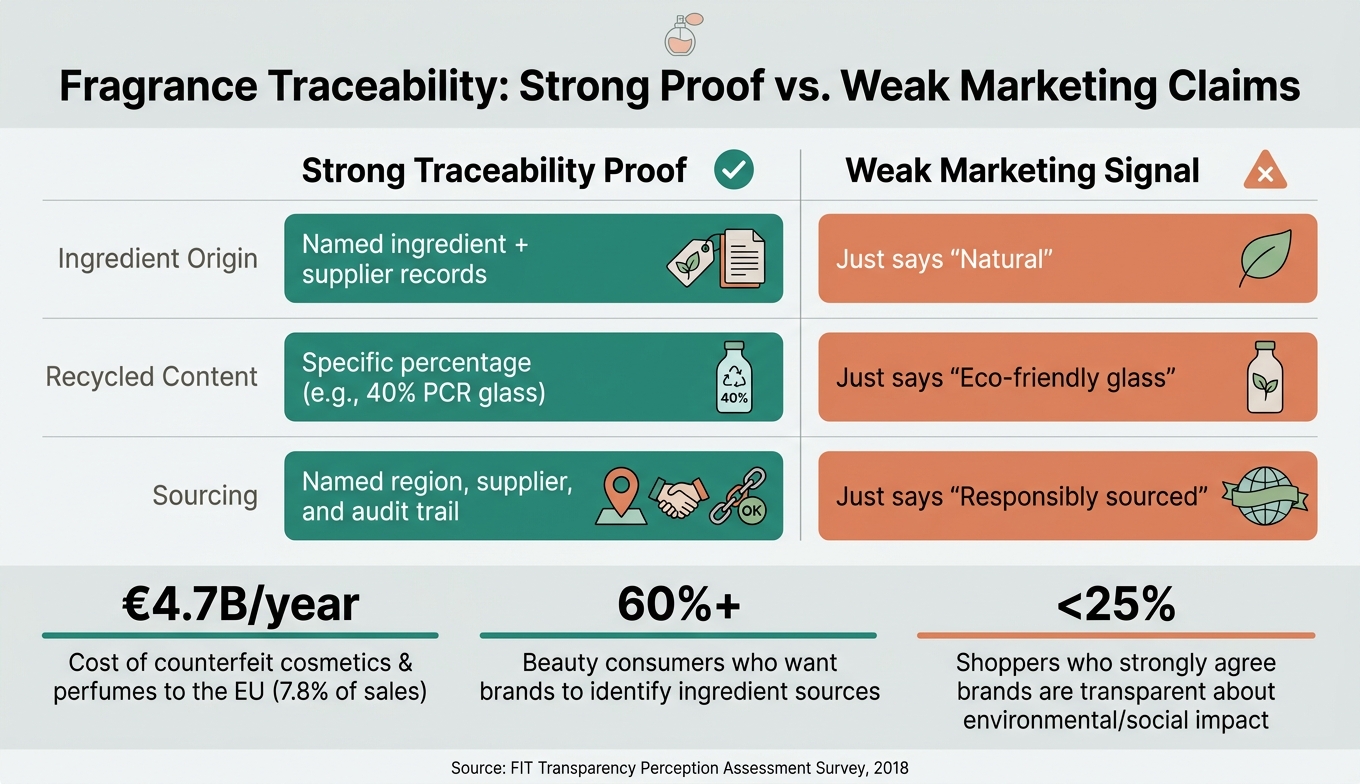
Trasabilitatea parfumurilor: dovezi solide versus afirmatii de marketing neconvingatoare
Trasabilitatea este capacitatea de a urmari un parfum de la ingredient pana la sticla. Mai simplu spus, inseamna ca un brand poate lega un anumit ingredient de sursa sa, de unitatea in care a fost procesat, de casa de parfumuri care l-a folosit si de sticla care a ajuns la tine. Pentru cumparatori, acest lant conteaza fiindca transforma afirmatiile despre provenienta, autenticitate si impact in lucruri pe care le pot verifica.
De la ingredient brut la flaconul finit
Un parfum modern trece prin etapele de aprovizionare, procesare, amestecare, umplere si distributie. La fiecare etapa se inregistreaza numerele de lot si codurile lotului. Asadar, daca provenienta unui parfum cu bergamota este trasabila, brandul ar trebui sa poata lega recoltarea, procesarea, formularea, umplerea si numarul lotului final printr-un singur lant de documente.
De ce trasabilitatea este mai mult decat o afirmatie de marketing
Diferenta esentiala sta in detaliile verificabile. O afirmatie de marketing se bazeaza pe expresii precum "aprovizionare responsabila" si "ecologic", fara sa le lege de ceva ce poti verifica.
Tabelul de mai jos arata clar diferenta. Acestea sunt indiciile pe care cumparatorii le pot folosi pentru a deosebi dovezile de imaginea de brand:
| Tipul afirmatiei | Dovezi solide de trasabilitate | Indiciu de marketing neconvingator |
|---|---|---|
| Originea ingredientelor | Documente privind ingredientele si furnizorii | Natural |
| Continut reciclat | Procent specific (de exemplu, 40 % sticla PCR) | Sticla ecologica |
| Aprovizionare | Regiune, furnizor si traseu de audit mentionate clar | Aprovizionare responsabila |
Cercetarile in randul consumatorilor confirma acest lucru. Un sondaj FIT din 2018, Transparency Perception Assessment Survey, a constatat ca peste 60 % dintre consumatorii de produse de infrumusetare vor ca brandurile sa indice sursele ingredientelor, iar 42 % considera ca nu primesc suficiente informatii despre siguranta ingredientelor. Totusi, mai putin de 25 % dintre cumparatori sunt pe deplin de acord ca brandurile sunt cu adevarat transparente in privinta impactului lor asupra mediului si societatii. Cererea exista. Adesea, insa, nu este urmata de actiuni.
Trasabilitatea reala iti ofera dovezi pe care le poti verifica. Lasa indicii pe care le poti cauta, precum un numar de lot, un cod QR sau un program al furnizorului identificat clar.
Aceste indicii duc la verificarile pe care cumparatorii ar trebui sa le faca inainte de achizitie.
Cum raspunde trasabilitatea celor mai mari trei preocupari ale consumatorilor
Aceste indicii conteaza fiindca raspund la trei intrebari simple ale cumparatorilor: cine l-a produs, este autentic si care este impactul sau?
Aprovizionare etica: mai multa transparenta asupra practicilor de munca si recoltare
Trasabilitatea arata de unde provin ingredientele si daca au fost recoltate in conditii de munca acceptabile. Daca un brand poate urmari un ingredient pana la sursa sa, poate arata si cine l-a recoltat si in ce conditii. Astfel, codurile furnizorilor, rapoartele de audit si datele privind bunastarea lucratorilor raman consemnate.
In practica, trasabilitatea transforma afirmatiile despre aprovizionare in lucruri pe care le poti verifica: regiuni si furnizori identificati, precum si audituri documentate. Fara aceste documente, brandurile recurg adesea la expresii precum aprovizionat in mod responsabil. Suna bine, dar, de una singura, expresia nu spune aproape nimic.
Autenticitate: verificarea provenientei si reducerea indoielilor
Contrafacerea ramane o problema majora pentru parfumuri in UE. Cosmeticele si parfumurile contrafacute genereaza pierderi anuale estimate la 3 € billion - aproximativ 4,8 % din vanzarile sectorului - iar milioane de produse sunt confiscate anual la granitele UE.
Aici intervin numerele loturilor, codurile QR serializate si registrele de custodie. Acestea le ofera cumparatorilor ceva concret de verificat. O sticla contrafacuta poate copia o eticheta. Nu poate copia un registru verificabil al lantului de aprovizionare.
| Indicator de autenticitate | Ce arata |
|---|---|
| Numar de lot | Leaga produsul de o anumita serie si data de productie |
| Cod QR sau cip NFC | Conecteaza produsul la registrele de distributie ale brandului |
| Listare la un distribuitor autorizat | Confirma ca vanzatorul face parte din lantul oficial de aprovizionare |
| Date despre ingrediente si provenienta | Ofera detalii despre aprovizionare pe care vanzatorii de produse contrafacute nu le pot reproduce, de regula |
Aceleasi registre care dovedesc provenienta ajuta si la sustinerea raportarilor privind impactul.
Impactul asupra mediului: corelarea afirmatiilor cu datele sursa
Aici apar cel mai des formularile vagi - si tot aici trasabilitatea face diferenta. Daca un brand poate urmari ingredientele de-a lungul etapelor de aprovizionare, procesare si transport, poate masura impactul fiecarei etape, in loc sa se limiteze la a numi produsul prietenos cu mediul.
Cea mai eficienta metoda in acest caz este Life Cycle Assessment (LCA). Aceasta masoara materialele, consumul de energie si emisiile, de la cultivare pana la eliminare. Indicatori precum kg CO₂-equivalent per 100 ml sau consumul de apa per ingredient au relevanta doar daca lantul de aprovizionare din spatele lor poate fi urmarit.
Pentru cumparatorii din Germania, testul e simplu: isi sustine brandul afirmatiile despre sustenabilitate cu date concrete si etape de aprovizionare identificate? Daca nu, afirmatia este probabil incompleta.
Expertul tău personal în parfumuri te așteaptă
Completează testul nostru rapid de parfumuri și descoperă parfumuri designer și de nișă autentice, alese pe gustul tău – explorează-le ca decanturi și mostre de 2, 5, 8 și 30 ml, ca să le poți încerca pe fiecare înainte de a alege un flacon întreg.
Descoperă-ți parfumulCe ar trebui sa verifice consumatorii inainte de a cumpara
Foloseste aceste verificari pentru a deosebi trasabilitatea reala de limbajul de marketing.
4 verificari care consolideaza afirmatiile despre trasabilitate
Incepe cu dovezile oferite de terti. Apoi verifica ingredientele, provenienta si raportarile.
Nu toti indicatorii inseamna acelasi lucru. Unii sunt mult mai usor de verificat decat altii, asa ca e util sa incepi cu cele mai solide dovezi.
Auditurile si certificarile realizate de terti au cea mai mare greutate. Afirmatiile solide precizeaza cine a realizat certificarea, cand a fost efectuata si unde poti gasi documentul public. O afirmatie vaga ca un brand este „certificat”, fara sa precizeze de cine sau pentru ce, nu iti spune mare lucru.
Dezvaluirea ingredientelor dincolo de lista standard este un alt semn bun. Brandurile cu trasabilitate reala numesc adesea ingredientele naturale exacte pe care le folosesc si provenienta lor, precum uleiul de bergamota din Calabria sau vanilia din Madagascar.
Datele despre provenienta si lot adauga un nivel suplimentar de verificare. Afirmatiile mai solide indica tara sau regiunea in care au fost recoltate ingredientele-cheie, modul in care au fost procesate si un numar de lot care corespunde registrelor brandului.
Raportarile privind sustenabilitatea merita o verificare rapida, dar numai daca includ cifre concrete. Cauta indicatori precum ponderea ingredientelor naturale trasabile, numarul furnizorilor auditati sau cifrele privind CO₂ raportate la un an de referinta.
Tabelul de mai jos arata cat de multa incredere poate sustine fiecare nivel de dovezi.
Trasabilitate completa, trasabilitate partiala si afirmatii neverificate
| Nivelul de trasabilitate | Dovezi furnizate | Nivel de incredere |
|---|---|---|
| Trasabilitate completa | Ingrediente identificate si regiuni de provenienta, liste de furnizori auditati, numere de lot corelate cu inregistrari digitale, certificare de catre terti insotita de documentatie publica | Ridicat - afirmatiile despre autenticitate si aprovizionare pot fi verificate in mod relevant |
| Trasabilitate partiala | Date despre provenienta doar pentru cateva ingrediente; cateva mentiuni despre furnizori; pagina generala despre sustenabilitate | Moderat - ai incredere acolo unde exista dovezi, dar nu presupune ca acestea se aplica intregului produs |
| Afirmatii neverificate | Doar formulari generice: "aprovizionat in mod responsabil", "curat", "transparent" - fara furnizori, regiuni, audituri sau certificari identificate | Scazut - trateaza afirmatiile ca pe marketing pana cand apar dovezi |
Daca pagina produsului unui brand se incadreaza in al treilea rand, iti cere sa-l crezi pe cuvant.
Cum sustine trasabilitatea descoperirea mai informata a parfumurilor
Odata ce provenienta este clara, urmatorul pas e mai simplu: ti se potriveste parfumul in purtarea de zi cu zi?
Pentru cumparatorii care au verificat provenienta, fiolele de 2 ml, 5 ml si 8 ml de la Scento, precum si decanturile de 30 ml din majoritatea parfumurilor, fac mai usoara testarea unui parfum inainte de a te decide asupra unui flacon intreg.
Concluzie: informatii mai bune duc la alegeri mai bune in materie de parfumuri
Trasabilitatea nu este doar pentru cunoscatorii din industrie. Le ofera consumatorilor o modalitate de a verifica un parfum inainte sa il cumpere.
Pe scurt, trasabilitatea faciliteaza verificarea dovezilor concrete pentru aprovizionarea etica, autenticitate si afirmatiile legate de clima.
Idei-cheie pentru consumatori
Industria parfumurilor se indreapta spre o transparenta mai mare. Lista de transparenta IFRA include acum ingredientele folosite de membri care sunt responsabili pentru aproximativ 80 % din productia globala de parfumuri, oferindu-le consumatorilor un punct de plecare clar pentru documentarea ingredientelor. Marcile si furnizorii incep, de asemenea, sa foloseasca pasapoarte digitale pentru produse si evidente QR ale loturilor, pentru a corela flacoanele cu date despre aprovizionare, certificare si productie.
Pentru cumparatori, concluzia este simpla: cere documente privind originea, date despre lot si dovezi din partea unor terti inainte de achizitie.
Diferenta dintre afirmatii si dovezi este acum mai usor de observat. O trasabilitate mai buna transforma aceasta diferenta intr-un criteriu de decizie.
Pentru consumatorii din Germania, unde parfumurile premium costa adesea peste 100 € per flacon, acest lucru conteaza. Trasabilitatea poate reduce riscul de a plati preturi de lux pentru produse ale caror afirmatii etice sau climatice nu pot fi verificate. Daca o marca comunica originile ingredientelor, mentionand numele acestora, ofera linkuri catre certificari ale unor terti si pune la dispozitie date despre loturi, cumparatorii isi pot alinia achizitiile cu valorile lor - de la munca echitabila la impactul asupra climei.
Odata ce aceste informatii de baza sunt vizibile, alegerea unui parfum devine o chestiune de gust, nu de presupuneri.
Foloseste trasabilitatea ca filtru permanent, nu ca verificare facuta o singura data. Incepe cu marcile care prezinta dovezi solide, apoi reevalueaza transparenta pe masura ce standardele se imbunatatesc. In timp, astfel poti construi o garderoba de parfumuri bazata pe informatii verificate, nu pe limbaj de marketing.
Intrebari frecvente
Cum pot verifica un parfum inainte de a-l cumpara?
Verifica daca exista certificari emise de terti, precum UEBT, Fair Trade, COSMOS sau NATRUE si confirma-le in bazele de date oficiale aferente acestor etichete. Nu te opri la insigna de pe cutie. Analizeaza cu atentie si ambalajul, si site-ul marcii, in special listele de ingrediente INCI, rapoartele privind aprovizionarea si politicile de aprovizionare responsabila.
In cazul decanturilor, detaliile de baza conteaza. Asigura-te ca vanzatorul este o companie inregistrata si ca foloseste flacoane originale sigilate din fabrica, achizitionate prin canale de vanzare autorizate. Scento ofera parfumuri autentice de designer si de nisa in fiole de 2 ml, 5 ml si 8 ml, precum si decanturi de 30 ml din majoritatea parfumurilor.
Ce dovezi ar trebui sa caut pentru a verifica afirmatiile privind aprovizionarea?
Nu te lasa convins de etichete vagi precum natural sau ecologic. Ceea ce conteaza sunt dovezile clare dintr-o sursa externa: regiunea de origine, numele furnizorului si un istoric de audit trasabil.
Este util sa verifici si daca exista certificari precum UEBT, Fair Trade, COSMOS sau NATRUE. Nu te opri la sigla de pe ambalaj - verifica-o in baza de date oficiala a organismului de certificare. Apoi, consulta site-ul sau ambalajul marcii pentru a gasi un certificat de conformitate IFRA, rapoarte privind aprovizionarea si liste complete de ingrediente INCI.
Trasabilitatea ajuta cu adevarat la identificarea parfumurilor contrafacute?
Da, dar mai ales indirect.
Daca o marca pune la dispozitie documente privind aprovizionarea pe care le poti verifica - precum audituri ale furnizorilor, certificate si transparenta la nivel de lot - ai dovezi concrete pe care le poti verifica, dincolo de afirmatiile de marketing. Acest lucru conteaza, pentru ca iti ofera un sir de documente justificative, nu doar un text bine slefuit.
In cazul decanturilor, totul tine de provenienta. Acestea ar trebui sa fie prelevate dintr-un flacon original sigilat din fabrica, achizitionat prin canale autorizate, si sa aiba codurile de lot corecte, precum si o performanta care sa corespunda parfumului din flaconul intreg.
Fara un astfel de lant de custodie trasabil, este mult mai usor ca produsele contrafacute sa treaca neobservate.

