Bespoke perfumes are gaining momentum as consumers move away from mass-market scents, favoring personalization and exclusivity. By 2028, the personalized fragrance market is expected to hit €1.13 billion, driven by:
- Individuality: Fragrances are now seen as personal signatures, capturing memories and emotions.
- Market Trends: Niche fragrances grow at 9.1% annually, outpacing mass-market perfumes at 2.69%.
- Technology: AI tools and DNA profiling simplify customization, making bespoke scents more accessible.
- Sustainability: Eco-friendly ingredients, refillable packaging, and ethical sourcing are reshaping the luxury market.
With entry-level bespoke services starting at €5,000 and premium options exceeding €100,000, this trend reflects a shift in luxury preferences, blending personalization, tech, and conscious choices.
Designing My Own Bespoke Fragrance With Floris London | Kirby Allison
Market Growth and Trends in Bespoke Fragrances
Bespoke Perfume Market Growth Statistics and Consumer Trends 2024-2035
Global Market Projections
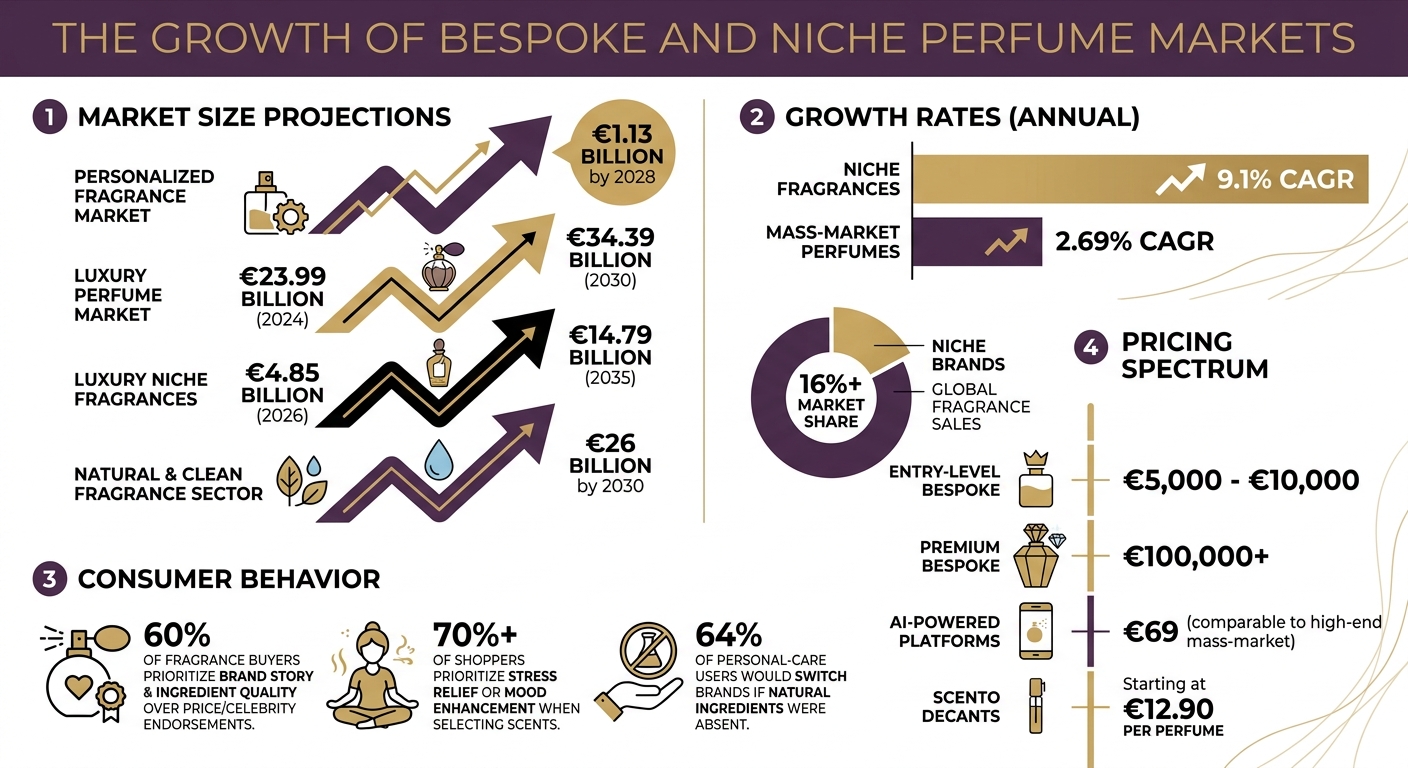
The demand for personalized fragrances is fueling notable growth in both luxury and niche perfume categories. In 2024, the luxury perfume market is estimated to be worth €23.99 billion, with projections suggesting it will climb to €34.39 billion by 2030. While mass-market fragrances grow at a modest 2.69% annually, niche fragrances are surging ahead with a growth rate of 9.1% each year.
Focusing specifically on luxury niche fragrances, the market is forecasted to reach €4.85 billion by 2026, with long-term estimates pointing to an impressive €14.79 billion by 2035. These niche brands now represent over 16% of global fragrance sales, underlining their growing influence in the industry.
What’s Driving Bespoke Growth
The rise of bespoke fragrances is shaped by several key factors. One major driver is market saturation, which has left consumers searching for scents that stand out. In a sea of similar options, the appeal of a truly unique fragrance has grown significantly.
Tom Pendrey, Perfumer and Co-Founder of AURA Candle Bar, highlights this shift:
Niche and artisanal fragrances are the fastest-growing segment of the entire global fragrance market, and it is reshaping what luxury scent means for an entirely new generation.
This evolution reflects a broader consumer preference. Today, 60% of fragrance buyers prioritize a brand’s story and the quality of its ingredients over factors like price or celebrity endorsements.
Another major influence is the clean beauty movement, which has extended its reach into the fragrance world. Consumers are now examining ingredient lists with the same level of scrutiny they apply to skincare products. Transparency about the use of phthalates, parabens, and synthetic compounds has become a critical factor. As a result, the natural and clean fragrance sector is expected to grow significantly, with projections estimating its value at €26 billion by 2030.
This blend of personalization, ingredient transparency, and premium quality is redefining how people use fragrances to express their individuality.
Consumer Demand for Personalization in Fragrance
The growing fragrance market reflects a deeper consumer desire to express individuality through scent.
The Shift to Individual Scents
With the market brimming with mass-market options, modern consumers are shifting their focus. Fragrance is no longer just a cosmetic product; it’s now seen as an extension of personal identity. In fact, over 70% of shoppers prioritize stress relief or mood enhancement when selecting a scent.
Interestingly, when people believe a fragrance is tailored specifically to them, their satisfaction increases - even if the scent isn’t flawless. This phenomenon, often linked to the placebo effect, highlights how personalization fosters a stronger emotional connection. The process of selecting notes or completing a customized questionnaire creates a sense of ownership, making the fragrance feel more personal and meaningful.
This deeper connection transforms fragrance into a unique form of self-expression.
Bespoke as an Expression of Identity
Bespoke fragrances go beyond mere customization - they’ve become a subtle but powerful tool for personal branding. Industry leaders describe this trend as a quiet yet transformative shift. A custom scent isn’t just a luxury; it’s an intimate reflection of one’s story, memories, and aspirations.
This exclusivity has elevated bespoke perfumes to the status of a luxury symbol. Unlike mass-produced designer bottles, a personalized fragrance tells a unique story. The market for these custom creations is expected to reach €1.13 billion by 2028. Consumers are willing to pay a premium, with entry-level bespoke experiences starting at €5,000 to €10,000. For those seeking the rarest ingredients, like orris butter or oud, prices can soar into six figures.
But it’s not just about exclusivity. Crafting a bespoke fragrance offers a creative and mindful escape in a world dominated by digital interactions. For Gen Z, who often see identity as fluid and multi-layered, custom scents provide a powerful way to express their individuality.
Technology in Bespoke Fragrance Creation
Technology is reshaping the world of bespoke fragrance creation by making the process faster, more affordable, and precise. As the demand for personalization grows, these advancements are redefining how custom scents are designed and delivered.
AI-Powered Tools for Personalization
Artificial intelligence is revolutionizing the speed and accuracy of creating personalized fragrances. For example, in June 2025, the startup Osmo utilized artificial olfactory intelligence and graph neural networks to develop custom fragrance samples within just 48 hours. This is a stark contrast to traditional bespoke services, which can take anywhere from 6 to 18 months.
Similarly, in July 2021, NoOrdinaryScent launched its AI "Scent Creator", a tool that analyzes three uploaded images - capturing activity, mood, and season - to match in-house accords and produce a formula within 5–7 days for €69. Co-founder Amelie Saltin Thor explained:
We’re putting the power of perfume memories in your hands.
For professional perfumers, AI simplifies the more labor-intensive aspects of fragrance creation. Frank Voelkl, Principal Perfumer at DSM-Firmenich, highlighted this shift:
The beauty of AI is that it manages regulatory concerns, issues around stability, phasing, performance... so I can focus much more on the creative part.
While traditional master perfumer services are priced between €4.700 and over €94.000, AI platforms like EveryHuman and tools such as Givaudan‘s Carto offer cost-efficient prototyping and ensure regulatory compliance, making personalized fragrances accessible at prices comparable to high-end mass-market perfumes.
Biometric and DNA Profiling
The next wave of innovation in bespoke fragrance creation dives into biology. Startups are exploring "bio-scent matchmaking", using analyses of olfactory receptors and genetic markers to identify scents that resonate most with an individual’s biology. Instead of relying on subjective preferences, these systems determine what your body is naturally inclined to respond to.
Premium DNA scent-matching services, aimed at elite clients, are set to expand between 2025 and 2026. These services analyze factors like olfactory receptor variations, skin pH, and neurological responses to create uniquely tailored formulas. Research indicates that the process of biometric testing - whether through an EEG headset or a DNA sample - enhances a consumer’s emotional connection to a fragrance, regardless of its chemical composition.
However, this shift toward biological data raises important questions. As DNA and biometric profiling become more common in fragrance design, concerns about the use and storage of sensitive personal data are growing. Regulators and consumers alike are beginning to debate the ethical implications of these advancements. Despite these challenges, these technologies are aligning personal biology with the artistry of perfume design, deepening the bespoke fragrance experience.
Your Personal Fragrance Expert Awaits
Take our quick scent quiz to discover authentic designer and niche fragrances matched to your taste — explore them as 2ml, 5ml, 8ml & 30ml decants and samples, so you can try each one before committing to a full bottle.
Find Your ScentSustainability and Ethics in Bespoke Perfumes
As bespoke fragrances redefine the luxury market, environmental responsibility and ethical practices are becoming central to consumer decisions. A survey revealed that 64% of personal-care users would consider switching brands if natural ingredients were absent from the product list. This shows how deeply sustainability influences purchasing behavior today.
Eco-Friendly Ingredients and Packaging
Perfume houses are rethinking their approach to both formulas and packaging. Many are moving from synthetic molecules to ingredients of natural origin, such as bergamot, sandalwood, and jasmine. They’re also incorporating upcycled oils derived from discarded fruit peels and wood scraps.
Take Elisire, for example. This independent perfume house offers 100% vegan and cruelty-free fragrances as of 2024. By combining green chemistry with white biotechnology, they craft sustainable scents while maintaining strict ethical standards throughout their supply chain. Their ethos is captured in their motto:
The best of nature and scientific research dedicated to sustainable excellence, that is ÉLISIRE’s motto.
Packaging innovation is also advancing rapidly. Minelli S.p.A., for instance, has developed "Legnavis", a patented wooden threaded cap made without plastic or glue. Their FSC certification, held since 1999, ensures that all wood components come from responsibly managed forests. Similarly, The Perfume Studio introduced a refill system in 2024, addressing the staggering 59 million perfume bottles discarded in UK landfills that year. This system allows customers to refill their bespoke scents, reducing the carbon footprint linked to new packaging.
Beyond packaging, brands are turning to regenerative agriculture to restore ecosystems. Collaborations with Fair Trade cooperatives in regions like Madagascar, India, and Morocco ensure that local communities benefit from the cultivation of key ingredients like vanilla. Notably, Madagascar produces around 80% of the world’s vanilla, making ethical sourcing crucial to addressing exploitative labor practices.
From ingredients to packaging, this commitment to ethical practices is redefining luxury in bespoke perfumery.
Responsible Luxury for Conscious Consumers
Ethical transparency has become just as important as material innovation in today’s luxury fragrance space. Sustainability in bespoke perfumery extends beyond sourcing - it’s also about providing traceability. Many consumers now expect QR codes on products that reveal sourcing details, distillation dates, and harvest regions, fostering trust in eco-conscious luxury.
Edoardo Cavagnetto of Minelli S.p.A. emphasized this shift:
Sustainability in perfume packaging design is no longer an afterthought - it is a central component of a brand’s ethos and a critical factor in its market appeal.
Biotechnology is also transforming the ethical landscape. Lab-created, bio-identical molecules like Ambroxan and bio-engineered musks now replicate rare or animal-derived scents such as ambergris and musk. This innovation eliminates harm to wildlife and reduces reliance on overharvested natural resources. Bespoke perfume houses can now offer the depth and complexity of traditional perfumery while adhering to cruelty-free and conservation principles.
For conscious consumers, verifying certifications, opting for refillable systems, and choosing brands with transparent supply chains are practical steps toward supporting sustainable luxury. With the personalised fragrance market projected to reach £1.13 billion by 2028, sustainability and ethics are no longer optional - they are shaping the future of bespoke perfumery.
Bespoke vs. Discovery Models: Bridging the Gap
The Challenges of Bespoke Fragrance
Bespoke fragrances occupy a realm of exclusivity, largely due to their cost and the time required to create them. Entry-level services typically range between €5,000 and €10,000, while premium offerings can soar past €100,000 for full ownership of a custom formula. The process itself is intricate, involving multiple consultations, drafts, and detailed skin chemistry analyses to craft a scent that embodies your essence.
As Lloyd Naake, Managing Director of The Perfume Studio, aptly puts it, bespoke perfume is "closer to commissioning a work of fine art than purchasing a cosmetic item". However, this artistic journey can be daunting for clients, who are often tasked with describing deeply personal memories or emotions without the technical vocabulary of a perfumer.
This is where discovery models step in, offering a more accessible gateway into the world of personalised scent creation.
Scalable Discovery Through Decants
Discovery models make personal fragrance exploration more approachable by reducing the financial and emotional risks. With over 6,000 new perfumes launched in 2025 alone, navigating this overwhelming sea of options can feel impossible. Decant subscriptions simplify the process, allowing consumers to test fragrances and discover their preferences without the hefty price tag of full bottles or bespoke services.
One standout example is Scento, which has redefined fragrance exploration for European consumers. By offering curated decants, Scento provides an affordable way to experiment with designer fragrances. Instead of spending €300+ on full-sized bottles that might end up gathering dust, customers can try 2 ml, 5 ml and 8 ml vials, and a 30 ml bottle decant on most perfumes. Scento is a perfume decant and sample retailer, and every product is available for one-time purchase without any subscription. Scento+ is Scento’s optional membership: the monthly fee comes back in full as store credit to spend on any perfume, members get 10% off, a free sample with every order, a free perfume every six months and a birthday gift, and you can pause anytime; to cancel, contact our team. This trend resonates particularly with Gen Z, who increased their fragrance spending by 26% in 2024.
Beyond the cost savings, discovery sets offer a deeper benefit: they enhance your "olfactory literacy." Sampling a variety of fragrances teaches you how scents evolve on your skin over time, how they behave in different settings (morning versus evening, humid versus dry), and which scent families align with your personal chemistry. Such insights are invaluable if you decide to pursue a bespoke fragrance later, enabling you to provide your perfumer with precise preferences instead of vague ideas.
Ultimately, discovery models and bespoke perfumery complement each other beautifully. While decants don’t replace the artistry of bespoke creations, they prepare you for it. Keeping a "scent journal" while exploring decants can help you uncover emotional triggers and favourite notes, giving you a clear roadmap for future bespoke consultations. In this way, decant sampling not only saves money but also sharpens your sensory awareness, laying the groundwork for a truly personalised fragrance journey.
Future Outlook: Bespoke Fragrance Trends in 2026 and Beyond
AI and Automation in Customization
Artificial intelligence is reshaping the bespoke fragrance industry, making personalized scents more attainable. Through innovations like "bespoke at scale", AI-driven tools such as scent quizzes, modular fragrance cartridges, and micro-batching are reducing the barriers to customization. This approach allows consumers to enjoy tailored scents without the hefty €5,000–€10,000 price tag typically associated with traditional bespoke perfumery.
Platforms like Scentalytics are leading the charge with advanced predictive modeling. Their Compose feature recommends scent formulas tailored to factors like gender, season, and preferred accords, while Analyze evaluates emotional resonance and consumer sentiment. As Scentalytics puts it:
We envision a world where AI serves as a catalyst for innovation, helping perfumers push the boundaries of their craft while maintaining the essential human touch that makes each fragrance unique.
Another exciting development is olfactory biofeedback, which uses physiological data - like heart rate variability and micro-expressions - to adjust fragrance formulations in real-time. This emerging technology could soon empower consumers to refine their scents based on how their bodies physically respond, going beyond just conscious preferences.
These advancements are redefining the customer experience, making it easier to journey from digital sampling to owning a personalized scent.
Decant to Full-Bottle Transitions
By 2026, many consumers are expected to embrace a rotation of personalized fragrances suited to different moods and occasions, moving away from the idea of a single signature scent. This trend aligns with the niche perfume market’s rapid growth, which boasts a 9.1% compound annual growth rate - far outpacing the mass market’s 2.69%.
Building on the popularity of decant discovery, fragrance platforms are now streamlining the transition from sampling to ownership. Automation plays a key role, enabling users to tweak existing formulas digitally and reorder their favorites in larger sizes - ranging from 30 ml to full bottles - once they’ve settled on their preferred scents. For example, Scento now offers a 30 ml bottle decant on most perfumes, encouraging customers to experiment affordably before committing to larger volumes. This seamless integration of digital customization and automated reordering makes it easier than ever to go from exploration to owning a curated fragrance collection.
The luxury niche fragrance market is projected to reach €4.85 billion by 2026. This growth is fueled by consumers who value brand storytelling and high-quality ingredients over celebrity endorsements - a sentiment shared by 60% of fragrance buyers. These shifts underline the importance of brands creating meaningful, guided experiences that take customers from their first sample to a thoughtfully curated collection of full-sized bottles. The future belongs to those who can merge innovation with a personalized touch.
Conclusion
The rise of bespoke perfumery highlights three major shifts in modern consumer preferences: a focus on individuality, the role of technology, and a growing appreciation for conscious luxury. With over 6,000 new perfumes introduced in 2025 alone, people are moving away from mass-market fragrances and gravitating toward scents that tell their personal stories. The personalized perfume market, projected to reach €1.13 billion by 2028, reflects this growing demand for fragrances that act as a "signature of identity".
Advancements in technology have played a key role in making bespoke fragrances more accessible. Tools like AI-driven scent profiling and modular fragrance systems now provide "bespoke at scale", significantly lowering the entry cost. What was once a luxury reserved for those willing to spend €5,000–€10,000 is now available at a fraction of the price. As Lloyd Naake, Managing Director of The Perfume Studio, puts it, creating your own perfume in today’s tech-dominated world is a quiet yet powerful act of personal expression.
Discovery models are also reshaping the luxury fragrance landscape by blending creativity with practicality. Scento, for instance, offers curated decants (2 ml, 5 ml and 8 ml vials, and a 30 ml bottle decant on most perfumes) that allow customers to test fragrances on their skin over 24–48 hours before committing to a full-sized bottle. This method not only enhances the personalization experience but also addresses waste in the €52 billion fragrance market, where expensive bottles often go unused.
The future of fragrance lies at the intersection of bespoke artistry and accessible, technology-enabled discovery. Whether through AI-powered customization or thoughtful sampling options, consumers can now curate a fragrance wardrobe that evolves with their identity - without the high costs or risks traditionally associated with bespoke perfumery. As these trends continue to blend personalization, innovation, and sustainability, bespoke fragrances are no longer exclusive to the elite but are becoming a meaningful way for anyone to express their individuality.
FAQs
How do I know if bespoke perfume is worth the €5.000+ cost?
A bespoke perfume priced at over €5,000 provides an intensely personal experience, crafting a scent that is entirely your own. For many, the appeal lies in its individuality and emotional depth, as it encapsulates your personal identity and cherished memories in a way that no mass-produced fragrance can achieve. Its exclusivity and the personal meaning it carries are key factors to weigh when considering whether it justifies the cost.
What data do AI or DNA-based scent services collect about me?
AI- and DNA-driven scent services gather personal data to craft tailored fragrances. This can involve lifestyle information, individual preferences, and even biometric data. Some advanced systems go a step further, examining molecular reactions or incorporating consumer feedback to refine scent profiles. By combining personal and sensory data, these technologies aim to push fragrance customisation to new levels.
How can I find my “signature scent” without buying a full bottle?
To find your signature scent without purchasing a full bottle upfront, consider exploring sample collections or discovery sets. These options let you try several fragrances in smaller amounts, making it easier to pinpoint the ones that match your style and preferences. Another exciting option is a bespoke perfumery experience, where a perfumer collaborates with you to create a custom fragrance perfectly aligned with your tastes. Both approaches make scent exploration both enjoyable and budget-friendly.

