
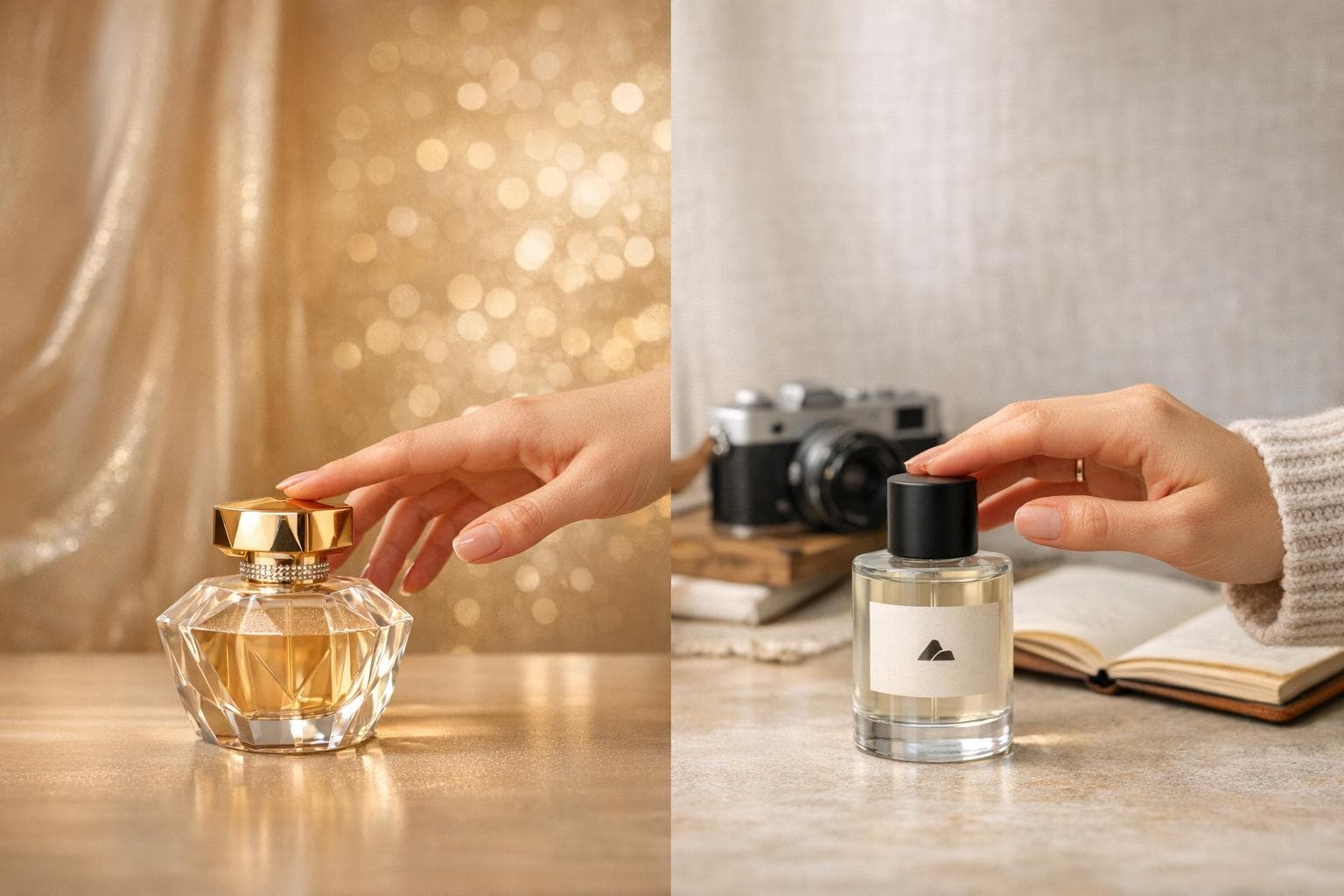
Celebrity and influencer fragrances cater to distinct audiences and use contrasting strategies to connect with buyers. Celebrity scents focus on star power and mass appeal, while influencer fragrances emphasize personal stories and niche vs designer connections. Here’s a quick breakdown:
- Celebrity Fragrances: Designed for broad audiences, often backed by high-budget campaigns. Examples include Ariana Grande’s billion-euro line and Billie Eilish’s vegan scents. These fragrances are aspirational, offering fans a connection to their idols.
- Influencer Fragrances: Target smaller, engaged communities through social media. They highlight transparency, the creative process, and personal involvement. Stephanie Ledda’s €1.9 million sales in 2024 show the success of this approach.
Key Trends:
- Gen Z prefers influencers for their relatability and focuses on curating "scent wardrobes" rather than sticking to one signature fragrance.
- Social media platforms like TikTok are pivotal for discovery, with interactive content driving engagement.
Comparison:
| Feature | Celebrity Fragrances | Influencer Fragrances |
|---|---|---|
| Target Audience | Broad, global fans | Niche, engaged followers |
| Marketing Style | Glossy ads, billboards, global campaigns | Social media, direct interaction |
| Price Range | Affordable luxury (€40-€120) | Mid-range (€40-€98) |
| Focus | Glamour, aspirational luxury | Personal connection, storytelling |
| Success Metric | Total sales, brand awareness | Engagement, conversion rates |
Both approaches reflect changing consumer priorities, with younger buyers valuing variety, transparency, and personal expression.
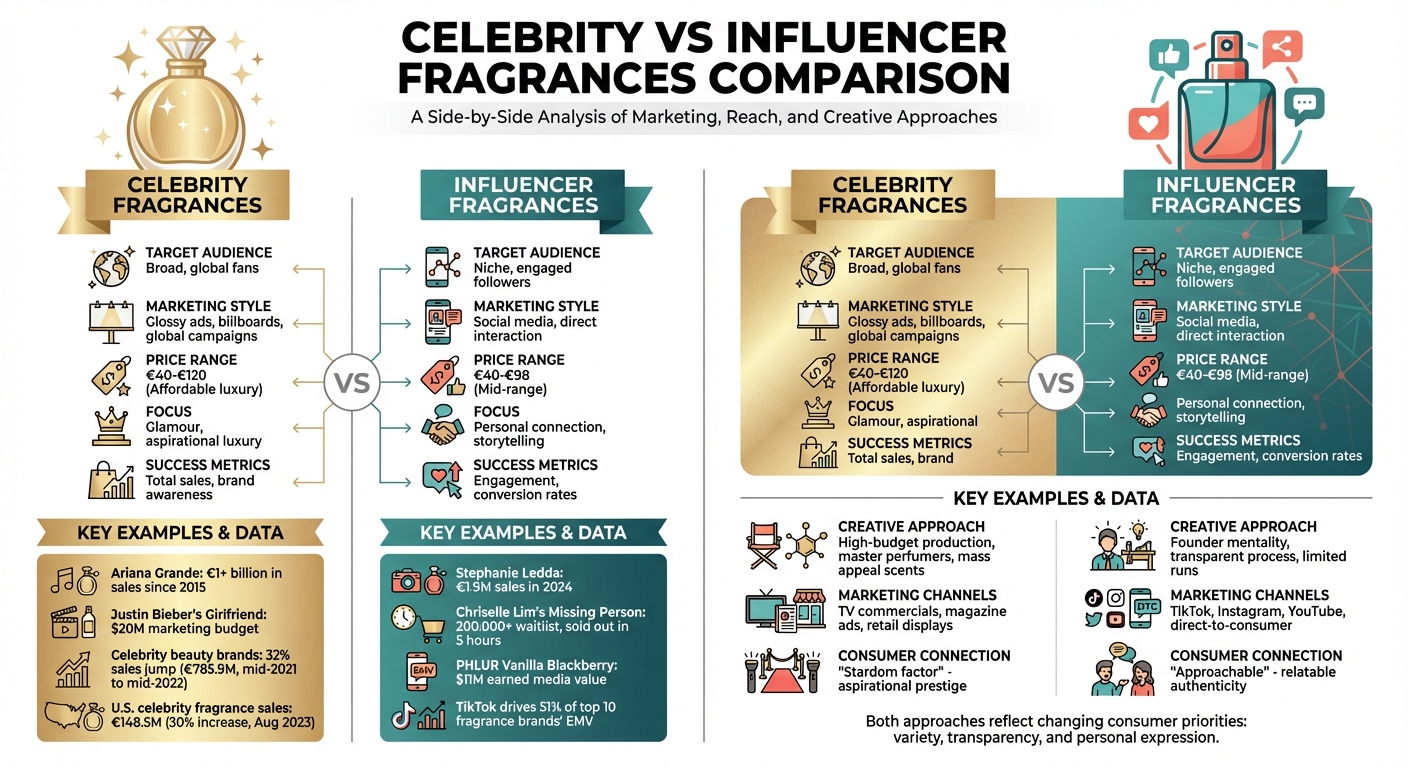
Celebrity vs Influencer Fragrances: Key Differences Comparison Chart
I Tested Every YouTuber Fragrance
Your Personal Fragrance Expert Awaits
Join an exclusive community of fragrance connoisseurs. Each month, receive expertly curated selections from over 900+ brands, delivered in elegant 8ml crystal vials. Your personal fragrance journey, meticulously crafted.
Try Your First MonthDesign Process: Glamour vs. Authenticity
The way a fragrance is created often reflects its target audience. Celebrity scents typically follow a well-funded, polished formula, while influencer fragrances lean into personal involvement and storytelling. These differences highlight the contrasting creative approaches between the two.
Celebrity Fragrances: High — Budget, Mass Appeal
Celebrity fragrances are all about glamour and broad appeal. These projects often come with hefty budgets - like Justin Bieber‘s Girlfriend, which reportedly had a marketing budget of $20 million. The process usually involves a collaboration between the celebrity, a major perfume house, and a master perfumer who crafts a scent that embodies the star’s image.
For instance, Victoria Beckham‘s September 2023 release of three fragrances drew from deeply personal moments, such as a 1997 romantic getaway to Portofino. Interestingly, this project was produced completely in-house without a licensee, showcasing a high-fashion campaign led by photographer Steven Klein. Similarly, Billie Eilish’s debut fragrance, Eilish, launched in November 2021 with a focus on vegan and clean ingredients. Its aesthetic and ethical choices resonated strongly with her younger, climate-aware audience, selling out online within hours.
These fragrances are designed to make an immediate splash. They feature accessible and familiar scent profiles that appeal to a broad audience, offering fans a piece of the celebrity’s allure in a bottle. The emphasis is on creating something aspirational and glamorous, aligning with the star’s persona.
Influencer Fragrances: Personal and Niche
Influencer fragrances take a different path, prioritizing authenticity and transparency over mass-market appeal. Consumers today want to know the story behind the product - details about the perfumer, the ingredients, and the creative process. As Lori Singer, President of Parlux Ltd., and Jonny Eckersley, Creative Director at Stephanie Ledda, note, this storytelling approach resonates with buyers. For reference, Ledda’s fragrance line achieved $1.9 million in sales in 2024.
This hands-on, intimate approach often results in smaller production runs. A great example is musician Father John Misty‘s 2013 collaboration with perfumer Sanae Barber on Innocence by Misty. Misty personally spent weeks refining the scent’s top, middle, and base notes, leading to a limited release of just 320 bottles priced at $75 each.
Another example comes from fashion influencer Danielle Bernstein, who launched WeWoreWhat 001 in November 2023. Partnering with Parlux and perfumer Jérôme Epinette, Bernstein invited her audience to join her on the creative journey, emphasizing the process behind the product.
This transparent approach helps influencers counter the "cash grab" stigma that often surrounds influencer products. By adopting a "founder mentality", they build trust within their communities, even if their sales don’t reach the billion-dollar heights of celebrity lines like Ariana Grande’s. These creative decisions also pave the way for their distinct marketing strategies.
Marketing Strategies: Broadcast vs. Community Engagement
When it comes to marketing, celebrity and influencer fragrances take distinctly different paths. Celebrity campaigns rely on traditional, broad-reaching methods to build mass awareness, while influencer campaigns focus on social media to create personal connections. These strategies influence budget priorities, audience targeting, and how success is measured.
Celebrity Marketing: Global Reach
Celebrity fragrance marketing is all about visibility on a grand scale. Think glossy TV commercials, eye-catching magazine ads, massive billboards, and premium retail displays. These campaigns often feature top-tier photographers and stylists to craft an aspirational image that resonates worldwide. Recent fragrance launches have leaned heavily on this high-fashion aesthetic.
This strategy works because it taps into the emotional bond fans already have with the celebrity. Essentially, the celebrity’s star power becomes the product’s selling point. Between mid-2021 and mid-2022, sales for celebrity beauty brands jumped by 32%, reaching €785.9 million. The broadcast approach excels at creating buzz and driving widespread awareness quickly.
In contrast, influencer campaigns take a more intimate, community-oriented approach.
Influencer Marketing: Social Media Connection
Influencer fragrance campaigns thrive on engagement. Platforms like TikTok, Instagram, and YouTube allow influencers to connect directly with their followers, presenting themselves as relatable peers rather than untouchable icons. This approach builds trust in a way that traditional advertising often cannot.
Influencer marketing has really taken over... Consumers are not just enamored with fragrance, but they also want to know the story behind the story. — Lori Singer, President, Parlux Ltd.
The focus is on creating interactive content, such as perfume decants unboxings. Live unboxings, behind-the-scenes clips, Q&A sessions, and direct replies to followers’ questions are all part of the playbook. For example, influencer Stephanie Ledda launched her fragrance brand in 2022 with Made With Runway. By 2024, her brand reached €1.9 million in annual sales, with fragrance becoming her most popular content category. Ledda herself emphasized the effectiveness of this strategy:
My clicks on fragrance translate to sales... The fact that it’s converting people based on my descriptions is powerful. — Stephanie Ledda, Influencer and Founder, Ledda
This model eliminates the need for traditional retail middlemen, allowing influencers to drive traffic directly to their e-commerce platforms at lower costs. However, the trade-off is scale. Influencer campaigns focus on smaller, highly engaged communities instead of casting a wide net.
Marketing Metrics Comparison
The differences in these strategies naturally lead to different ways of measuring success. Celebrity campaigns prioritize total sales and broad awareness, while influencer campaigns focus on engagement and conversion rates.
| Metric Category | Celebrity Fragrance Marketing | Influencer Fragrance Marketing |
|---|---|---|
| Primary Success Metric | Total sales volume / Brand awareness | Conversion rate / Engagement rate |
| Audience Reach | Global / Mass audience | Niche / Community-focused |
| Engagement Strategy | Broadcast (TV, magazines, billboards) | Direct interaction (TikTok, Instagram, YouTube) |
| Cost — Effectiveness | High initial spend; low per-acquisition via fame | High conversion; lower entry cost via social |
| Consumer Connection | Aspirational / Prestige | Relatable / Authentic |
| Key Data Source | Retail sell-through / NPD Group data | Trackable links / Social sentiment analysis |
Celebrity fragrances often measure success by the splash they make during launch - how fast they sell out or the revenue generated in the first weeks. For instance, Ariana Grande’s fragrance line has earned over €1 billion since its debut in 2015. Influencer brands, however, are judged on their ability to sustain engagement and evolve from direct-to-consumer sales to retail partnerships with outlets like Ulta or Sephora.
Consumers will buy a brand for the founder, for the celebrity... once. But what makes them come back twice is the scent itself. — Lori Singer, President, Parlux Ltd.
Both approaches have their merits, but they reflect fundamentally different philosophies on how to connect a fragrance with its audience. These strategies not only shape marketing but also influence how consumers perceive and interact with the product.
Audience Appeal: Prestige vs. Relatability
The key distinction between celebrity and influencer fragrances lies in how consumers connect with the individual behind the scent. Celebrity fragrances offer a glimpse into an unattainable world of glamour, while influencer fragrances focus on a shared sense of trust and personal connection. These differences in creative vision and promotional strategies shape their appeal to distinct audiences.
Celebrity Fragrances: Aspirational Prestige
Celebrity fragrances thrive on what fragrance expert Sue Phillips calls the "stardom factor" - the allure of a life that feels larger than reality, filled with red carpets and exclusive moments. When someone buys a celebrity fragrance, they’re not just purchasing a product; they’re stepping into the fantasy of a luxurious, star-studded lifestyle.
Celebrity fragrances have always had an aspirational aspect to them... Stardom is the secret ingredient to a successful celebrity perfume. — Sue Phillips, Fragrance Expert
In recent years, celebrity fragrances have evolved to appeal to modern values. Figures like Harry Styles with Pleasing and Billie Eilish have embraced gender-neutral scents and inclusivity, resonating with younger, socially conscious consumers.
Celebrity fragrances are the epitome of affordable luxury. — Judah Abraham, CEO, Slate Brands
The audience for celebrity fragrances typically includes teens, Gen Z, and millennials - those drawn to the idea of owning a piece of their idol’s dazzling world.
Influencer Fragrances: Relatable Authenticity
Influencer fragrances take a completely different path, focusing on approachability and authenticity. Influencers are seen as relatable peers, not distant icons, which fosters a sense of trust and connection.
The new thing is being approachable. People who are on TikTok and influencers are not strangers or untouchable. They’re very much immediate and approachable. — Sue Phillips, Fragrance Expert
This trust is built through transparency. Influencers often share the creative process behind their fragrances - talking about the perfumer, the notes they selected, and the personal stories that inspired the scent. This storytelling approach resonates deeply with Gen Z and millennials, who prioritize authenticity and enjoy curating a "fragrance wardrobe" to reflect different facets of their personality.
Influencer fragrances are generally priced between €40 and €80, making them accessible, though some, like Stephanie Ledda’s Eau de Parfum at €98, are entering a more premium space. Buyers are drawn to the genuine connection they feel with the creator and the story behind the product.
The fact that it’s converting people based on my descriptions is powerful. — Stephanie Ledda, Influencer and Founder, Ledda
The success of influencer fragrances underscores their appeal. In November 2022, beauty influencer Stephanie Ledda launched her brand Ledda, debuting the scent "22 Orris", created with perfumer Frank Voelkl. With its focus on intimate, wearable scents, the brand reached €1.9 million in sales by 2024. Similarly, in February 2022, Chriselle Lim’s "Missing Person", launched under her brand Phlur, sold out in just five hours, amassing a waitlist of over 200,000 people. The relaunch tripled the brand’s sales within a year.
Future Trends: Blending Prestige with Authenticity
The fragrance world is shifting, blending the allure of celebrity glamour with the relatability of influencer culture. This transformation builds on earlier approaches that combined high-end design with marketing strategies aimed at connecting with consumers on a personal level. Today, creators are moving beyond licensing deals to take majority ownership of their brands, ensuring their products align with their personal vision and values. These evolving dynamics are setting the stage for bold, fresh collaborations and product launches.
To strike a balance between mass appeal and luxury, celebrities and influencers are teaming up with renowned perfumers. For example, Stephanie Ledda collaborated with Frank Voelkl, the nose behind Santal 33, while Victoria Beckham Beauty introduced her late-2023 fragrance trio, including Portofino 1997, as part of the niche vs designer perfumes landscape. Similarly, in January 2025, Burberry partnered with British singer Olivia Dean to debut Her Parfum, a rich, gourmand fragrance featuring notes like whipped cream and amber, marketed as the most concentrated version of the line.
Social media, particularly TikTok, plays a pivotal role in this evolution. In 2022, PHLUR’s Missing Person, spearheaded by influencer Chriselle Lim, gained massive attention on the platform for its "nostalgic skin scent" story, amassing a waitlist of over 200,000 people. By September 2025, PHLUR launched Vanilla Blackberry exclusively on TikTok Shop, generating $11 million in earned media value (EMV) - a 45% spike in just one month. Currently, TikTok is responsible for driving 51% of the collective EMV for the top 10 fragrance brands.
In addition to these celebrity and influencer-led ventures, hybrid product launches are reshaping the market. One standout example is the late-2023 collaboration between niche fragrance brand DedCool and haircare brand Ouai. Together, they introduced a luxury laundry detergent infused with fine fragrance notes of bergamot, lychee, and cedarwood. These partnerships transform everyday items into indulgent experiences, appealing to consumers who prefer curating a "fragrance wardrobe" rather than sticking to a single signature scent.
"Consumers are not just enamored with fragrance, but they also want to know the story behind the story... they want to hear how it was created." — Lori Singer, President, Parlux Ltd
As Gen Z continues to prioritize transparency and authenticity, successful brands will master the art of blending celebrity prestige with relatable storytelling. This fusion creates a new wave of high-end fragrances that feel both luxurious and approachable, catering to modern consumers who want glamour without sacrificing connection.
Key Takeaways
Celebrity and influencer fragrances follow distinct strategies to connect with consumers. Celebrity scents often rely on aspirational marketing, using high-profile campaigns and broad distribution to appeal to fans who want a piece of their idol’s world. In the 12 months leading up to August 2023, sales of celebrity fragrances in the U.S. reached €148.5 million, reflecting a 30% increase from the previous year. Ariana Grande’s fragrance line alone has surpassed €1 billion in total sales since its debut in 2015.
On the other hand, influencer fragrances focus on relatability and transparency. A great example is Stephanie Ledda’s brand, which achieved €1.9 million in sales in 2024. This model, often called the "founder mentality", emphasizes creator ownership, with influencers taking the lead and involving their audience in the creative process. This approach builds trust by sharing stories about the perfumer, ingredients, and the journey behind each scent.
The current market leans toward variety, with consumers curating a collection of scents for different moods rather than sticking to a single signature fragrance. This shift benefits both celebrity-driven and influencer-led brands, as shoppers prefer sampling multiple options without committing to a full bottle upfront.
Platforms like Scento make it easier to explore these trends by offering decants in sizes like 0.75ml, 2ml, and 8ml, along with an optional 8ml subscription. This aligns with the growing demand for accessible luxury and personalized experiences. Whether you’re intrigued by a celebrity’s latest release or an influencer’s niche creation, these smaller formats provide a risk-free way to try before you buy - helping you avoid spending on fragrances that might not fit your style.
FAQs
Are influencer fragrances better quality than celebrity perfumes?
Influencer fragrances often rival, and sometimes surpass, the quality of celebrity perfumes. The key differences lie in how they’re marketed and perceived. Celebrity perfumes typically lean on luxury branding and mass-market appeal, aiming to attract a broad audience. In contrast, influencer fragrances emphasize authenticity, creativity, and a sense of exclusivity. Influencers often foster a closer connection with their followers, which builds trust and adds allure to their fragrance collaborations. While the actual quality can vary across both categories, branding strategies and consumer trust play a significant role in shaping public perception.
How can I tell if a fragrance is a real passion project or a cash grab?
To spot a passion project, pay attention to fragrances that carry a strong personal touch or artistic vision from their creator. These often shine through in distinctive scents, thoughtful branding, or an engaging backstory. They tend to emphasize genuine craftsmanship and creativity.
On the other hand, cash grabs are usually driven by mass-market appeal, flashy marketing, and limited involvement from the creator. These fragrances often chase trends and prioritize profits over originality or quality. Look closely at the story and effort behind the fragrance to make an informed choice.
What’s the easiest way to try multiple scents without buying full bottles?
The simplest way to try out different fragrances without buying full-sized bottles is through perfume decants or samples. Scento provides carefully selected decants in sizes such as 0.75ml, 2ml, and 8ml. This approach is both budget-friendly and practical, allowing you to explore a variety of scents and pinpoint your favorites without overspending or creating unnecessary waste.