


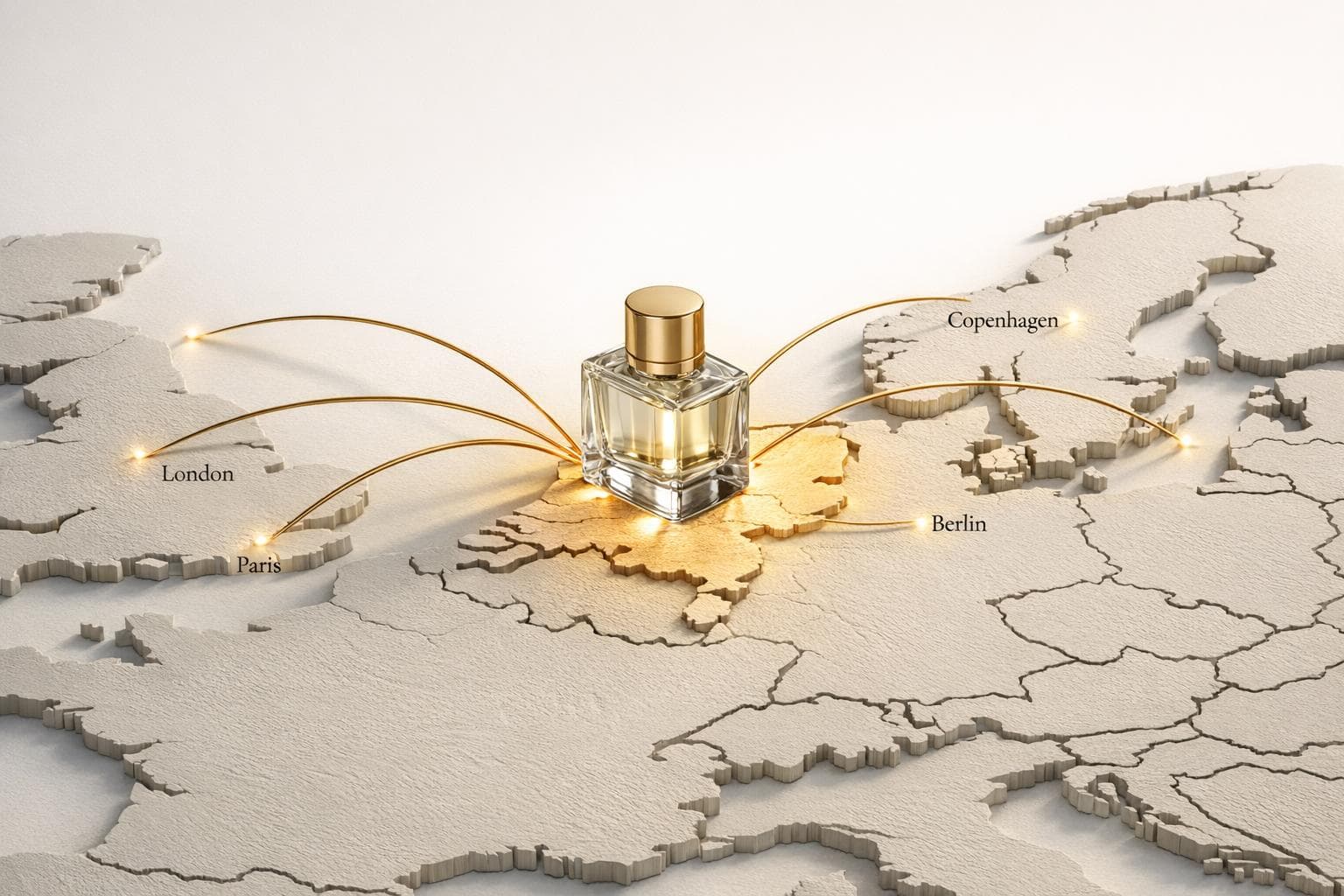
The Netherlands plays two roles in European fragrance simultaneously, and almost no other EU country plays both at once. It is a structurally elevated per-capita consumer of fragrance, sitting third in the EU per-capita ranking at 836 kilograms per 1,000 population. It is also Europe's de facto fragrance distribution and re-export hub, with Rotterdam port and Schiphol airport jointly handling the largest reciprocal fragrance trade flows in the European Union after Germany.
This dual profile means the Dutch fragrance story is more about logistics than about any single domestic-buyer headline. Approximately 1.9 billion USD in fragrance product enters the Netherlands annually, the second-largest fragrance import value in the EU after Germany. Comparable volume exits to Germany, Poland, France, Belgium, and the Czech Republic. The country is simultaneously buying fragrance heavily for its own residents and routing fragrance through its logistics infrastructure for the rest of Europe. Scento's analysis of the Dutch fragrance market in 2026 builds the full picture across both roles.
The Dutch buyer is also unusual within Europe. Digitally native, channel-flexible, price-aware, and increasingly engaged with niche fragrance after a long period of designer-mainstream dominance. The combination of dual-role market structure (heavy consumer plus logistics hub) and an unusually demanding online buyer profile means the Netherlands operates as both a destination market and a stress-test environment for any retailer or brand expanding into Northern Europe. Scento's analysis traces both roles together rather than in isolation.
The structure of this analysis covers six sections. The per-capita ranking, where the Netherlands sits third in the EU behind Belgium and Ireland. The re-export hub mechanics, where Rotterdam and Schiphol anchor the EU-wide fragrance logistics backbone. Domestic buyer behaviour, with its emphasis on digital-native channel flexibility. Top brands sold in the Netherlands, where the supplier mix differs meaningfully from Belgium. The online channel, with the country's structural lead in digital beauty penetration. And the 2030 outlook, where Scento's view is that all four roles deepen rather than reverse.
Netherlands' Per — Capita Position: Number Three in Europe
The Netherlands consumed approximately 836 kilograms of perfumes and toilet waters per 1,000 population in 2024, the third-highest per-capita level in the European Union. The ranking sits cleanly above the EU average, well above the Western European mean, but materially below the per-capita leaders. The published European per-capita ranking, top-three: Belgium 1,486 kilograms per 1,000, Ireland 1,447 kilograms per 1,000, Netherlands 836 kilograms per 1,000. The Netherlands ranks third, not second, on per-capita fragrance consumption.
On absolute volume, the Netherlands is among the EU's top eight fragrance consumers, sitting in the same roughly 3% national-share band as Belgium, Romania, Ireland, and Portugal. The country's 17.8 million population is large enough to deliver a top-eight absolute volume ranking but small enough to keep the per-capita figure structurally below Belgium and Ireland's lead. The Randstad corridor of Amsterdam, Rotterdam, The Hague, and Utrecht concentrates the bulk of premium domestic retail volume, with Eindhoven, Groningen, and Maastricht as the strongest secondary markets.
Dutch per-capita consumption is best framed as structurally elevated rather than category-leading. The Dutch buyer is more fragrance-engaged than the EU mean, with high disposable income, dense urban concentration, and best-in-class specialist beauty retail penetration as the structural drivers. The country falls short of Belgium's per-capita lead because its retail and gifting culture, while strong, lacks the unusual French-fluency-plus — Dutch-discipline combination that drives Belgian outperformance. Dutch buyers also spread their beauty and personal-care spend more broadly across categories, with skincare and haircare absorbing share that in Belgium routes more heavily into fragrance.
The structural ceiling for Dutch per-capita consumption is meaningfully below Belgium's. Scento's view: the Netherlands is unlikely to challenge Belgium or Ireland for per-capita leadership through 2030, but the country's third-place position is durable. The drivers (income, density, retail) are durable, and the gap to fourth place (Portugal in some years, France in others depending on how border consumption is netted out) is large enough that the Netherlands' top-three slot is structurally protected.
The Dutch per-capita figure also has to be read in context of the country's logistics-hub role. Some share of the 836 kilograms per 1,000 population is fragrance that transited Dutch warehousing en route to other EU destinations and was statistically attributed to Netherlands consumption rather than to the final-destination market. The volume bias is small but non-trivial, and means that Dutch domestic buyer behaviour produces a slightly lower true per-capita number than the published figure suggests. Scento's analysis treats the published 836 figure as the operative benchmark, while noting the logistics-hub adjustment for context.
The Re — Export Hub: How Rotterdam and Amsterdam Move Fragrance Through Europe
The Netherlands is Europe's largest fragrance distribution and re-export hub, and this dual role is the defining feature of the Dutch fragrance market that no per-capita figure alone can capture. The country is anchored by two pieces of logistics infrastructure that together handle roughly a quarter of all European fragrance trade flows.
The Port of Rotterdam is Europe's largest by volume, handling the deep-sea container imports of fragrance ingredients, packaging, and finished product that arrive from North America, Asia, and the Gulf. Schiphol Airport in Amsterdam is Europe's third-busiest cargo airport and handles the air-freight imports of premium, niche, and time-sensitive fragrance product that bypasses the slower sea-freight channel. Together, these two nodes give the Netherlands an outsized role in EU-wide fragrance logistics that no other country matches.
The trade flow numbers tell the same story. Approximately 1.9 billion USD in fragrance product enters the Netherlands annually as imports, the second-largest fragrance import value in the EU after Germany at 2.1 billion USD. Approximately 1.6 to 1.9 billion USD exits as exports to Germany, Poland, France, Belgium, and the Czech Republic. The structural import-export balance means a meaningful share of fragrance product consumed in DE, PL, BE, FR, and CZ first transits through Dutch warehousing and customs, even when the brand, retailer, and end-consumer are not Dutch.
The supplier mix on the import side is meaningfully diversified. Spain anchors a large share of Dutch fragrance imports through the Catalonia and Barcelona-area manufacturing footprint that supplies a meaningful share of the Puig portfolio's European distribution. Germany supplies a meaningful share through both branded designer exports and the Hamburg specialist re-export trade. The United States supplies a smaller but growing share, reflecting the post-2022 acceleration of US niche fragrance into European retail through Schiphol-routed direct distribution. The supplier diversity is one of the structural reasons that the Netherlands' import volume has grown faster than peer markets since 2022.
Concrete examples Scento can point to. Schiphol-area beauty fulfilment centres handle multi-brand European distribution for niche houses that do not operate their own logistics, with several major American and French niche houses routing all their EU-wide direct-to-consumer volume through Amsterdam-area fulfilment partners. Rotterdam port warehouses cluster fragrance import containers for redistribution by air and road across the EU, with the Dutch road network's connectivity to Germany making Rotterdam a more efficient route to the Frankfurt and Hamburg distribution centres than direct German ports for many supply-chain configurations.
The growth rate is significant. Netherlands fragrance imports have grown at approximately 13.67% CAGR over 2020 to 2024, among the fastest in Europe, with the 2023-to-2024 single-year growth at roughly 21.58%. The acceleration reflects the post-pandemic premiumisation of European fragrance combined with structural centralisation of EU-wide distribution into Dutch hubs. The trajectory is not slowing.
The logistics-hub role compounds with the consumer-market role in a way no other EU country matches. Brands that route their EU-wide distribution through Dutch infrastructure also gain a structural advantage in Dutch domestic retail, because the same Amsterdam-area warehouses that ship to Hamburg also ship to Bol.com, Douglas Online, and ICI Paris XL Online with overnight or two-day lead times. The retail-and-logistics flywheel reinforces the Netherlands' dual position and is one of the structural reasons that any major European beauty brand evaluating EU expansion strategy starts with Dutch warehousing first.
Scento's framing: the Netherlands is simultaneously a per-capita-elevated domestic market and the EU's de facto fragrance logistics-hub, a dual role no other EU country plays. The implications cascade across the broader fragrance industry. Brands evaluating EU distribution strategy disproportionately consider Dutch warehousing first; retailers expanding cross-border increasingly partner with Schiphol-area fulfilment players; consumer-facing e-commerce platforms shipping into the EU often route through Dutch infrastructure regardless of where the end customer lives. Buyers can browse Scento's full catalogue, and fragrance accessories and travel atomizers for the wardrobing behaviour that follows from a country at the centre of the EU fragrance trade.
Domestic Buyer Behavior: How the Dutch Shop for Fragrance
The Dutch fragrance buyer is digitally native. Over 80% of Dutch adults shop online regularly across all categories, and roughly 30.7% of Dutch adults aged 12+ bought cosmetics, perfume, or beauty products online in 2024, up from 21.4% in 2020. This is the highest online beauty penetration in any major Western European market, and the trajectory through 2030 has been one of the most consistent upward channel-shift patterns in EU retail.
The domestic fragrance market value sits at approximately 534 million USD in 2025 retail terms, growing modestly at roughly 1.3% CAGR. Mass channels (drugstores, supermarkets, Etos, Kruidvat, Albert Heijn) account for a large share of fragrance volume; specialist perfumeries (Douglas, ICI Paris XL with 150+ Dutch stores) dominate the premium segment. Online channel gains share every year, with Bol.com, Douglas Online, ICI Paris XL Online, Etos Online, and Kruidvat Online as the five largest online perfume retailers by aggregate volume.
The Dutch buyer is the European Union's rational shopper. Price-aware, channel-flexible, increasingly willing to buy premium-niche but slower to spike on impulse than their Belgian neighbours. The same buyer who is willing to spend 250 to 350 euro on a niche fragrance is also actively price-comparing across Bol.com, Douglas, and EU-wide cross-border retailers before purchase. The combination produces a retail environment that rewards execution, breadth, and price transparency, and that punishes opaque retail or impulse-only positioning.
Generational splits match Western European patterns. Older Dutch buyers (55+) anchor the designer-classic rotation and remain heavily concentrated in specialist beauty retail. Younger buyers (under 40) split between specialist retail, online direct-to-consumer, and increasingly cross-border purchasing. The under-30 cohort, in particular, drives niche category awareness through TikTok and Instagram, with Dutch fragrance content creators among the most active on the EU side of the platform. Decants and travel-size bottles are the lowest-friction entry into niche for the digitally native Dutch buyer, who values the test-before-commit dynamic that decants enable.
Gender split in the Dutch fragrance market mirrors the broader EU average, with female buyers anchoring approximately 58 to 60% of total category volume. Male penetration has been growing steadily since 2022 and is likely to reach approximately 45% of total buyers by 2030. The Dutch male buyer is meaningfully more willing to engage with niche fragrance than the EU male average, partly because of the country's stronger digital-content ecosystem and partly because the wardrobing behaviour that drives niche penetration is less gender-coded in Dutch retail than in Southern European markets.
Geographic concentration of premium retail volume in the Randstad corridor produces an unusual pattern. Approximately two-thirds of Dutch premium fragrance volume is consumed within a roughly 80-kilometre radius spanning Amsterdam, Rotterdam, The Hague, and Utrecht. The remaining third is distributed across the rest of the country, with Eindhoven, Groningen, and Maastricht as secondary clusters. The high spatial concentration of premium demand makes Dutch retail planning more efficient per-store than equivalent Belgian or German retail, and is one of the structural reasons that ICI Paris XL and Douglas have been able to operate dense Dutch store networks profitably.
Top Brands Sold in the Netherlands (2026): A German — French — Spanish Mix
The Dutch top-brand mix differs from Belgium's. Where Belgium leans French, the Netherlands draws fragrance imports more heavily from Spain, Germany, and the United States, collectively roughly 32% of import value, with France, Italy, and the United Kingdom as supporting suppliers. The geographic spread reflects the country's role as a multi-source distribution hub rather than a single-corridor importer.
The bestseller rotation reflects this multi-source pattern. Designer houses anchor the top of the lists: Dior's catalogue, YSL's catalogue, Tom Ford's catalogue, Hugo Boss's catalogue, Calvin Klein's catalogue, Lancome, and Giorgio Armani. The Hugo Boss and Calvin Klein presence is particularly visible in Dutch retail relative to Belgium, reflecting both the Dutch buyer's broader willingness to engage with American and German designer houses and the supplier-mix tilt toward those countries' export volumes.
Niche penetration is led by Maison Francis Kurkdjian's catalogue, Parfums de Marly's catalogue, Creed, Le Labo's catalogue, Byredo's catalogue, and Diptyque. Le Labo and Byredo have particularly strong Dutch footprints relative to their overall European share, partly because the houses' minimalist design language matches the Dutch retail aesthetic, and partly because Bol.com and Douglas Online have invested in deeper niche curation than the equivalent Belgian online channels.
ICI Paris XL, with over 150 Dutch stores plus a strong online presence, is the country's dominant specialist beauty retailer. Douglas Netherlands and Bol.com round out the e-commerce-and-omnichannel landscape. The full Scento catalogue surfaces the breadth of houses that match Dutch buyer preferences, with fragrances curated for women and fragrances curated for men mapping to the gender-split patterns visible across Dutch specialist retail. The wider niche perfumery category is the segment growing fastest in Dutch retail through 2026 and 2027.
The brand-mix evolution since 2020 has been steady but distinct from Belgian patterns. Where Belgian retail has held its French-house concentration, Dutch retail has progressively diversified its niche tier, with American houses (Le Labo, Byredo) and Italian houses (Xerjoff, Acqua di Parma) gaining share alongside the French niche stalwarts. The diversification is partly driven by the Dutch buyer's broader cultural openness to multiple national styles and partly by the country's logistics-hub role, which makes any niche house's EU-wide distribution easy to surface in Dutch retail.
The Online Channel: Bol, Douglas, ICI Paris XL, and the 30% Online Beauty Penetration
The Netherlands has the highest online beauty penetration in Western Europe. Public consumer-survey data shows 30.7% of the Dutch population aged 12+ bought cosmetics, perfume, or beauty products online in 2024, up from 21.4% in 2020. Cosmetics and perfume now sit as the sixth-most-popular online category in the country overall, behind clothing and electronics but ahead of categories that anchor online retail in most other European markets.
The Dutch e-commerce landscape is unusual within Europe. Bol.com, the country's domestic e-commerce leader with over 2 billion USD in annual sales, outperforms Amazon in the Netherlands, a structural advantage that benefits domestic fulfilment players and that produces a meaningfully different competitive landscape from Germany, France, or the United Kingdom. Specialist beauty e-tailers Douglas, ICI Paris XL, Etos, and Kruidvat dominate the perfume online channel, with each playing a distinct role: Douglas anchors premium designer and select niche, ICI Paris XL anchors specialist depth, Etos anchors mass-and-drugstore, and Kruidvat anchors price-led volume.
Total Dutch beauty e-commerce passed 2 billion USD in 2024 and is forecast to reach 3 billion USD by 2029. Online's share of total beauty retail is one of the highest in Europe and is forecast to keep growing. Fragrance specifically follows this trajectory, with online's share of fragrance category sales rising consistently year-on-year through 2024 and 2025. Scento's forecast: online's share of total Dutch fragrance retail will pass 40% by 2030, the fastest of any major EU market.
For brands and retailers, the Dutch online channel is the most demanding execution environment in Western European fragrance retail. The price transparency, breadth of cross-border alternatives, and channel-flexibility of the Dutch buyer mean that any online retail proposition has to compete on merit rather than on captive audience. The brands and retailers who win Dutch online tend to also win the broader Northern European online consumer cohort, because the Dutch buyer is the most-stress-tested online beauty consumer in Europe. Scento's current fragrance bestsellers reflect what the most demanding Northern European buyers are converting on most consistently in 2026.
Mobile commerce share within Dutch beauty e-commerce has been rising steadily, although not as quickly as in some Southern European markets. Dutch buyers split mobile and desktop purchasing roughly evenly, with desktop retaining share for higher-value premium and niche purchases where price comparison and content depth matter most. The mobile-desktop split is more balanced than in any other major EU market, and reflects both the Dutch buyer's willingness to engage with longer browsing sessions on desktop and the maturity of Dutch mobile retail UX.
Subscription and discovery-quiz models have a particular fit with the Dutch online buyer. The country's digitally native, channel-flexible buyer profile is structurally well-suited to test-before-commit dynamics, where decants and personalised recommendations lower the commitment cost of niche category exploration. Dutch buyers convert from quiz-based discovery into full-bottle purchases at materially higher rates than less digitally-fluent EU peer markets.
Logistics and fulfilment quality also play a meaningful role in Dutch online beauty retail. The country's exceptional last-mile delivery infrastructure produces consistent next-day or same-day delivery economics that few other EU markets match. Dutch buyers expect this delivery standard and migrate share to retailers that meet it. Any brand or retailer entering Dutch online retail without competitive last-mile execution will struggle to build buyer loyalty regardless of catalogue depth or price competitiveness, because the delivery-quality bar is set by Bol.com's domestic infrastructure and is non-negotiable for the Dutch online beauty buyer.
2030 Outlook: NL Holds Per — Capita Position, Strengthens Re — Export Role
Three structural calls Scento makes on the Dutch fragrance market through 2030.
First, the Netherlands will hold its third-place per-capita position. Belgian and Irish per-capita leadership is structurally entrenched, and the gap from the Dutch level to the runner-up positions above is large. The gap below the Netherlands to the fourth-place market is also large, with Portugal, France, and a handful of other markets clustered together but consistently below the Dutch level. Dutch per-capita consumption is forecast to creep upward modestly through 2030, with the third-place ranking durable.
Second, the re-export hub role will deepen. More global beauty brands are centralising EU distribution through Rotterdam and Schiphol-area fulfilment centres, with Dutch perfume imports forecast to continue compounding at 8 to 12% annually through 2030. The trajectory reflects both organic growth in EU-wide fragrance trade volumes and structural centralisation of EU-wide distribution operations into Dutch hubs. The 2030 import value is on track to exceed 3 billion USD, materially closing the gap with Germany.
Third, online channel share will pass 40% of total fragrance category sales by 2030, the fastest channel-shift trajectory in any major EU market. The drivers (Bol.com's domestic dominance, Douglas's strong online execution, ICI Paris XL's specialist depth, the Dutch buyer's channel-flexibility) are durable, and the trajectory through 2024 and 2025 has been remarkably consistent. The Dutch online beauty buyer will remain the most demanding execution test in EU retail through at least 2030.
The dual-role market structure (heavy domestic consumer plus EU logistics hub) is the durable feature that distinguishes the Netherlands from any peer EU market, and is the reason the country's fragrance industry footprint extends well beyond its 17.8 million population. The 2030 endpoint has the Netherlands further entrenched as the EU's logistics backbone for fragrance, with a domestic premium market that holds its third-place per-capita ranking and an online channel that leads Western Europe on penetration.
The competitive dynamic between physical and online retail will continue to compress through 2030. Dutch specialist beauty chains have invested heavily in omnichannel execution since 2022, and the convergence between in-store curation and online breadth is faster in the Netherlands than in any peer EU market. The retailers who maintain depth of premium and niche curation while matching online-channel price discipline will continue to dominate Dutch fragrance category share through 2030. Those who fail at either dimension will lose share to the cross-border online specialists serving Dutch buyers from German, Belgian, and Italian fulfilment centres.
The implications for brand strategy are clear. Brands that route their EU-wide distribution through Dutch hubs and that invest in deep specialist-online presence in the Netherlands will gain a structural advantage that compounds across the broader Northern European market. Brands that treat the Netherlands as a secondary market behind Germany or France will continue to underperform their potential, because the Dutch buyer rewards execution depth more than scale and tends to actively pull share away from underinvested brands toward those who match the country's demanding standard.
The 2030 forecast for the Dutch fragrance market is constructive but stress-testing across every dimension. Per-capita consumption holds. Re-export volumes compound at high single-digit rates. Online channel share reaches 40% of total category sales. The buyer cohort deepens its niche engagement and continues to cross-shop aggressively. Specialist retail consolidates further, with the strongest omnichannel operators capturing share from weaker peers. The country's role as both a domestic premium market and an EU-wide logistics anchor remains the operative analytical frame, and any brand or retailer evaluating Dutch strategy should treat both roles as inseparable rather than as separate market opportunities.
For Scento and the broader fragrance industry, the Netherlands is simultaneously a domestic premium market and the operational backbone of EU fragrance distribution. Winning the Dutch buyer is winning the EU's most-digitally-native fragrance shopper, and winning Dutch warehousing infrastructure is winning the supply-chain backbone for Germany, Poland, Belgium, France, and the Czech Republic. Personalised fragrance discovery remains the lowest-friction entry point for new Dutch premium buyers, and the wider niche perfumery category is where the structural growth through 2030 will be earned.
For broader European context on how the Netherlands sits within the EU-wide fragrance landscape, see Scento's Europe-wide fragrance market analysis.
This analysis is based on Scento's review of the Dutch fragrance market, October 2025 to April 2026. A detailed methodology is available to press on request at [email protected].