
Luxury perfume prices have surged between 2020 and 2025, with iconic scents like Chanel No. 5 increasing from €110 to €172. By 2026, the global luxury fragrance market hit €57.28 billion, reflecting growing demand driven by rare ingredients, sustainability efforts, and advanced technologies like AI and blockchain. However, steep tariffs, ingredient shortages, and marketing costs have made perfumes 30% pricier than pre-pandemic levels.
Key insights:
- Rare materials like oud now cost €50,000–€80,000 per liter.
- Marketing and packaging often account for 80–90% of the retail price.
- Consumers increasingly prefer niche brands and refillable options.
Understanding these factors helps explain why luxury scents cost what they do - and how to make smarter buying decisions in 2026.
Luxury Perfume Pricing Breakdown 2026: Market Statistics and Cost Factors
Luxury Fragrance Market Size and Growth in 2026
Global Market Value and Growth Rates
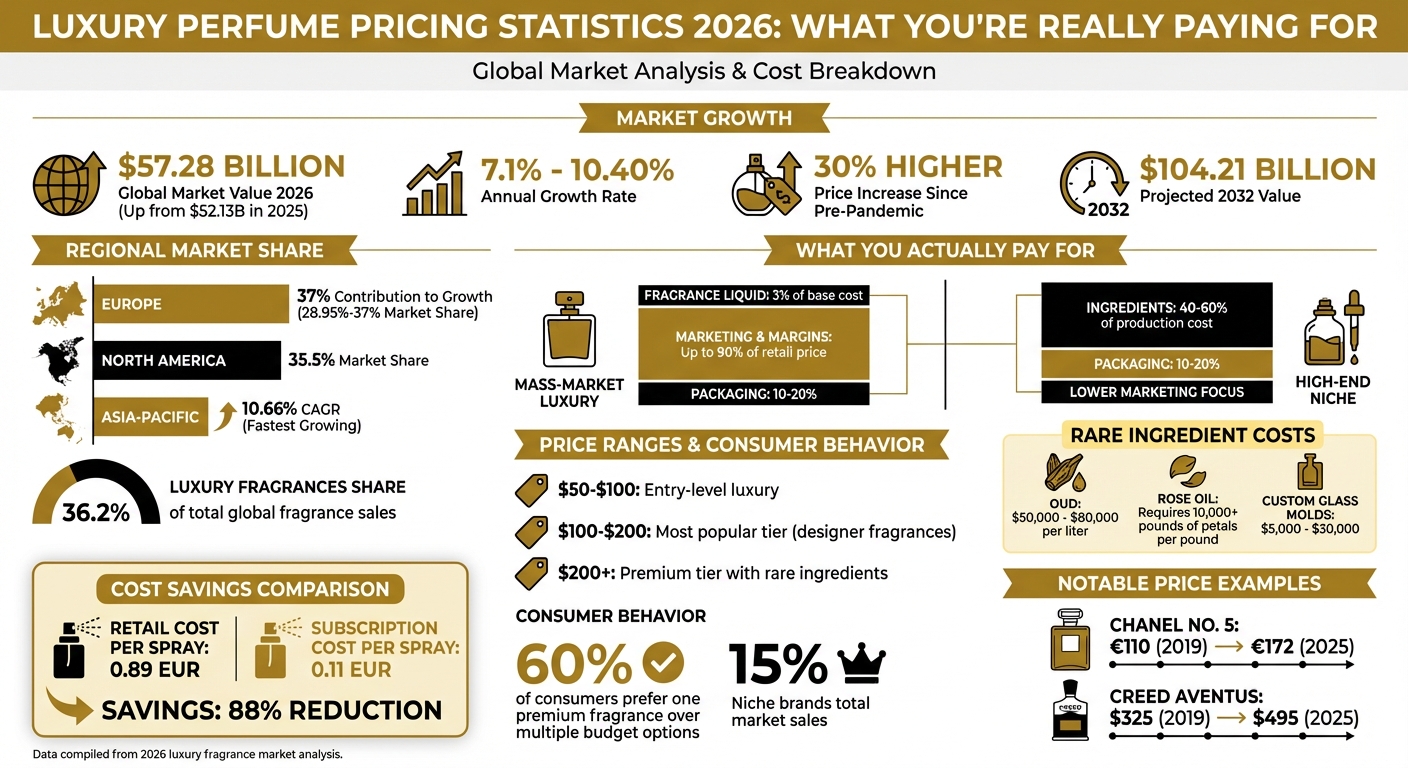
The luxury fragrance market reached a value of $57.28 billion in 2026, climbing from $52.13 billion in 2025. Analysts predict this upward trend will continue, with the market projected to hit $104.21 billion by 2032, growing at an annual rate between 7.1% and 10.40% through the decade.
Europe remains the dominant regional market, contributing 28.95% to 37% of global sales, while the Asia — Pacific region is identified as the fastest-growing, with an anticipated growth rate of 10.66% from 2026 to 2031. These numbers highlight how consumer preferences and spending habits are evolving across different regions.
Luxury fragrances now account for 36.2% of total global fragrance sales, showcasing the increasing preference for premium products. Women’s fragrances lead the market with a 78.47% share, though men’s luxury fragrances are gaining momentum, growing at an annual rate of 9.86%. This growth reflects shifting consumer priorities and a broader appeal for premium scents.
Changes in Consumer Demand and Spending
Consumer preferences are shifting toward "olfactory identity", where individuality and ingredient transparency are becoming as important as brand prestige. This trend has fueled the rise of niche and artisanal brands like Byredo, Le Labo, and Diptyque, which now account for nearly 15% of total market sales by focusing on raw-material sourcing and small-batch production.
"The mass and prestige markets are converging, with premium-priced brands in mass retail and value-priced prestige brands outperforming their counterparts."
- Larissa Jensen, SVP and Global Beauty Advisor, Circana
Technology is also playing a pivotal role in transforming how consumers discover and purchase fragrances. AI-driven personalization tools have boosted engagement rates by up to 40%, while 95% of major luxury houses now use blockchain to ensure ingredient traceability. Despite these digital advancements, the tactile experience remains significant, with specialty stores holding 48.21% of the market share.
Spending patterns show that the $100–$200 price range dominates, offering a balance between luxury and accessibility for consumers with higher disposable incomes. These trends are reshaping the luxury fragrance market, setting the stage for deeper insights into consumer spending behaviors in this sector.
Luxury Perfume Price Ranges and Spending Patterns
Price Tiers and Where Consumers Spend Most
Luxury perfumes are typically divided into three price categories, each reflecting different consumer spending habits.
The $50–$100 range represents entry-level luxury, offering accessible options that attract a broad audience. This segment has historically led in terms of sales volume and customer loyalty.
In the $100–$200 bracket, you’ll find designer fragrances with more intricate compositions, appealing to those with higher disposable income. A notable example is Coty Inc.’s launch of Burberry Goddess in August 2023, which achieved record-breaking sales across several markets.
For those willing to spend more than $200, perfumes in this tier often feature rare ingredients such as oud, which can cost between $50,000 and $80,000 per liter. These fragrances also emphasize craftsmanship and heritage. A standout release in this category was Dolly Parton’s Crystal Edition Parfum in December 2024, limited to 1,946 numbered bottles with rhinestone-adorned caps, targeting niche collectors. Interestingly, more than 60% of consumers in developed markets now prefer investing in a single premium fragrance over purchasing multiple budget-friendly options.
This tiered pricing structure has also encouraged the development of alternative ways to make luxury scents more accessible.
Accessible Luxury Options: Decants and Subscriptions
Decants and smaller formats have emerged as practical solutions for those who want to experience luxury fragrances without committing to a full-size bottle. For example, Bella Hadid’s Orebella brand introduced 10ml travel-sized bottles priced at £32 at Selfridges in May 2024, making high-end scents more attainable. Similarly, Guerlain expanded its La Petite Robe Noire collection with a 20ml refillable bottle, Le Flacon Coeur.
Full-sized bottles carry additional costs due to custom glass molds, which can range from $5,000 to $30,000, as well as elaborate packaging and retailer markups. Marketing and advertising also play a significant role, often accounting for up to 80% of a luxury perfume’s retail price. Interestingly, the actual fragrance itself typically represents less than 1% of the total cost. By sidestepping these marketing-driven expenses, decants and subscriptions offer the same luxurious scents at a fraction of the price.
Scento members, for instance, pay an average of just 0.11 EUR per spray, compared to 0.89 EUR per spray at retail - a striking 88% reduction in cost-per-wear.
How Luxury Perfume Prices Vary by Region
Average Prices Across Major Markets
Luxury perfume prices fluctuate globally due to a mix of economic factors, regulations, and consumer preferences. North America, holding a 35.5% share of the market, is characterized by high spending per capita and an established retail network. However, U.S. tariffs introduced in 2025 on premium fragrances imported from Europe and the Middle East have driven up prices, as manufacturers face increased production and distribution costs.
Europe accounts for 37% of the luxury perfume market’s growth, with France leading the charge by exporting over $10 billion in fragrances annually. Regulatory changes, such as the European Chemicals Agency’s stricter rules on synthetic musks, have increased research and development costs by 15–20%. These added expenses often trickle down to consumers.
Asia — Pacific is the fastest-growing region, with a projected compound annual growth rate (CAGR) of 7.9% through 2030. Rising disposable incomes in countries like China and India are making luxury perfumes a status symbol. For example, India’s market is expected to surpass $3.1 billion by 2032. Meanwhile, the Middle East stands out for its high per-capita spending, driven by a preference for rich, high-concentration fragrances, particularly those featuring oud.
These regional dynamics highlight how economic and cultural factors shape the pricing of luxury perfumes.
| Region | Market Characteristic | Pricing Driver |
|---|---|---|
| North America | 35.5% market share | 2025 U.S. tariffs on European and Middle Eastern imports |
| Europe | 37% contribution to growth | Stricter ECHA regulations raising R&D costs |
| Asia — Pacific | Fastest growth, 7.9% CAGR | Rising disposable incomes in China and India |
| Middle East | High per-capita spending | Preference for oud and opulent scents |
How Culture and Economics Affect Pricing
Cultural preferences and local economic conditions play a significant role in shaping perfume prices. In the Middle East, consumers often prefer bold, resinous fragrances with oud as a key ingredient. This preference drives up costs, as oud is one of the most expensive raw materials in perfumery. European buyers, on the other hand, value heritage, craftsmanship, and sustainability, which influence both product development and marketing investments.
The 2025 U.S. tariffs have also forced many luxury fragrance brands to rethink their supply chains. To mitigate the financial impact, some companies have shifted to domestic production or tariff-friendly transshipment strategies. However, these adjustments have led to noticeable price differences between regions.
Travel retail, particularly in airport duty-free stores, adds another layer to pricing variations. These outlets often avoid local consumer taxes, offering more competitive prices. For instance, a perfume bottle might cost less at Dubai International Airport than at a high-end department store in Manhattan, even before factoring in currency exchange rates.
What You’re Actually Paying For in Luxury Perfumes
Main Cost Factors: Ingredients, Packaging, and Brand
When you buy a luxury perfume, you’re paying for much more than just the fragrance inside the bottle. For mass-market luxury brands, the actual liquid - often referred to as the "juice" - makes up only about 3% of the product’s base cost. The remaining cost is split among packaging, marketing, distribution, and profit margins.
Niche and high-end brands, however, take a different approach. They dedicate 40-60% of their production costs to high-quality ingredients and meticulous craftsmanship. This explains why the price of a 100ml bottle of Creed Aventus rose from about $325 in 2019 to $495 in 2025. Rare ingredients, often sourced through labor-intensive and climate-sensitive processes, drive up costs and contribute to price fluctuations.
Packaging is another major expense, accounting for 10-20% of total costs. Meanwhile, marketing and overhead can consume up to 90% of the retail price. Luxury brands spend heavily on celebrity endorsements and global campaigns to maintain their prestige. For example, LVMH’s Perfumes & Cosmetics division saw a 5% revenue increase in the first nine months of 2024, thanks in part to campaigns featuring Rihanna as the face of Dior’s J’adore.
Luxury perfumes are typically priced at 3 to 7 times their manufacturing cost. For a $100 bottle, the breakdown might look like this: $10 for manufacturing, $10 for marketing, $5 for packaging, and $3 for distribution, leaving $72 for brand profit and retailer markup.
| Component | Mass — Market Luxury | High — End Niche/Bespoke |
|---|---|---|
| Ingredients (Juice) | ~3% of base cost | 40-60% of production cost |
| Packaging | Standardized luxury | 10-20% of cost; custom glass |
| Marketing & Margins | Up to 90% of retail price | Lower marketing, higher ingredient focus |
Sustainability efforts are also becoming a key factor in pricing, adding another layer to the cost structure.
Sustainability and Ethical Practices in Pricing
The rising demand for sustainable and ethical practices is reshaping the luxury perfume market. In January 2025, the European Chemicals Agency restricted two commonly used synthetic musks, leading to reformulations that increased research and development costs by an estimated 15-20%. Many brands are now investing in "green chemistry" to create eco-friendly synthetic alternatives that align with modern consumer values.
These changes have a tangible impact on prices. For instance, the price of Chanel No. 5 rose from about $110 in 2019 to $172 in 2025, partly due to stricter ingredient sourcing and transparency requirements. With 65% of luxury consumers willing to pay more for sustainably and ethically produced products, brands are focusing on upcycled materials and transparent supply chains.
Natural ingredients bring their own challenges. Rare materials like jasmine absolute, which is hand-harvested at night to capture its peak fragrance, or oud, which takes decades to form in specific trees, are costly to source responsibly. These labor-intensive and time-sensitive processes add to the final price. Even the maceration process, where perfumes rest in stainless steel tanks to develop their scent, contributes to costs as it requires time - a hidden but critical "ingredient".
Shipping also plays a role. Transporting hazardous liquids and navigating international tariffs can add 10-20% to the final retail price. Combined with sustainability investments, these factors explain why luxury fragrance prices in 2025-2026 are about 30% higher than pre-pandemic levels.
While packaging and marketing dominate the cost breakdown, eco-friendly reformulations and ethical practices are becoming increasingly important. Consumers are showing they’re willing to pay a premium for sustainability, but subscription models like Scento offer a more affordable alternative. Members pay an average of just 0.11 EUR per spray compared to 0.89 EUR at retail, proving that cutting out traditional markups can make luxury scents far more accessible.
Your Personal Fragrance Expert Awaits
Join an exclusive community of fragrance connoisseurs. Each month, receive expertly curated selections from over 900+ brands, delivered in elegant 8ml crystal vials. Your personal fragrance journey, meticulously crafted.
Try Your First MonthNiche and Personalized Fragrances: A Growing Market
Niche Fragrance Brands and Their Pricing
Niche perfumery has transformed the luxury fragrance market, focusing on artisanal craftsmanship and rare ingredients. The global luxury niche perfume market, valued at $3.8 billion in 2024, is expected to grow to $7.6 billion by 2032, with an annual growth rate of 13.2%.
These brands emphasize exclusivity and quality, setting themselves apart from traditional luxury names like Chanel or Dior, which typically price their offerings between $100 and $200. Niche perfumes, however, often start at $200 and can climb significantly higher. For instance, the House of Creed’s limited-edition "Royal Service" sold for $1,750 per bottle, while Roja Parfums’ "Haute Luxe" is priced at $4,000 per bottle, reflecting the labor-intensive processes and rare materials like orris butter. At the pinnacle, Clive Christian’s "No.1 Imperial Majesty" was priced at an astonishing $215,000 per bottle, featuring a five-carat diamond collar and produced in a limited run of just ten bottles.
The gap between niche and mainstream luxury pricing continues to grow. As Thomas Saujet, CEO of Saujet Fragrances Group, puts it:
"There’s a major trend in super luxe fragrances that are priced well over the standard $250 to $350 price tag. There’s a growing gap in the market between super exclusive niche houses and luxury fragrances at a lower price point. There’s no middle ground".
This "Super Luxe" category now frequently includes fragrances priced between $350 and $460+ for standard sizes.
Niche brands justify these prices by focusing on ingredient quality. In niche perfumery, ingredients can make up 40% to 60% of the total cost, compared to less than 1% in mass-market luxury perfumes. For example, high-grade oud oil costs between $50,000 and $80,000 per liter, and producing one pound of rose oil requires over 10,000 pounds of rose petals. Additionally, niche fragrances often feature higher concentrations, such as Extrait de Parfum with 20-40% fragrance oil, offering 8+ hours of longevity, compared to the 2-4 hours typical of mass-market options.
Custom — Made Perfumes and Their Costs
The rise of niche perfumery has paved the way for personalized fragrances, now seen as the ultimate luxury. Custom-made perfumes, tailored to individual preferences, typically range from $500 to over $5,000, depending on the complexity of the formula. Advances in technology, like AI-driven scent recommendation engines and digital profiling tools, have made personalization more accessible, allowing consumers to co-create their own signature scents.
This trend reflects a growing desire for individuality. As Daniel Patrick Giles, CEO of Perfumehead, explains:
"Individuality is the new luxury... Customers tell me constantly, ‘I don’t want to smell like everyone else’".
This mindset is driving a shift away from the idea of a single "signature scent" toward "fragrance wardrobing" - rotating between 10-15 scents based on mood, occasion, or outfit. Lynn King, Founder of Fleurit Parfums, highlights this change:
"The era of the signature scent, one perfume worn faithfully for a lifetime, is fading. We are seeing a massive shift toward fragrance wardrobing, where consumers treat scent like fashion".
Technology is also elevating personalization. In 2025, Estée Lauder Companies partnered with Exuud Inc. to integrate Soliqaire™ smart fragrance hardware into its luxury offerings, enabling customizable fragrance experiences using biodegradable plant polymers. Additionally, major fragrance houses are leveraging blockchain technology to achieve up to 95% ingredient traceability, reinforcing the premium appeal of personalized products.
Brands are adapting with creative pricing strategies. While ultra-luxury bespoke services remain in the thousands, some brands are introducing entry-level personalization options, like 10ml travel-sized bottles priced at $32 to attract younger buyers. There’s also a noticeable shift toward smaller bottle sizes, with 50ml becoming the new standard. This "smart sizing" trend appeals to consumers looking to build diverse fragrance wardrobes while maintaining the premium feel that justifies higher per-milliliter costs.
Luxury Perfume PRICE HIKES Explained In Detail For 2025
How to Evaluate Luxury Perfume Costs in 2026
Understanding perfume pricing in 2026 requires digging into both the formula and the additional costs that come with luxury fragrances. With prices on the rise, knowing what drives those costs can help you make smarter choices.
When it comes to high-end perfumes, the liquid inside the bottle often represents just a small fraction of the overall cost - only about 3% of the base price. Packaging, on the other hand, can account for 10–20%. The rest? It often goes toward marketing, celebrity endorsements, and the allure of the brand itself. What you’re really paying for is the expertise, rare ingredients, and the careful craftsmanship that go into creating the scent.
Another key factor is concentration. Instead of focusing on bottle size, look at the type of formulation. For example, Extrait de Parfum or Eau de Parfum contains 15–40% fragrance oil and can last 8–24 hours. That means fewer sprays per use, stretching your investment further. Compare that to Eau de Toilette, which has only 5–15% fragrance oil and lasts 2–6 hours. A $495 bottle of Creed Aventus (up from $325 in 2019) may seem pricey, but its longevity makes it more cost-effective per wear compared to fragrances that need frequent reapplication.
Refillable packaging is another way to save over time. Brands offering refill programs not only cut down on costs but also appeal to buyers looking for sustainable options. This is becoming increasingly important, as 41% of consumers surveyed by Vogue Business feel that current luxury prices don’t always match the value offered. Prioritize brands that pair premium ingredients with refill options to get the most out of your purchase.
Lastly, never skip testing before committing to a full bottle. Over 60% of shoppers prefer in-store testing for high-value fragrances. This allows you to experience the "dry down" phase - how the scent evolves hours after application - which often reveals the perfume’s true character. If you’re unsure, start with smaller decants to evaluate longevity and performance. This is especially useful as the niche fragrance market continues to grow at an annual rate of 13.2%.
FAQs
Why have luxury perfume prices risen so much since 2020?
Luxury perfume prices have climbed sharply since 2020, driven by a mix of economic and industry-specific factors. One major contributor has been the rising cost of raw materials, including rare floral extracts and natural oils, which are essential for crafting high-end fragrances. Inflation and persistent supply chain challenges have further pushed up production and distribution costs.
On top of that, luxury brands often implement price increases intentionally. By doing so, they not only protect their profit margins but also enhance their image of exclusivity. Together, these elements have made luxury fragrances pricier than ever before.
Why do rare ingredients like oud make luxury perfumes so expensive?
Rare ingredients like oud significantly drive up the cost of luxury perfumes. This is largely due to their limited availability and the complex methods needed for extraction. Pure oud oil, often called “liquid gold,” can fetch prices as high as $1,000 per gram, ranking it among the priciest materials in the fragrance industry.
The process of sourcing oud is equally demanding. It comes from agarwood trees, which are naturally scarce and often require careful, sustainable cultivation. The combination of its rarity and the artistry involved in blending oud into fragrances elevates perfumes featuring this ingredient to a true symbol of luxury.
How is technology shaping the future of luxury fragrances?
Technology is reshaping the luxury fragrance world, making it more tailored, efficient, and eco-friendly. AI-powered scent personalization is transforming how consumers explore fragrances, offering options that match their individual tastes and creating a more immersive shopping journey. At the same time, features like smart packaging and verified supply chains are helping brands showcase their commitment to sustainability, meeting the rising demand for environmentally conscious choices.
On the operational side, advancements in AI and machine learning are optimizing supply chains and speeding up product development. These tools allow brands to innovate faster and more effectively. With growing investments in digital perfumery and personalized scents, the future of luxury fragrances is set to blend cutting-edge technology with individual lifestyles and values seamlessly.
Perfume Price per Milliliter: How to Compare Fragrances Honestly
Bottle price hides the real economics. Calculate price-per-milliliter and the fragrance market clusters into three honest tiers — mass at $0.60–$2/ml, premium designer at $2–$5/ml, luxury and niche at $5–$20/ml. Scento decants land at $0.75–$4/ml, putting niche-house try costs squarely in the mass-fragrance economic band.
The mass and drugstore tier runs $0.60–$2.00/ml: Demeter at $0.40/ml, Replica body spray at $0.20/ml, entry Calvin Klein at $1–$2/ml. Bottle representatives sit at $40–$80 per 100ml. The premium designer tier spans $2.00–$5.00/ml: Dior Sauvage at roughly $2.80/ml at 100ml, Tom Ford Black Orchid at $3.20/ml at 100ml, YSL Libre at $2.90/ml at 90ml. Bottle representatives: $80–$200 per 100ml. The luxury and niche tier runs $5.00–$20.00/ml: Creed Aventus at $5.20/ml, Maison Francis Kurkdjian Baccarat Rouge 540 at $5.90/ml, Roja Elysium at $8/ml, Clive Christian No. 1 at $15–$20/ml. Bottle representatives: $300–$1,000+ for 50–100ml. The ultra-luxury and bespoke tier starts at $20.00/ml: Henry Jacques bespoke commissions, Roja Haute Luxe at $30+/ml. Bottle representatives: $1,500–$5,000+ for 50ml.
Scento's decant tier sits inside this map as the wedge product. A 2ml decant runs $5–$8, working out to $2.50–$4.00/ml. A 5ml decant runs $12–$25, or $2.40–$5.00/ml. An 8ml decant runs $18–$32, or $2.25–$4.00/ml. The structural arithmetic: buying a 2ml decant of a $400 niche bottle costs 1–2% of the full-bottle price — the cheapest informed buy-decision in luxury fragrance. The same per-ml economics that make a Creed Aventus 100ml expensive at $520 make the Aventus 2ml a coffee at $7.
Scento's 2ml, 5ml, and 8ml decants cover every house at every price tier. The scent-matching quiz maps your budget to a tier in 90 seconds. Creed at $5/ml is the canonical luxury entry — try in 2ml first. MFK Baccarat Rouge 540 in 2ml validates one of the most-recommended bottles in modern niche before you commit. Tom Ford Private Blend sits at the top of premium-designer per-ml economics. European buyers reorder at predictable per-ml ranges; the bestseller list reveals where the real value sits.
How Tariffs Are Reshaping Luxury Perfume Prices 2025-2026
Two tariff shocks hit luxury perfume in 2025–2026 — the EU — US 15% reciprocal duty and a 10% Section 122 add-on. The supply-chain reroute is already pricing in. Expect 5–12% retail price uplift on EU-produced fragrance reaching U.S. shelves in 2026; expect 10–20% logistics premium on botanical extracts globally.
The EU — US 15% reciprocal tariff was confirmed in August 2025 and applies to all EU-produced beauty, cosmetics, perfumes, fashion, and leather goods. The U.S. Section 122 tariff adds 10%, effective February 24, 2026, expiring approximately July 24, 2026. U.S. Section 301 China-origin tariffs run 7.5–100% depending on classification — affecting geranium, eucalyptus, spearmint, and peppermint oils sourced from China. The HTS Chapter 33 MFN average baseline is 2.8%; perfumes (HTS 3303) historically run MFN-free, but Section 122 and reciprocal tariffs stack on top of the existing classification.
The botanical extract layer is where supply-chain costs concentrate. Rose oil from Morocco and Bulgaria runs $2,000–$50,000 per pound at production cost; oud oil from Cambodia and Laos sits in the same range; jasmine absolute from Egypt similar. Every 1% tariff at the input layer adds $20–$500/lb in landed cost. The logistics premium for 2024–2026 reaches 10–20% for niche houses dependent on long-distance air freight for small-batch ingredients.
Scento's analysis estimates 5–12% retail uplift on luxury fragrance EU-to — US flow in 2026, with 8–15% likely on niche houses with single-source ingredient supply chains — a Bulgarian-rose-led MFK bottle faces structurally more tariff exposure than a synthetic-led designer flanker. Houses are responding three ways: manufacturing reshoring to the EU for U.S. brands, ingredient diversification with fallback supply for tariffed inputs, and refillable formats with cartridges produced in tariff-favorable jurisdictions to reduce exposed surface area. Buyers can hedge tariff exposure by sampling pre-tariff inventory through 2ml decants of the same juice from the same supply chain. Creed's heritage botanicals face direct exposure on the rose and ambergris layers; the scent-matching quiz can isolate tariff-stable picks across synthetic-heavy compositions.
Decant vs Full Bottle: The Real Cost Math
A decant is the most rational financial decision in luxury fragrance — and the most underused. The math is unambiguous.
Buying a 100ml of a $300 niche bottle blind costs $300 at $3.00/ml — a 100% commit on a scent you've smelled once at a counter. Buying a 2ml decant first, then the 100ml if you love it, costs $305–$308 total — a marginal premium of +1.7–2.7% for full validation. Buying a 2ml decant first and walking away costs $5–$8 at $2.50–$4/ml — under 3% of full-bottle cost lost on an informed reject. Buying five 2ml decants from five houses and committing to your top pick costs $25–$40 on the decants plus $250–$400 on the chosen bottle — under 12% of full-portfolio price for portfolio-level discovery.
The 60-day window framing makes the upside concrete. Industry research shows roughly 60% of full-bottle purchases are regretted within 60 days — fragrance preference shifts faster than bottle volume. A 2ml decant lasts 30–60 wears at 2 sprays per use — long enough to live with the scent through changing weather, settings, and moods. Full-bottle commit-without-try translates to roughly $180 average wasted spend per regret at the $300 mid-niche tier — versus $5–$8 per regret at decant tier. Try-cost as a percentage of full-bottle price: 1–4%. The cheapest validation step in luxury fragrance economics.
Every Scento decant — 2ml, 5ml, 8ml is the primary commerce route for this math. The quiz that picks your first 5 decants automates the portfolio-discovery sequence. Decants European buyers reorder reveals revealed preferences across the catalog. Byredo decants at $7 per 2ml, Le Labo Santal 33 in 2ml, and Diptyque from Do Son to Philosykos all sit in the same try-cost band. The structural argument: in a category where 60% of blind buys are regretted, a 2ml decant is the only form of fragrance ownership where the math always works.
Concentration vs Price: Why a Parfum Costs More
Higher concentration means more aromatic compound and longer wear — and the per-ml price reflects this exactly. Calculate per-wear cost and the apparent expensive label flips.
Eau Fraiche and Eau de Cologne at 2–5% aromatic load retail at £15–£40 per 50ml, lasting 8–10 hours at 1–2 wears per spray, with per-wear cost at $0.30–$0.80. Eau de Toilette (EDT) at 5–15% runs £30–£120 per 50ml, lasting 4–6 hours per wear, at $0.50–$2.00 per wear. Eau de Parfum (EDP) at 15–20% runs £80–£300 per 50ml, lasting 6–10 hours, at $1.00–$4.00 per wear. Parfum and Extrait at 20–40% runs £150–£1,000+ per 50ml, lasting 10–14 hours, at $2.00–$15.00 per wear.
A 50ml Parfum can cost twice a 50ml EDP of the same scent — driven directly by aromatic-compound loading. Per-wear cost flips the apparent expensive tag: a £200 EDP that lasts 8 hours over 30 wears equals £6.67 per wear; a £400 Parfum that lasts 12 hours over 50 wears equals £8 per wear — only 20% more per wear, despite a 100% retail premium. Eau de Cologne and Eau Fraiche tend toward aromatic-fresh and citrus-coded daily wear, with the lowest per-wear cost and the lowest sillage. Niche houses skew Parfum-heavy; designer houses skew EDT-heavy — which explains the headline-price gap between equivalent bottles at niche and designer counters.
Buyers can test concentration intensity directly through 2ml decants across all four concentration tiers. Citrus-led Eau Fraiche compositions remain the most-popular daily-wear entry, while Guerlain's Parfum heritage represents the high-concentration end of mainstream luxury. The structural insight: concentration is a longevity-loading decision, not a luxury-signaling decision. A higher per-ml price often reflects more juice per spray, not just better marketing.
Price Hike Tracker: 10 Iconic Perfumes 2020 vs 2026
The signature scents of European wardrobes have moved fast. Eight of the top ten iconic women's fragrances tracked have grown 20–32% since 2019. Inflation explains some, but the real driver is luxury repositioning of perfume itself.
Chanel No. 5 EDP 100ml went from €110 to €172 — +56%. Miss Dior EDP 100ml from €105 to €135 — +29%. La Vie est Belle 100ml from €98 to €118 — +20%. Coco Mademoiselle 100ml from €115 to €160 — +39%. J'adore EDP 100ml from €110 to €152 — +38%. Light Blue Pour Femme 100ml from €78 to €108 — +38%. Black Opium 90ml from €95 to €132 — +39%. Hypnotic Poison EDT 100ml from €82 to €115 — +40%. Daisy 100ml from €95 to €120 — +26%. Tom Ford Black Orchid 100ml from €130 to €186 — +43%.
Average price increase across these 10 iconic bottles: ~37%, ranging +20% to +56% — well above cumulative French CPI of roughly 13% over the same window. The average price of a perfume sold in France moved from €63 in 2019 to €70 in 2025 — a 10% mass-market drift, against 20–56% on luxury icons. The drivers stack: climate stress on Grasse-region flower harvests; EU regulatory reformulation costs from new allergen rules; deliberate luxury-repositioning by houses; post-pandemic margin defense across 2021–2023; exchange-rate harmonization between EU and U.S. retail.
Chanel No. 5 specifically still sells a bottle every 30 seconds globally — roughly 10 million bottles per year, hundreds of millions cumulatively. Price has compounded at roughly 5% annually since 2019 — nearly twice general French inflation. Consumer adaptation runs strong: 80% of consumers say they're willing to pay more for a fragrance they fall in love with — a bracket effect rather than demand destruction. Dior's J'adore, Miss Dior, and Hypnotic Poison sit at the heart of this tracker; Tom Ford Black Orchid represents the heritage-niche end. All ten icons in 2ml let buyers test the pre-tariff economics before any 2026 price increase. The scent-matching quiz can find icon-tier picks under any budget.
Refillable Perfume Bottles: Are They Actually Cheaper?
Refillables save money — but the savings are non-linear and brand-specific. The cost win is real; the convenience cost is real too.
Prada Paradoxe initial bottle (1.7 fl oz / 50ml): $112. Refill (5 fl oz / 150ml): $138. Long-term savings over 200ml total: ~48%. Dior Sauvage initial 100ml: $107. Refill 300ml: $228. Savings over 400ml: ~21%. Armani Code initial 50ml: $77. Refill 150ml: $123. Savings over 200ml: ~35%. Hugo Boss The Scent initial 50ml: $101. Refill 150ml: $138. Savings over 200ml: ~33%. Mugler Angel 100ml refill (in store): roughly $95 against $155 new — savings of ~39% versus new bottle.
Refills are typically 30–50% cheaper per ml than buying a new bottle — you pay for the juice, not the packaging. Refillables cut packaging waste up to 70%. Mugler Angel's refill program reports 100% metal saved, 83% plastic, 68% cardboard, 74% glass on refill versus new. The convenience cost is real: refilling requires a fountain visit (Mugler-style) or careful at-home decanting — adds friction. Niche refillables remain limited. Guerlain offers refills on certain modern bottles; Hermes, Maison Margiela, Mugler, Rabanne, and YSL all run refillable lines. Most niche houses do not yet offer refills — Le Labo's labels are bottle-locked, Byredo's are not.
The break-even economics start winning after the second refill — first bottle's premium pricing offsets refill 1's discount. Tariff resilience is an additional 2026 angle: refill cartridges produced in tariff-favorable jurisdictions reduce exposed cost surface, worth roughly 5–10% to the consumer. Scento's refillable atomizer cases — 5ml refillables work with any decant and bring the refillable economics down to the sample tier. Guerlain's refillable La Petite Robe Noire remains the heritage-house entry. MFK refillable lines bring refill economics into mid-niche. For the global market sizing context behind these prices, see Scento's fragrance market analysis; for niche-house brand-share economics, see Scento's niche analysis.
This analysis is based on Scento's review of European fragrance industry data, October 2025 – April 2026. A detailed methodology is available to press on request at [email protected].