Indigenous scent knowledge can disappear in just one or two generations. From what I’ve read, the main issue is simple: if communities lose land, language, plant access, or control, scent knowledge often goes with it.
Here’s the short version:
- Smell-based knowledge is easy to lose because people learn it by doing, not just by reading.
- More than 75% of 12,495 recorded medicinal plant uses in one cross-region study were known in only one language.
- Wild sandalwood stocks may have fallen by up to 90% in parts of Western Australia after about 175 years of harvest pressure.
- Jasmine and lavender yields have dropped by 15–30% in some places under climate stress.
- Law often does not fit community-owned knowledge, so outside brands can use ideas or materials without proper consent or payment.
What seems to work best is not more hype or more product launches. It’s community control first:
- clear consent before any recording or sales work
- local rules on what stays private or sacred
- plant care and harvest limits
- written sharing of money, tools, training, or other support
If I boil the article down to one point, it’s this: protecting scent knowledge means protecting people, plants, place, and community decision-making at the same time.
The rest of the piece shows where loss happens, which legal tools can help, and how perfumery can take part without crossing the line.
The Main Problems Blocking Preservation
Three barriers keep getting in the way of preservation: weak documentation, ecological decline, and legal systems that don’t match collective knowledge. The damage tends to appear in a clear sequence. First, traditions are missed by archives. Then the plants and places tied to them start to disappear. After that, markets move in without much protection for the communities involved.
Documentation gaps and weak heritage recognition
Heritage institutions still tend to favour what can be seen, touched, or read. Buildings, textiles, and manuscripts slide neatly into archives. Smell does not. UNESCO‘s intangible heritage framework barely makes room for smell, and only a small number of inscriptions refer to olfactory knowledge indirectly, such as the perfumery skills of Grasse or incense use in Holy Week processions. That leaves most scent-based traditions without formal recognition.
Indigenous knowledge is already given too little space in official heritage frameworks, and smell-based knowledge falls outside most archives and catalogues. Museum and archive records rarely include smell metadata. So even when smell-related objects sit in collections, they usually can’t be searched for or understood as olfactory heritage. That makes smell heritage hard to store and easy to lose once the practice stops.
Better records would help. But records alone won’t keep a tradition alive if the plants and landscapes behind it are fading away.
Ecological loss, overharvesting, and disappearing smellscapes
The plants that carry Indigenous fragrance knowledge are under heavy pressure. Researchers in Western Australia estimate that 175 years of commercial harvesting may have cut wild sandalwood populations by as much as 90%, with very little natural regeneration observed. Industrial harvesting has pushed wild sandalwood close to collapse, while Indigenous use was historically sparing and non-extractive.
Climate change adds another layer of strain. Jasmine and lavender yields have fallen by 15–30% in some regions because of climate stress. In Egypt’s Nile Delta, farmers report rising temperatures and long dry spells that weaken oil concentration and reduce harvests. When flowering times shift and familiar seasonal scents become less predictable, ceremonial calendars and everyday sensory markers tied to those plants are disrupted as well.
Even if a species survives, preservation can still break down when communities lose control over how that knowledge is used.
Appropriation, legal gaps, and loss of community control
That’s the last barrier: protection has to go beyond access to the knowledge itself.
Standard intellectual property law was built around individual authorship, novelty, and fixed written expression. Indigenous fragrance knowledge is usually collective, ancient, and oral, which means it rarely fits patent or copyright rules. A sacred resin blend shaped over centuries by a community has no single inventor and no registration date. So the door stays open for commercial use without consent or credit.
When companies build products from plant uses or extraction methods rooted in old community practice, those communities often get no credit, no consent, and no share of the revenue. The Nagoya Protocol requires prior informed consent and benefit-sharing, but enforcement remains uneven.
Legal and Ethical Frameworks That Can Protect Indigenous Scents
Protection gaps are legal as much as ecological. That means preservation needs more than recognition. It needs governance with teeth. No single law does the whole job, so the best protection usually comes from combining formal legal tools with rules that communities define for themselves.
From heritage recognition to biocultural protection
Formal recognition can make a tradition more visible and help open the door to funding. But visibility is not the same as control. If a community’s sacred scent practice is recognised as heritage, that still does not stop an outside company from sourcing the raw material and turning it into a commercial product.
Biocultural protection connects land, species, and knowledge. In plain terms, protecting a scent tradition means protecting the plants, the harvesting rules, and the decision-making systems behind it. The trees, extraction methods, and meaning are part of one whole. The Nagoya Protocol gives this approach legal force through prior informed consent and mutually agreed benefit-sharing. In the EU, companies also need to document due diligence when they source these materials or related knowledge.
Each tool covers part of the picture:
- Trademark can stop misleading branding, but it does not protect the knowledge, rituals, or practice behind a scent.
- Geographical Indication (GI) ties a product to a place and method as a collective right, but it may not fit sacred or non-commercial use.
- Access and Benefit-Sharing (ABS) Agreement (Nagoya) requires prior informed consent and benefit-sharing over time, but enforcement depends on legal capacity.
- Biocultural Label signals provenance and ethical duties, though it is not always legally binding.
- Community Protocol sets out customary law and shows who can give consent, and for what, but it needs recognition from states and partners to carry its full force.
Why community-led governance matters more than legal paperwork alone
Legal tools matter. Still, they only work when communities write the rules that govern their own knowledge. An ABS contract signed with a government office instead of the knowledge-holding community may look compliant on paper while leaving the people who hold that knowledge with nothing. The Nagoya Protocol explicitly calls on states to respect customary laws, community protocols, and internal procedures when putting consent and benefit-sharing into practice.
This is where community governance becomes the centre of the whole system. Councils of elders, women’s groups, and youth representatives often know what outsiders do not: which scents are part of daily life, which belong to ceremony, and which should never enter commerce. A community protocol makes those lines clear before any partnership starts. It can spell out who has authority to give consent, which plants or rituals are off-limits, what kind of benefits are acceptable, and how compliance is checked over time.
Public access does not equal commercial consent. For fragrance, that line matters a great deal: consent to access is not the same as consent to sell.
That legal baseline is what makes responsible collaboration possible.
Your Personal Fragrance Expert Awaits
Take our quick scent quiz to discover authentic designer and niche fragrances matched to your taste — explore them as 2ml, 5ml, 8ml & 30ml decants and samples, so you can try each one before committing to a full bottle.
Find Your ScentHow Modern Perfumery Can Help Without Exploiting Tradition
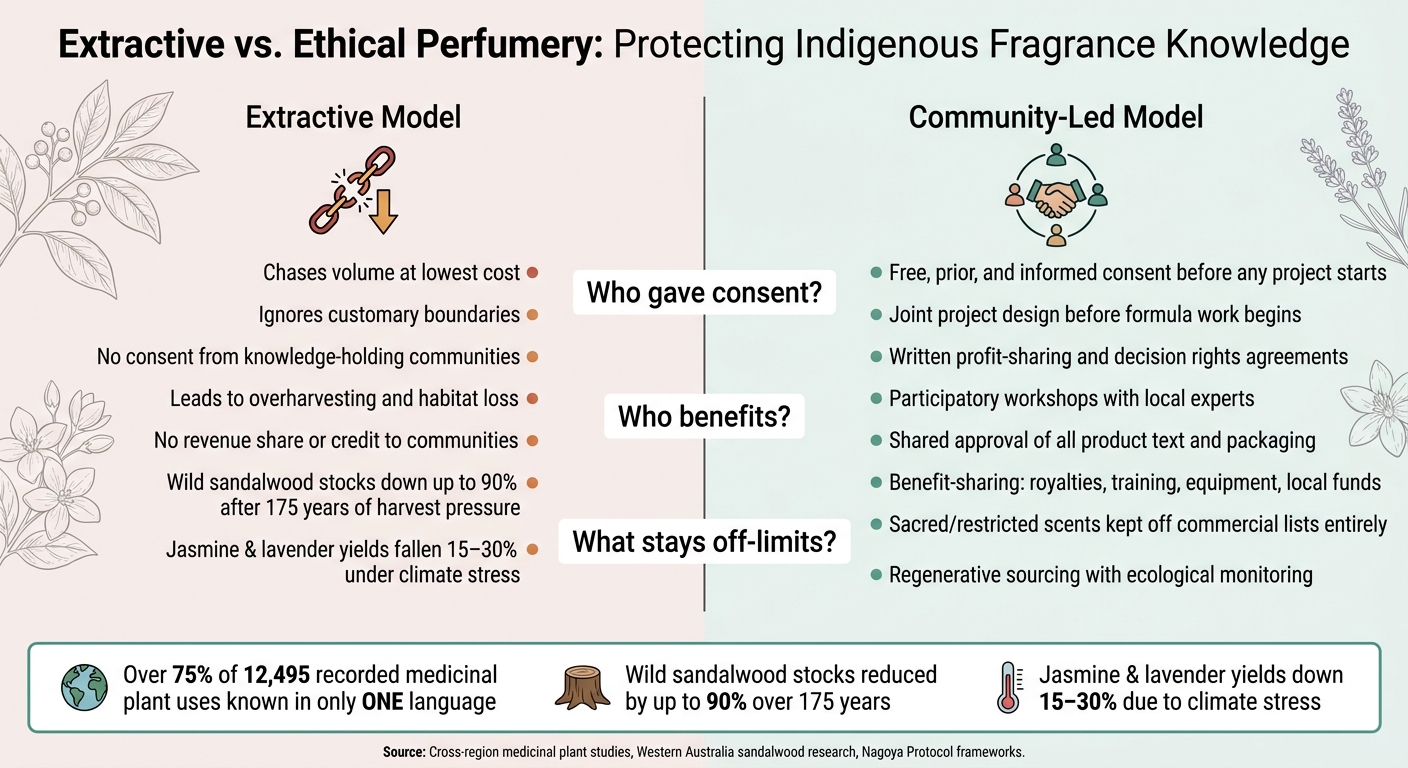
Extractive vs. Ethical Perfumery: Protecting Indigenous Fragrance Knowledge
Modern perfumery can help preserve scent knowledge, but only if communities stay in charge. That’s the line that matters. The main question is plain: does this model protect community authority, or does it water it down?
Some approaches clearly fail that test. Extractive sourcing chases volume at the lowest cost, ignores customary boundaries, and can lead to overharvesting and habitat loss. Better models already exist. Community co-created scents keep authorship and decision-making with the community, rely on consent, require shared approval of product text, and can support regenerative sourcing. Archival documentation projects take a different path: they focus on passing knowledge on rather than selling it, keep full community control over access and use, and add zero harvest pressure to plants.
The strongest starting point is documentation under community control, not product development.
Documentation, co-creation, and benefit-sharing done right
Preservation begins before a perfume formula is drafted. Oral histories, participatory smell circles, and olfactory walks can record how plants and resins are used, what they mean, and the setting around them. In these walks, elders and younger community members identify materials together on site. That process can lead to smell maps, audio recordings, and descriptive notes held under community-approved access rules, often in local cultural centres as well as restricted outside repositories.
When a fragrance does move toward commercial work, the process needs guardrails from the start. Co-creation done properly follows a clear sequence:
- Joint project design before any formula work starts
- Written agreements on profit-sharing and decision rights
- Participatory workshops where local experts assess trial accords in their own scent vocabulary
- Shared approval of product text, including packaging copy and product pages, by community representatives
Benefit-sharing can also include practical support, not just money. Equipment for sustainable harvesting, training programmes, and scholarships all fit within that model.
Protecting sacred boundaries and sourcing plants responsibly
Some ritual scents should never become perfume. That decision should rest with the communities themselves, because they are the ones best placed to say what is restricted. Perfumers who take this seriously keep no-commercial-use lists. If a community marks a scent or ingredient as sacred, it is recorded only for internal transmission and kept out of formulas, marketing imagery, and sampling campaigns.
For materials that can be shared, responsible sourcing means steady ecological monitoring, support for cultivation, and work with certified supply chains. The FairWild-certified frankincense project in Somaliland is a good example. It uses annual on-site monitoring of trees, harvesters, and business practices so resins are produced in an ethical and sustainable way. Brands can also back ceremonial plant conservation directly by funding replanting programmes or youth ranger initiatives, without asking for a product link in return.
Where Scento fits in a respectful fragrance culture
Discovery formats make sense within this ethic when they cut waste without acting as if tradition can be owned. Scento offers designer and niche fragrances in small-format sampling - 2 ml, 5 ml and 8 ml vials, and a 30 ml bottle decant on most perfumes - which can reduce overbuying and lower the footprint of fragrance discovery. That matters even more when ingredients carry ecological sensitivity or deep cultural meaning.
Conclusion: What Preservation Should Look Like Going Forward
Indigenous fragrance knowledge is living heritage. It isn’t a museum piece, and it shouldn’t be treated like something outsiders can simply take and use. It sits inside land care, healing, and ceremonial life that communities still shape now. When that knowledge is lost, the damage runs deep.
Preservation breaks down when heritage stays unseen, ecosystems are harmed, knowledge is taken out of context, and legal systems protect single owners instead of communities. So protection has to work on three levels at once: ecological, legal, and led by the people who hold the knowledge.
The starting point is simple: community control comes first. That means free, prior, and informed consent before any documentation or commercial project starts. It also means a clear right to refuse, including in cases involving sacred or restricted knowledge that should never end up in a perfume formula.
Good practice also depends on sourcing that gives proper weight to local harvest rules, seasonal limits, and community authority. And it needs written benefit-sharing in plain terms, whether that includes royalties, training, equipment, or local funds.
Modern perfumery can play a part here, but communities have to set the terms. Perfumers, brands, and shoppers can help most by asking a few direct questions:
- Who gave consent?
- Who benefits?
- What stays off-limits?
If a brand or project can answer those points clearly, that’s a good sign. If it leans on vague stories about "ancient wisdom" while sidestepping consent or community rights, that’s where alarm bells should ring.
UNESCO’s ethics guidance says the communities who create intangible cultural heritage should benefit from protection of the moral and material interests arising from its use, research, documentation, promotion, or adaptation.
That idea matters just as much for a resin harvested in Namibia or a smoke ritual in Amazonia as it does for any other form of expression. Preservation means giving communities the authority, resources, and room to keep this knowledge alive on their own terms.
FAQs
Why is fragrance knowledge lost so quickly?
Fragrance knowledge can disappear fast. The main reasons are damage to the natural world, economic pressure in farming communities, and the fading of local know-how.
Climate change, overharvesting, and intensive monoculture shrink the biodiversity that perfumery has long depended on. At the same time, poverty and weak long-term security push younger people away from these labour-heavy crafts. And when that happens, the skills and plant knowledge passed down over centuries start to thin out.
How does climate change affect scent traditions?
Climate change is putting pressure on the ecosystems that fragrance crops rely on. The result is simple and harsh: lower yields and weaker ingredient quality.
In Grasse, France, for example, heat waves and droughts have reduced floral harvests by as much as 40%. That’s not a small dip. It changes what growers can produce and what perfume houses can source.
There’s another layer to this, too. Higher temperatures can shift the chemical composition of botanicals, which means the scent itself may change. A flower might still grow, but it may not smell the way perfumers expect.
For local farmers, this hits on two fronts:
- income becomes less stable
- long-standing fragrance methods tied to nature come under strain
When harvests shrink and raw materials change, the pressure lands not just on supply chains, but on the people and places behind them.
How can perfumers work with communities respectfully?
Respectful collaboration comes down to fair pay, clear reporting, and long-term work. For perfumers, that means building direct ties with local co-operatives instead of treating sourcing like a one-off deal. The aim is steady income, fair wages, and support for community needs such as healthcare and education.
It also means working within frameworks like the Nagoya Protocol, using certifications such as UEBT or Fairtrade, and keeping traceability in place through audited origin records and open reporting.

