
Romania is the European Union's most under-covered fragrance growth story. The country has crossed 400 million euro in domestic retail value, posted a roughly 25% increase against the pre-pandemic baseline, and quietly built a domestic artisanal scene that did not exist a decade ago. Yet the English-language record on the Romanian perfume market remains thin, fragmented, and out of date. Scento's analysis closes that gap.
This article synthesises public market data, trade indicators, and Scento's own order signal from over a thousand Romanian fragrance buyers into a single view of where the Romanian market sits in 2026 and where it is heading by 2030. The picture is consistent across every angle Scento examined: a maturing market mid-shift, with the premium segment taking value share faster than the mass segment is losing it, and a buyer profile that increasingly resembles Western Europe a generation removed.
The Romanian fragrance buyer in 2026 is no longer the same buyer who anchored Romanian beauty retail through the 2010s. Higher real incomes, a maturing premium retail footprint, and a generational shift in how fragrance is treated culturally have produced a market that looks structurally different from the country that joined the European Union in 2007. Scento's analysis of the Romanian buyer base since 2023 confirms what the public market data has been hinting at: Romania is in the early innings of a multi-year premiumisation arc that has further to run than most observers assume.
What follows is a structured, country-specific analysis built across seven sections: market context, consumption trends, the premium shift, top brands, e-commerce growth, tax and pricing, and the 2030 outlook. Each section is anchored in real data and triangulated against Scento's order signal where the cell size supports proprietary framing. The structural conclusion across every section is the same: Romania is moving in the direction Western Europe moved a generation ago, with younger demographics and a shorter compression window producing one of the EU's most interesting fragrance growth trajectories.
Romania's Fragrance Market in 2026: Context
Romania ranks as the seventh-largest fragrance consumer in the European Union by volume, sitting in the roughly 3% national-share band alongside the Netherlands, Ireland, and Portugal. Domestic market value crossed 400 million euro in 2025, a roughly 25% increase versus the pre-pandemic baseline. The structural tailwinds are well-established: falling inflation as the Harmonised Index of Consumer Prices recovers toward the EU mean, rising average incomes across Bucharest, Cluj — Napoca, and Timisoara, and a maturing premium retail footprint that now includes Douglas, eMAG Beauty Hub, Sephora Bucharest, and a deepening Marionnaud presence.
Scento's framing of Romania is that it is the EU's most under-covered fragrance growth story. The absence of credible English-language Romania fragrance coverage is itself part of the story: a market this large, growing this fast, with a domestic artisanal scene this fresh, ought to be better documented than it is. Romanian beauty buyers, particularly the urban premium cohort, have shifted preferences faster than the public record can keep up with. The mismatch between what is happening on the ground and what is documented in English-language industry analysis is itself a market opportunity for any brand or retailer paying attention.
The category mix matches a country at an inflection point. Designer fragrance still leads volume, but niche has graduated from a fringe curiosity to a credible secondary tier. Mass fragrance, particularly drugstore-channel volume, has plateaued in real terms since 2022 and is forecast to keep losing value share through 2030. Specialist beauty retail has expanded steadily since the late 2010s, anchored by eMAG's Beauty Hub shop-in-shop concept opened in 2020 and Douglas Romania's continued physical-store rollout across Bucharest, Cluj, Timisoara, and Iasi. Marionnaud and Sephora round out the high-traffic Bucharest mall presence at AFI Cotroceni, Mega Mall, and Promenada Mall.
The macro context for fragrance demand is constructive. Romanian disposable income has compounded ahead of the EU average since 2018, with average household income now within roughly 30% of the EU mean on a purchasing-power-parity basis. The 2022 to 2023 inflation peak eroded real purchasing power across the category, but moderation through 2024 and into 2025 has restored the upgrade-friendly conditions that were already pulling Romanian buyers toward premium before the inflation shock. Bucharest in particular has emerged as one of the most beauty-active urban markets in CEE, with retail density per capita approaching Warsaw and Prague benchmarks.
Demographic structure adds another constructive dimension. Romania has a younger population mix than the EU average, with a larger share of the population under 35 than France, Italy, or Germany. The under-35 cohort is structurally more open to niche fragrance, scent-wardrobing, and online-first beauty purchasing than older cohorts, and the demographic tailwind is durable through at least 2030. The combination of younger demographics, rising real incomes, and a maturing retail footprint is the structural setup behind the 25% retail-value growth Romania has posted since 2019. The trajectory is unlikely to flatten before 2028.
Consumption Trends: Volume, Value, and the Premium Tilt
The headline volume number for Romania is approximately 6,000 metric tons of perfumes and toilet waters consumed per year on a 2024 base, placing the country inside the EU top ten by volume despite middle-of-pack per-capita. That figure conceals the more interesting story underneath: value growth has outpaced volume growth meaningfully and consistently since 2020.
Premium fragrance volume in Romania grew slower than premium fragrance value over the period, the classic statistical signature of a market mix-shifting upward. Scento's view of this gap, framed as analytical observation rather than promotional claim: each Romanian fragrance buyer is spending more, on fewer but better bottles. The same trend is visible in adjacent CEE markets but is more pronounced in Romania than in Hungary or Bulgaria, and roughly comparable to what Poland recorded between 2017 and 2021 when Polish premium retail crossed its own inflection point.
The average Romanian fragrance basket grew approximately 4 to 5% year-on-year in 2024 and 2025 in current value terms, even as unit volumes were flat to modestly higher. The driver is segment substitution: a buyer who was purchasing two designer bottles per year five years ago is now purchasing one designer bottle and one entry-level niche bottle, with the niche purchase carrying meaningfully higher price-per-millilitre economics. Scento's analysis of Romanian order data confirms the pattern at the buyer-cohort level. The same buyer cohort that placed 80 euro orders in 2023 is now placing 110 to 130 euro orders in 2026, with the basket reshape concentrated in the niche tier.
The premium-mass split tells the same story from a different angle. The premium segment now accounts for an outsized share of value growth, with mass volume largely flat. By 2026, premium and prestige fragrance combined contribute the majority of category value despite a smaller volume footprint. The mass segment, dominated by Avon's direct-sales channel and drugstore retail through DM, Mueller, and ProfiMed, retains volume relevance but is no longer the growth engine.
The seasonality pattern in Romanian fragrance demand has also shifted. Q4 has always been the largest quarter on the back of Christmas and Mother's Day gifting, but the gap between Q4 and the rest of the year has narrowed as scent-wardrobing behaviour spreads through the urban premium cohort. The Romanian buyer in 2026 is more likely to make multiple smaller purchases across the year and less likely to anchor an entire year's fragrance spend in November and December. The flattening of the seasonality curve is one of the structural signatures of a maturing fragrance market, and Romanian retail is increasingly Western European in this respect.
The Mother's Day gifting peak in March is also an unusually strong driver in Romanian fragrance demand. Cultural emphasis on the Mother's Day occasion in Romania produces a Q1 retail bump that exceeds the EU average for the same period, with fragrance one of the most common gifting categories. The combined Q1-and — Q4 gifting concentration in Romanian fragrance retail is meaningfully higher than the EU average, but the trajectory is gently flattening as wardrobing behaviour spreads.
Within the premium segment, the orientation toward gourmand, oriental, and amber fragrance families is particularly pronounced. Romanian buyers gravitate toward the warm, sweet, vanilla-and-amber profile that anchors Maison Francis Kurkdjian Baccarat Rouge 540, the Parfums de Marly oriental rotation, and the broader Middle Eastern niche aesthetic. The fresh-citrus and aquatic profiles that dominate Mediterranean buyer preferences sell less well in Romania than in Italy or Spain. The cultural and climatic fit between the warm-oriental fragrance family and Romanian buyer preferences is one of the durable patterns Scento has identified, and one that anchors the niche-tier growth trajectory through 2030.
The Premium Shift: From Mass to Niche, From Drugstore to Boutique
Three concrete moves Romanian buyers are making in 2026, presented as Scento's analysis of the Romanian buyer profile.
The first move is trading up from mass to designer. Buyers who were anchored to Avon, drugstore designer dupes, and entry-level body sprays through their twenties are graduating to first-tier designer in their thirties: Dior Sauvage, Yves Saint Laurent Libre, Tom Ford Black Orchid, Lancome La Vie Est Belle, and the broader designer rotation that dominates DACH and CEE shelf-share. This first move is now well-established and feeds the bulk of designer volume growth. The first-time designer buyer in Romania has become a structurally larger cohort year over year since 2022, and the buyer profile within this cohort skews younger and more urban than the legacy mass-channel base.
The second move is trading up from designer to entry-level niche. The buyer who already wears Dior or Tom Ford as a confident designer purchase is increasingly willing to consider Le Labo Santal 33, Maison Francis Kurkdjian Baccarat Rouge 540, or a Parfums de Marly oriental in the 250 to 350 euro band. This second move is newer, more concentrated in the urban premium cohort, and growing faster than the first move on a percentage basis. It is the move that is changing the shape of the Romanian premium market. The graduating-to-niche buyer typically owns three to five designer bottles before adding a first niche purchase, and Scento's order data shows the niche addition correlates strongly with rising aggregate annual fragrance spend.
The third move is the emergence of a small but credible domestic artisanal scene. Romania now hosts 15 active fragrance brands, 13 of them created in the last five years. Calaj Perfume, founded in Arad in 2020, has won international competition recognition and built a credible export channel into Western European specialist retail. The relaunched Miraj from Bucharest, originally a 1950s Romanian fragrance house, returned to the market in 2023 and has posted material year-on-year sales growth. These brands do not yet move European-wide volume, but they signal a domestic creative scene that did not exist a decade ago and that may produce a breakout international niche house by the early 2030s.
The third move matters culturally as much as commercially. A domestic artisanal fragrance scene gives Romanian buyers a reason to engage with fragrance as creative practice rather than imported luxury, and the cultural shift compounds with the income shift to deepen overall category engagement. Romanian press coverage of Calaj and Miraj has been steadily rising since 2023, and the level of fragrance literacy among urban Romanian buyers has measurably improved over the same period.
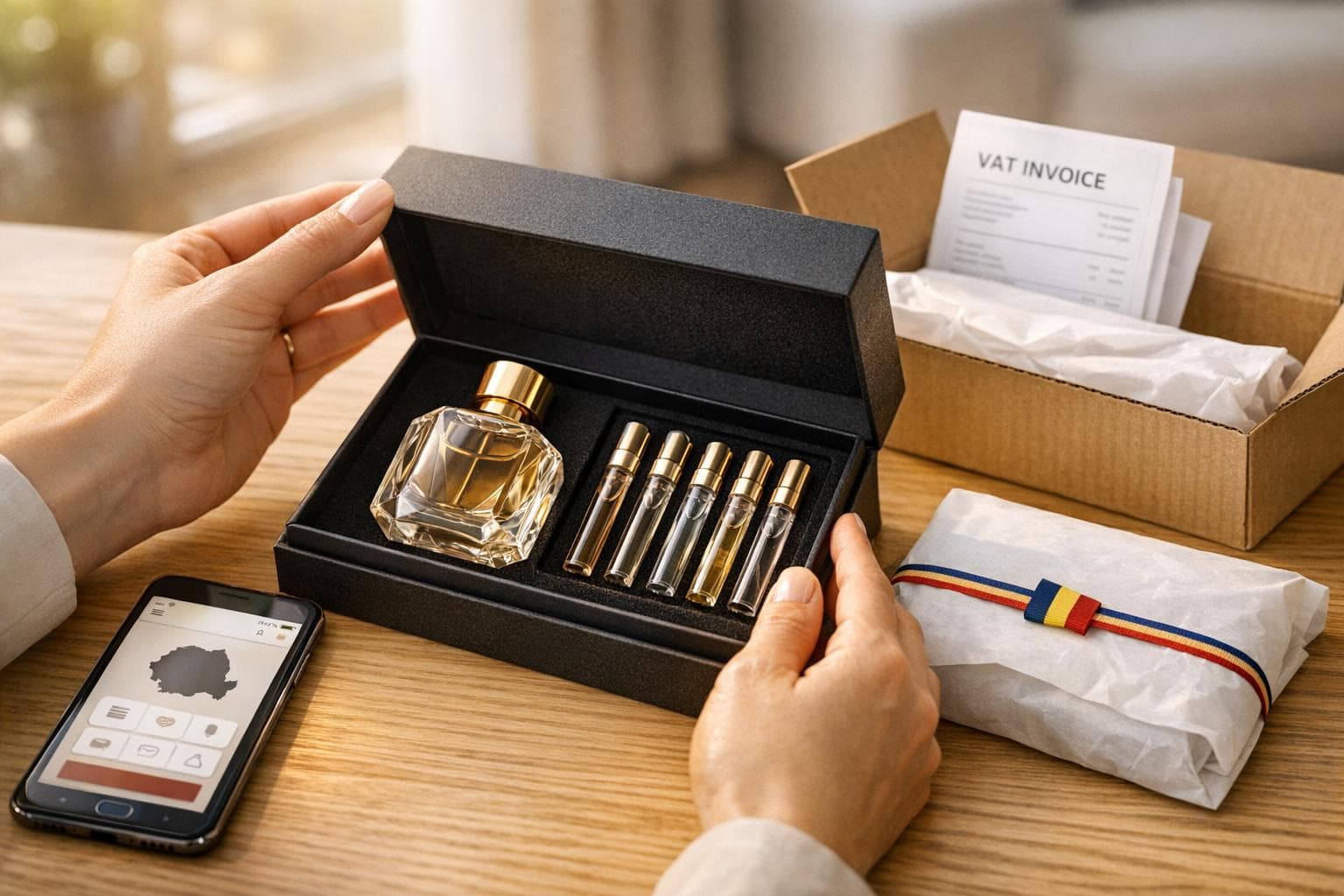
Decants and travel-size bottles are the bridge that lets entry-level premium buyers test 250 to 350 euro niche fragrances without 300 euro commitment risk. This is exactly the buyer Scento was built for, and the structural fit between the Romanian premium-shift cohort and the decant model has been visible in Scento's order data since 2023. Buyers who try a 2 millilitre decant of an MFK or PdM fragrance convert to full-bottle purchases at materially higher rates than buyers who first encounter the brand at full retail. Decants and travel-size bottles remain the lowest-friction entry into the niche category, and Scento's personalised fragrance discovery quiz routes new Romanian buyers into curated niche-and-designer recommendations matched to their preference profile.
Top Brands Sold in Romania (2026): Designer Mainstream and Emerging Niche
Romanian fragrance demand splits roughly 70/30 designer-to-niche today, with the niche slice growing two to three times faster than designer year-over-year. The designer rotation that anchors Romanian bestsellers is largely the same rotation that dominates DACH and CEE retail: Dior, Yves Saint Laurent, Tom Ford, Giorgio Armani, Versace, Calvin Klein, Hugo Boss, Lancome, and Carolina Herrera. The niche tier sold to Romanian buyers is led by Maison Francis Kurkdjian, Parfums de Marly, Creed, Xerjoff, and Amouage, the same niche bestseller stack that anchors the German, Italian, and French premium-niche markets, but with thinner penetration depth.
This is Scento's analysis of Romanian fragrance buyers, drawn from over 1,000 unique buyers across 1,200+ orders shipped to Romanian addresses since 2023. The signal is consistent across order cohorts, customer segments, and seasonal slices. Designer houses lead by buyer count and by aggregate volume; niche houses lead by average order value, by repeat-purchase rate, and by category growth. The niche-cohort repeat rate is materially higher than the designer-cohort repeat rate, which is a meaningful indicator that niche buyers in Romania are building scent wardrobes rather than making one-off purchases.
Romanian buyers are particularly responsive to the powerhouse niche launches that drive press coverage and category awareness. Maison Francis Kurkdjian's catalogue, anchored by Baccarat Rouge 540 and the broader oriental-amber rotation, posts disproportionately strong velocity in Romania relative to its overall European footprint. Parfums de Marly's catalogue, particularly Layton, Delina, and Pegasus, has built a Romanian following over the past three years that punches above the brand's general CEE share. Creed's catalogue, especially Aventus, retains a durable Romanian buyer base anchored by the male-fragrance segment.
The designer tier is led by the global rotation. Dior's catalogue and YSL's catalogue are the two largest designer houses by Romanian volume, with Tom Ford's catalogue a close third anchored by the Private Blend rotation that bridges designer and niche economics. Giorgio Armani's catalogue, particularly Si and Acqua di Gio, anchors a meaningful share of female and male designer volume respectively. Versace, Lancome, and Calvin Klein round out the high-volume designer rotation, with the Versace Eros and Calvin Klein CK Everyone rotations carrying disproportionate male-cohort weight.
The gender split in Romanian fragrance demand mirrors the broader Western European pattern. Female buyers anchor approximately 60% of total Romanian fragrance volume, with the male buyer cohort growing faster on a percentage basis since 2022. Male niche penetration has accelerated meaningfully in Bucharest and Cluj, with the Creed Aventus, Parfums de Marly Layton, and Tom Ford Tobacco Vanille rotations leading male niche awareness. Fragrances curated for women and fragrances curated for men on Scento's catalogue surface the full designer and niche selection that matches Romanian preference patterns. Buyers can also browse the full catalogue for a market-spanning view.
E — Commerce Growth: eMAG, Douglas, and the Online Fragrance Channel
Romanian beauty e-commerce is led by eMAG, the country's largest online retailer by aggregate sales. eMAG launched its premium Beauty Hub shop-in-shop concept in Bucharest's Baneasa district in 2020 and has steadily expanded perfume SKU count and brand depth since. Douglas Romania operates 30+ physical stores plus an active e-commerce presence, with Bucharest, Cluj, Timisoara, and Iasi as the strongest urban anchors. Sephora and Marionnaud round out the high-traffic Bucharest mall presence at AFI Cotroceni, Mega Mall, and Promenada.
The structural shift in channel mix has been clean and consistent. Online's share of Romanian fragrance category sales rose from sub-15% before the pandemic to approximately 25% in 2024, and is forecast to continue compounding through 2030. The Romanian e-commerce buyer profile leans younger, more urban, and more cross-border-active than the in-store buyer, with a meaningful share of online spend going to EU-based retailers shipping into Romania at lower — VAT-jurisdiction prices.
Scento's analytical observation is that Romania's fragrance buyer is increasingly the online buyer first, the boutique buyer second. This is a tailwind for cross-border e-commerce players including Scento, and a structural pressure on the legacy in-store specialist channel. Douglas Romania's response has been an accelerated online-and-store integration strategy; eMAG's response has been deeper premium SKU coverage and a more visible Beauty Hub physical presence. The competitive pressure between domestic specialist retail and EU-wide online players is one of the defining dynamics of Romanian fragrance retail in 2026.
The cross-border component is meaningful. A material share of online perfume volume consumed in Romania transits through low — VAT-jurisdiction EU fulfilment, with Romanian buyers actively comparing landed prices across DE, NL, and IT-based retailers. The price-comparison behaviour is most pronounced in the niche tier, where the absolute euro savings on a 250 to 350 euro purchase justify the additional shipping time and the marginal complexity of cross-border ordering. Romanian buyers comfortable shopping cross-border for niche are generally also the buyers most engaged with the category, producing a durable correlation between cross-border behaviour and total annual category spend.
Mobile commerce share is meaningfully higher in Romania than in most Western European markets. Romanian buyers are mobile-first to an unusual degree, with smartphone-driven beauty purchases accounting for a larger share of total beauty e-commerce than the EU average. The mobile-first pattern reflects both demographic structure (younger overall population) and infrastructure (excellent mobile broadband coverage). For brands and retailers serving Romania, mobile execution is a meaningfully larger share of total ROI than it would be in Germany or France. Scento's current fragrance bestsellers reflect what Romanian buyers are converting on most frequently in 2026, and the curated rose accord rotation maps to Romania's deep cultural affinity for the Damask Rose, which has been part of the country's perfumery and gardening tradition since the early modern period.
Tax, VAT, and Pricing Effects on the Romanian Buyer
Romania's standard VAT rate sits at 19%, on the lower end of the EU spectrum. Germany and Austria sit at 19 to 20%, the Nordics at 24 to 25%, and France at 20%. Romania's lower VAT rate is a structural advantage that has helped it emerge as a price-attractive destination for cross-border fragrance fulfilment, and a partial offset for the higher import logistics costs that any Eastern EU market faces relative to the German and French manufacturing centres.
Recent inflation moderation has stabilised purchasing power. The Harmonised Index of Consumer Prices for cosmetics has tracked the broader CPI back toward the European Central Bank's 2% anchor through 2024 and into 2025, after the 2022 to 2023 erosion. The 2025 fiscal package introduced broader tax adjustments without targeting fragrance specifically, leaving the category VAT regime stable. The structural tax position for Romanian fragrance retail and Romanian buyers is constructive.
What this means for the buyer at the cash register: a Romanian-purchased decant of a 250 euro niche fragrance routed through a low — VAT EU jurisdiction can land 5 to 15% cheaper than the same purchase made in DE or NL. This is a concrete cross-border arbitrage that explains part of Romania's cross-border fragrance volume and is one of the structural reasons that EU-wide e-commerce platforms shipping into Romania have outpaced domestic retail growth since 2022. The arbitrage will narrow as VAT harmonisation continues, but the gap is durable through at least 2027 and probably 2028.
Currency dynamics also matter for cross-border arbitrage. The Romanian leu has been relatively stable against the euro since 2023, after a multi-year period of moderate depreciation. Currency stability lowers the FX-risk friction on cross-border purchasing and makes the underlying VAT arbitrage easier for Romanian buyers to act on. The combined effect of currency stability and VAT differential has been a durable structural tailwind for EU-wide fragrance e-commerce serving Romanian buyers, and the dynamic is unlikely to reverse before 2027.
2030 Outlook: Where Romania Goes from Here
Three structural calls Scento makes on the Romanian fragrance market through 2030.
First, the premium-mass mix in Romania will continue tilting toward premium. Niche fragrance is forecast to capture an additional 5 to 10 percentage points of value share by 2030, lifting the niche share from roughly 30% in 2026 toward 35 to 40% by decade-end. This is a faster trajectory than the EU average and reflects Romania's catch-up dynamics relative to Western Europe. The buyer cohort driving this shift is concentrated in Bucharest, Cluj, and Timisoara, with secondary growth in Iasi, Brasov, and Constanta. Smaller cities and rural Romania will lag the premium shift but will not regress; the mass-segment baseline is stable through 2030 even as the premium share grows.
Second, e-commerce share of fragrance sales will cross 35 to 40% by 2030, narrowing the gap with Western Europe. The online channel will continue to gain share from in-store specialist retail, with the cross-border component remaining structurally meaningful through at least 2027. Specialist online retailers, EU-wide platforms, and brand-direct e-commerce will be the three channels capturing share; mass retail and drugstore will hold flat to mildly declining. Mobile-first execution will remain disproportionately important relative to Western European peers, and any retailer or brand serving Romania will need to optimise for mobile beauty purchasing as a primary rather than secondary channel.
Third, the domestic artisanal scene, currently 15 brands strong with 13 launched in the last five years, is small but compounding. Calaj, the relaunched Miraj, and the broader 2020 to 2025 cohort of new Romanian brands will continue to professionalise their distribution, design language, and international press positioning. Romania could plausibly produce one breakout international niche house by 2030, with the credible candidates being Calaj or one of the late-2024-and-2025 launches that have not yet built international visibility. The domestic scene's compounding effect on overall category engagement is more important commercially than its direct retail volume contribution.
For the broader fragrance industry, Romania is one of the most under-covered growth opportunities in the European Union. Buyer behaviour is moving in the same direction as the rest of Europe, only faster, and the structural ceiling, if Romania's per-capita consumption converges with the Netherlands or Germany, is roughly double the current footprint. The 2030 endpoint for Romanian fragrance value is plausibly in the 600 to 750 million euro range at retail, depending on the speed of the premium shift and the durability of the macro tailwinds. Personalised fragrance discovery remains the most frictionless entry point for new Romanian premium buyers, and the wider niche perfumery category is where the next decade of growth will be earned.
For deeper context on how Romania sits within the EU-wide fragrance landscape, see Scento's Europe-wide fragrance market analysis.
This analysis is based on Scento's review of the Romanian fragrance market, October 2025 to April 2026. A detailed methodology is available to press on request at [email protected].