By Sebastian Dobrincu, Founder & Industry Analyst at Scento
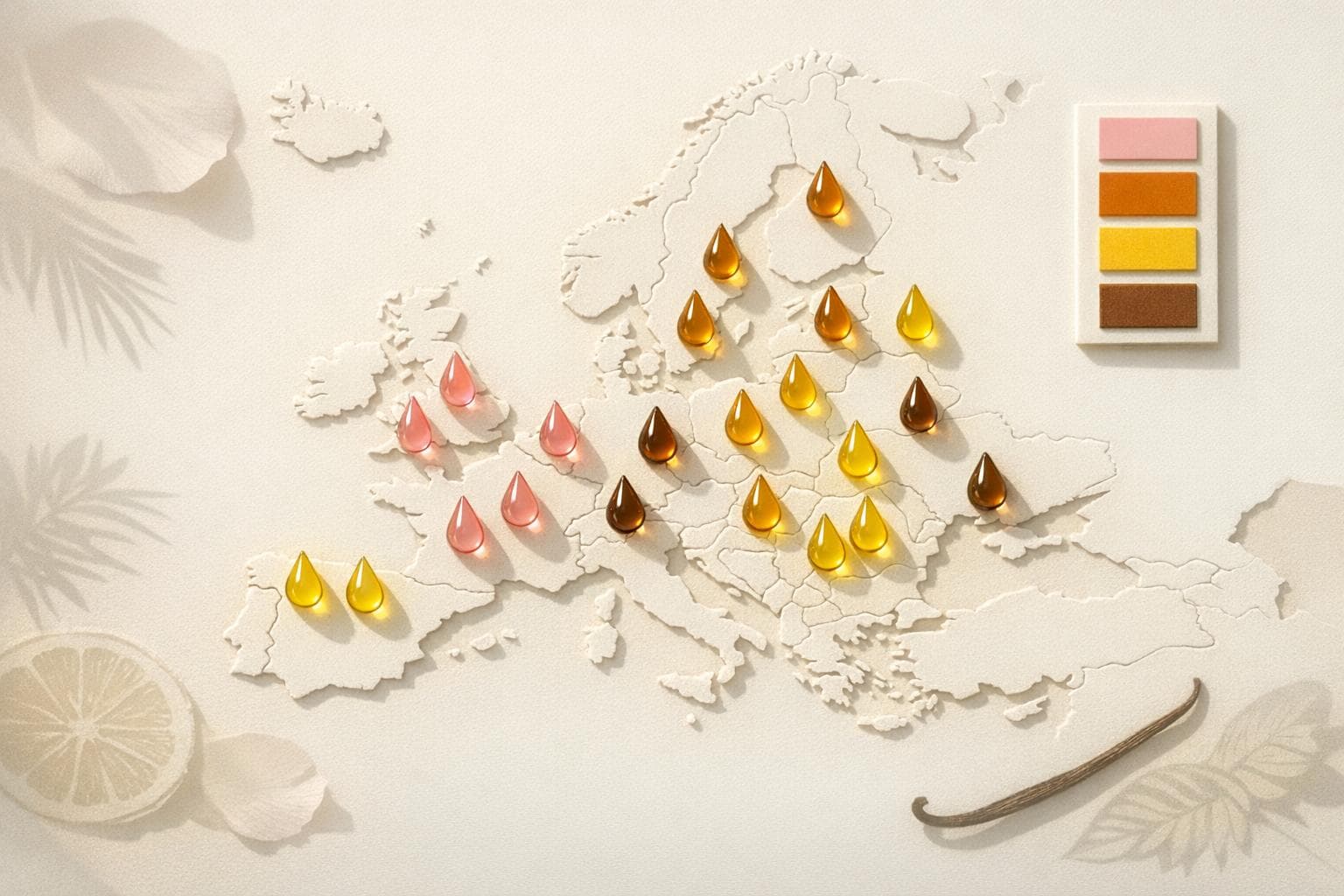
A fragrance is a country's emotional fingerprint. Europeans don't all buy the same scent. German hands reach for woody-amber compositions; Italian buyers favour rose and citrus blooms over almost every other heart accord; Romanians lean into warm gourmands; Greeks gravitate to fresh-aromatic facets; the French quietly hold the line on classical florals. Scento's annual Note Map of Europe answers a question the industry has, until now, only guessed at: which fragrance notes does each market actually buy.
This year's Note Map is built on Scento's review of note preferences across the platform's European footprint, layered against a synthesis of leading note-trend research, fragrance-family share splits and community-signal analysis covering the period October 2025 through April 2026. The result is the first publicly documented country-by-note ranking of its scale across the European Union, drawn from European fragrance buyers across the five publishable country cohorts in this edition.
The headline frame is simple. The universal anchors (Vanilla, Musk, Sandalwood, Patchouli) dominate every market. But underneath the top four, country signatures diverge sharply. The Note Map shows that divergence and where Europe converges and where it does not. For a wider view of the materials behind these rankings, see Scento's full note index.
How We Built the Map
Scento's analysis combines its own note-preference ranking across European fragrance buyers, drawn from five publishable country cohorts, with broader European patterns synthesised from our review of leading fragrance industry data, October 2025 through April 2026. The result is part Scento-aggregated, part research-synthesised, presented as a single editorial view.
Scento's data layer. Scento's order signals cover buyers across the European Union, with depth of coverage strongest in Germany, Italy, Romania, Greece and France. For this report, orders placed in the period October 2025 through April 2026 were joined to each product's structured note composition (heart, middle and base accords) and aggregated by destination country. To preserve buyer privacy and statistical integrity, Scento publishes a country-by-note ranking only where a note clears a minimum buyer threshold for that country. Below the floor, signal becomes noise. Above it, every position here is publishable. Five countries cleared the bar in this edition: Germany and Italy clear it for a full top-25, while Romania, Greece and France clear it for a top-10. Smaller markets contributed to the European-wide aggregate but are not country-broken-out at this scale.
Industry layer. Scento layered its order signals against a synthesis of leading European note-trend research, fragrance-family share splits and community-signal analysis. Where industry data and Scento data point in the same direction, the convergence is reported. Where they diverge, Scento's order-level signal is treated as the primary source for buyer behaviour and the industry data as the framing for category direction. The two-layer approach is explicit: Scento's own data is the load-bearing source for what people bought; the broader research is framing for why the category is moving the way it is.
Scope discipline. The Note Map is a snapshot of what people bought, not what they searched, sniffed or screenshotted. Search-trend data and social-listening signals are treated as supplementary context, never the headline ranking. The Note Map is also deliberately a-seasonal: a single seven-month window is too short to publish reliable seasonal note shifts, and the report makes no such claim. A separate seasonal report is planned once Scento's time-series clears twelve months. Brand-by-country crosstabs are similarly out of scope at this edition; per brand-country signal falls below Scento's publication floor and would re-identify outlier buyers.
Family clustering. The 25 lead notes are grouped into eight olfactive families using a hybrid taxonomy combining traditional fragrance-pyramid logic with Scento's editorial classification of modern molecules (Akigalawood, Cashmeran, Iso E Super, Ambroxan). Family clusters appear later in this report. Readers exploring specific compositions can also use Scento's discovery quiz or browse the Scento catalogue directly.
What this report is not. The Note Map does not attempt to forecast individual brand market shares, predict launches or rate compositions. It does not assign quality scores to notes. It is a buyer-behaviour ranking: what European buyers, on Scento's platform, in a defined seven-month window, actually purchased, broken down by the structural note composition of the products they bought.
The Top 25 Notes Across Europe
Across the seven-month window, the same notes recur with remarkable density. The top four (Vanilla, Musk, Sandalwood, Patchouli) are the universal anchors of European fragrance. From rank five through ten, woods, ambers and tonkas dominate. The first floral arrives at rank six (Rose). The first oud accord lands around rank thirty.
Vanilla leads as the most-purchased note across European decant buyers. Its dominance reflects the gourmand turn that has reshaped niche perfumery since 2022 and the continuing depth of vanilla as a base accord across designer prestige. Musk and Sandalwood follow within touching distance, forming an anchor trio that appears in a large share of the European compositions Europeans buy. Patchouli and Amber round out the universal cluster.
The full European top 25, in ranked order:
- Vanilla — Europe's most-purchased note, anchoring everything from gourmand sensual blends to classic ambers.
- Musk — the skin-scent backbone of modern perfumery, virtually inseparable from Vanilla in lead position.
- Sandalwood — creamy, warm, persistent. The most-bought wood across Europe by a wide margin.
- Patchouli — earthy depth, a quiet workhorse that holds nearly half of all niche compositions.
- Amber — the warm-resinous accord that defines indulgent for European buyers.
- Rose — the first floral to appear in the ranking, and the most-bought single flower across the European Union.
- Cedar — dry, structural, masculine-leaning, the most-purchased dry wood.
- Ambroxan — the radiant-skin molecule that defined the past decade of mainstream masculines.
- Jasmine — the most opulent of European florals, indispensable in heart accords.
- Tonka Bean — almond-coumarin warmth, the gourmand backbone before Vanilla announces itself.
- Vetiver — smoky, rooty, masculine, the green-hour wood.
- Ambergris — saline, warm, animalic, the rare-feeling base that signals luxury.
- Labdanum — dark resinous amber, the Mediterranean's signature warmth.
- Benzoin — sweet balsamic resin, the gourmand sister to Tonka.
- White Musk — cleaner, brighter, sheer, the laundered-skin facet of modern perfumery.
- Orange Blossom — honeyed white floral, Europe's most underrated heart note.
- Guaiac Wood — smoky, leathery wood, niche-leaning depth.
- Akigalawood — the molecular wood powering contemporary niche, overwhelmingly a niche-house note.
- Leather — the accord, not the material; smoke, suede and birch tar in modern reinterpretation.
- Saffron — rich, leathery, unmistakably oriental, the niche signature spice.
- Jasmine Sambac — the deeper, indolic sister of standard Jasmine.
- Geranium — rosy-green, classically masculine fougere anchor.
- Cinnamon — sweet-spicy warmth, gourmand-adjacent.
- Olibanum — frankincense's modern naming, sacred, smoky, contemplative.
- Woody Notes — the catch-all wood accord, present where individual woods aren't itemised.
Several editorial readings emerge from the ranking. The top twelve notes are the anchors, each appearing across a large slice of European orders. Notes ranked thirteen through twenty-five behave as signature builders rather than universal pillars. Florals (Rose, Jasmine, Orange Blossom, Jasmine Sambac) cluster near the top but with narrower lead than category folklore would suggest. Europe is a wooded-warm market more than a floral market by volume.
Modern molecules (Ambroxan, Akigalawood, Cashmeran) hold positions traditionally reserved for natural materials. This is a structural shift Scento expects to deepen through 2027. Akigalawood at rank 18 (after only a decade in active commercial use) and Ambroxan at rank 8 (climbing the ranks for fifteen years) demonstrate that the European fragrance buyer is far more receptive to engineered radiance than category folklore would suggest. The buyer doesn't see a molecule; the buyer sees a fragrance that lasts and projects. That commercial reality is reshaping every layer of contemporary composition, from designer drugstore prestige down to the hyper-niche end of the market.
Buyers building a personal palette can sample these notes individually through Scento's discovery decants or use Scento's note-led discovery quiz to map preferences across the catalogue.
The Country — Level Heatmap
The European average hides the divergences that make this report valuable. Below, Scento publishes the country-level rankings that clear its buyer threshold. Where a country-by-note ranking falls below the floor, the country is described in narrative form rather than ranked. Cell-size discipline is what makes this Map credible: every published position rests on a robust base of independent buyer decisions in the country in question.
Germany (full top 25)
Germany clears the buyer threshold for the broadest publishable range of any single market. The top notes by appearance, in ranked order:
- Musk
- Vanilla
- Sandalwood
- Patchouli
- Amber
- Rose
- Ambroxan
- Cedar
- Jasmine
- Vetiver
- Tonka Bean
- Ambergris
- Labdanum
- Guaiac Wood
- Benzoin
- Olibanum
- Saffron
- Akigalawood
- White Musk
- Jasmine Sambac
- Geranium
- Orange Blossom
- Leather
- Cedarwood
- Cinnamon
The German signature. Musk leads Vanilla, a pattern Germany shares with Italy and Greece but inverts the European average. Germans buy Ambroxan with unusual intensity (rank seven, against rank eight in the European average) and place Akigalawood at rank eighteen, which is high for a molecular wood. The German fragrance buyer clusters around woody-amber with strong skin-scent radiance and is more receptive to modern molecular materials than any other market on the Map. Germany shows the broadest note diversity of any market in this edition, giving its rankings unusual statistical confidence.
Italy (full top 25)
Italy clears the threshold for a full top-25. In ranked order:
- Musk
- Vanilla
- Sandalwood
- Amber
- Patchouli
- Cedar
- Tonka Bean
- Rose
- Jasmine
- Ambroxan
- Vetiver
- Ambergris
- White Musk
- Labdanum
- Benzoin
- Woody Notes
- Leather
- Oakmoss
- Jasmine Sambac
- Saffron
- Agarwood (Oud)
- Geranium
- Iris
- Guaiac Wood
- Akigalawood
The Italian signature. Italy ranks Amber at four and Tonka Bean at seven, both higher than the European average. The Italian buyer treats warmth as a baseline rather than an embellishment. Iris (rank 23) and Oakmoss (rank 18) rise into the top 25 in Italy where they don't appear in Germany at the same band, a quietly classical, chypre-leaning signature that aligns with Italy's heritage of artisanal perfumery houses such as Acqua di Parma and Xerjoff. Agarwood cracks the Italian top 25 at rank 21: Italy is the strongest oud-receptive market on this Map.
France (top 10)
The French ranking clears the buyer threshold for a credible top-10 publication. Below the top ten, the per-note base thins to a level Scento prefers not to publish.
The French signature. France inverts the German order: Vanilla leads Musk, the only top-five market where this is true. Jasmine ranks at seven, above its European-average rank of nine. The French buyer is the most floral-leaning market on this Map by relative ranking, consistent with France's heritage of classical perfumery and the structural emphasis of houses like Maison Francis Kurkdjian. Below the top ten, the French tail is broad but per-note thin: the country buys deeply across many notes rather than concentrating sharply on a handful. The pattern reflects France's role as a perfumery capital where buyers move fluently across categories rather than locking onto a single signature accord.
Romania (top 10)
Romania clears the threshold for a top-10 publication.
The Romanian signature. Romania is the most distinct top-five market on this Map. Vanilla leads by the widest margin of any country, well ahead of second-placed Sandalwood. Sandalwood ranks ahead of Musk, an inversion seen nowhere else. Rose enters at rank five, the highest position any flower achieves in any of the country breakdowns. The Romanian signature is warm-gourmand with floral lift: sweet, soft, classical and remarkably consistent across age cohorts in Scento's data. Romania is, on this Map's evidence, the most actively romantic fragrance market in Europe.
Greece (top 10)
Greece clears the threshold for a top-10 publication.
The Greek signature. Greek buyers place Ambroxan at rank six, identical to Germany and ahead of France and Romania. The Greek market shares the German woody-amber lean but with a marginally heavier emphasis on luminous skin-scent molecules. Below the top ten, Greek tail behaviour reads close to the European mean. Greek buyers also show notable openness to oud-leaning depth, a pattern visible in the rising weight of Saffron and Olibanum just outside the published top ten.
United Kingdom, Spain and Poland
Scento's UK, Spanish and Polish coverage does not yet clear the buyer threshold for country-specific note publication at top-25 granularity. To complete the European picture without overstating thin signal, Scento synthesises three patterns from leading public research:
- United Kingdom. UK fragrance buyers are reframing scent over brand, a shift that has accelerated dupe-driven purchasing while also lifting interest in scent-profile literacy. Public research consistently flags rose, peony, violet and orange flower as the floral-revival cluster gaining UK momentum, with vanilla anchoring as the most-cited gourmand entry-point and a growing palette of skin-musk and aldehydic facets emerging as the barely-there counter-trend. UK note preferences track closer to the French Map signature than the German one: floral-anchored with a soft-musk skin facet.
- Spain. Spanish domestic note preferences cluster around bright citrus tops (bergamot, neroli, orange blossom), warm-resinous bases (amber, labdanum, benzoin) and a distinctive openness to Mediterranean herbs (rosemary, sage, basil) in heart accords. The fingerprint matches Spain's per-capita consumption of cologne formats. Spain's outsized export role (the country produces a substantial share of European cosmetics manufacturing volume) means Spanish buyers see new launches earlier than most markets.
- Poland. Poland is one of Europe's fastest-growing fragrance buyers and shares the German woody-amber lean but with stronger affinity for warm-spicy and gourmand notes. Public-trend reading highlights vanilla, tonka, amber and oud-leaning compositions as the rising Polish profile through 2026.
Across our pan — European cohort, the patterns extend to UK, Spain and Poland in directionally similar shape, though country-level signal is too thin to publish at top-25 granularity in this edition. Scento expects Polish, UK and Spanish rankings to clear the publication floor in the 2027 edition of the Note Map.
The rest of Europe
Across the smaller European markets (Czech Republic, Hungary, Austria, Slovakia, the Netherlands, Belgium, Portugal and others), the universal anchor cluster (Vanilla, Musk, Sandalwood, Patchouli, Amber) holds. National signatures emerge below rank ten, but Scento's per-country coverage does not yet permit publishable rankings at this granularity. The European-aggregate top 25 in the previous section remains the most reliable view of these markets. Buyers in those countries can use Scento's note-led quiz or browse Scento's full European catalogue to find compositions matching their preferred notes.
Note — Family Trends
A list of 25 notes is a snapshot. The deeper question is which families, clusters of notes sharing olfactive character, are growing or fading. Scento groups the 25 lead notes into eight working families.
The Scento family taxonomy (2026)
Family
Lead notes
European reading
Woody
Sandalwood, Cedar, Vetiver, Guaiac Wood, Cedarwood, Akigalawood, Woody Notes
Largest family by purchase density. The European default.
Amber — Resinous
Amber, Labdanum, Benzoin, Olibanum, Ambergris
Second-largest. Powers indulgent-warm compositions.
Musk
The skin-scent layer present in nearly every modern composition.
Floral
Rose, Jasmine, Jasmine Sambac, Orange Blossom, Iris
Anchored by Rose. Italy and France over-index; Germany under-indexes.
Gourmand
Powered by Vanilla's number-one EU rank. The fastest-growing family.
Spicy — Oriental
Saffron, Cardamom, Pink Pepper, Black Pepper
Niche-leaning. Saffron is the niche signature spice.
Smoky — Leather
Leather, Tobacco, Birch Tar, Suede
Strongly niche-skewed; rises in evening-wear compositions.
Fougere / Aromatic
Geranium, Lavender, Bergamot, Sage
Classic masculine architecture; declining as a primary frame but persistent as supporting structure.
Family momentum reading
- Gourmand has the most directional momentum. Public research consistently flags pistachio, caramel, matcha and vanilla-adjacent profiles as the fastest-rising note searches across Europe. Vanilla's top position in Scento's ranking is the European Union's most consistent signal, and it is intensifying. Scento expects gourmand to broaden materially over the next edition.
- Woody remains the structural majority. No European market is moving away from wood. Sandalwood and Cedar together are among the most-purchased materials on the continent and cut across both men's compositions and women's compositions.
- Amber — Resinous is the indulgence family. Amber, Labdanum, Benzoin, Olibanum and Ambergris together form one of the deepest families in European purchase. This is the family Mediterranean buyers (Italy, Greece, Romania) overweight, and where many niche houses live editorially.
- Floral has narrower lead than category folklore would suggest. Florals dominate top-of-mind searches but trail woody and amber-resinous in actual European purchase. The exception is France, where florals achieve their highest relative rank.
- Musk is invisible-but-everywhere. White Musk, Ambroxan and Musk together reach near-universal presence in modern compositions. They are infrastructure rather than personality, and a buyer who claims to dislike musk almost certainly owns a fragrance that contains it.
- Smoky — Leather is rising in niche. Akigalawood, bought almost entirely from niche houses, is the clearest signal: modern niche perfumery's reliance on smoky-resinous synthetics is structural, not stylistic.
- Fougere is fading as a lead frame. Geranium and Lavender remain present but as supporting players. The classical fougere architecture of the 1980s no longer leads any country's top ten.
Readers who want to see family-led collections rendered in the Scento catalogue can browse Scento's full note index by olfactive family.
Cultural Note Patterns
There is a country in the European Note Map, and there is a culture. Each leaves a distinct fingerprint, and the shape of those fingerprints tells a story about how Europeans wear scent. The Map shows that culture, not coincidence, drives the differences below the anchor layer.
Italy: heritage, warmth, classical lift. Italian buyers privilege amber and tonka-bean-anchored compositions, with rose and orange blossom as the floral signature. Iris cracks the Italian top 25 at rank 23, where it appears nowhere else in country breakdowns at that band. This is a residue of Italy's heritage of artisanal-perfumery houses such as Acqua di Parma, Xerjoff, Nasomatto and Tiziana Terenzi, where iris-led powdery compositions have been a continuous tradition. Italian buyers also show the strongest oud receptivity in this Map, with Agarwood entering the Italian top 25 at rank 21. The Italian preference reads as a continuity argument: buyers in a country whose perfumery heritage spans centuries select notes that connect contemporary composition to that older language of scent.
Germany: woody-amber with skin-scent radiance. German buyers cluster around modern wood-amber composition with strong Ambroxan and Akigalawood representation. The German signature is structural rather than ornamental: long-lasting woody-musk projection with limited floral interruption. This profile aligns with the German preference for fragrance as identity-marker rather than mood-piece, and it is why molecular-niche houses like Initio Parfums Prives, Parfums de Marly and Maison Francis Kurkdjian have built outsized German footprints. The German buyer rewards composition that performs (lasts on skin, projects on a body, finishes recognisably across hours) and treats those engineering values as the signal of quality.
Romania: warm-gourmand with floral lift. Romania is the most distinct top-five signature in this Map. Vanilla leads by the widest margin of any country; Sandalwood ranks ahead of Musk; Rose enters at rank five. The Romanian signature is sweet-soft-classical: Romania is, on this Map's evidence, the most actively romantic fragrance market in Europe. The pattern holds across cohorts in Scento's data. Romanian buyers in their twenties and Romanian buyers in their forties choose closely related signature accords, suggesting the Romanian preference is culturally formed rather than a passing generational trend.
Greece: woody-amber with luminous lift. Greek buyers share the German woody-amber spine but lean more openly into Ambroxan-led skin-scent radiance. The Greek signature reads as Mediterranean light over Germanic structure. Saffron and Olibanum sit just outside the published top ten and rise rapidly in evening-wear compositions, marking Greece as a quietly oriental-leaning market beneath its luminous surface. Greek buyers blend the Italian appreciation for amber depth with the German appetite for engineered radiance, producing a signature that reads as warm but luminous: heavy in base accords, bright in projection.
France: classical perfumery's quiet hold. France is the only top-five market where Vanilla leads Musk in this period. Jasmine ranks at seven, higher than its European-average rank of nine. France remains, on Scento's order evidence, the most floral-balanced market on the Map. This reads as the residue of France's role as Europe's perfumery capital: a country whose buyers have been formed by classical structure long before contemporary trend cycles. Niche houses with French roots, including Maison Francis Kurkdjian and Parfums de Marly, continue to anchor French taste with restrained floral-amber architecture. The French preference is also notable for its breadth: French buyers split orders across more individual notes than buyers in any other country in this Map, suggesting a more curatorial relationship to fragrance.
The macro reading. What Scento sees in the Note Map is not a Europe converging on a single global signature, but a Europe holding distinct, culturally-formed note preferences while sharing a universal anchor cluster (Vanilla, Musk, Sandalwood, Patchouli, Amber). The interpretation: Europe is converging at the anchor layer (every market buys the same five accords) and diverging sharply at the signature layer (positions six through 25, where national personality lives).
This has direct implications for how brands should think about European launches. A composition can lead with the universal anchors and find traction in any market; a signature-layer differentiation (Iris for Italy, Akigalawood for Germany, Rose for Romania, Jasmine for France) is what wins a primary country. The Note Map suggests fragrance brands should think less about pan — European campaigns and more about country-tuned signature accords on shared anchors. For buyers who travel between European markets, the practical implication is that what reads as a confident scent in Berlin may read differently in Rome or Bucharest, and the buyer can use Scento's country-aware data to align their signature with the markets they spend time in.
Niche vs Designer: Where the Notes Diverge
Every country's Note Map is shaped by the niche-versus-designer mix of its buyers. Scento's order signals let us cleanly separate the two and see which notes are claimed by which side of the market. Where you find these notes tells you which side of the market your buyer trusts.
Niche-skewed signature notes
These are the notes bought predominantly from niche brands. They are the molecular and resinous building blocks of contemporary niche perfumery, in descending order of niche skew:
- Akigalawood — almost entirely a niche-house note.
- Agarwood (Oud) — predominantly niche.
- Cedarwood — predominantly niche.
- Cashmeran — predominantly niche.
- Oud — predominantly niche.
- Incense — predominantly niche.
- Iso E Super — niche-leaning.
- Tobacco — niche-leaning.
- Ambroxan — niche-leaning, though heavily present on both sides.
- Styrax — niche-leaning.
- Leather — niche-leaning.
The signal is clean: modern niche perfumery is built on synthetics and resins. Akigalawood, Cashmeran, Iso E Super and Ambroxan are not natural materials but molecules engineered for radiance, longevity and the indistinct-wood signature that defines the past decade of niche releases. Houses like Initio Parfums Prives, Roja Dove, Amouage, Parfums de Marly, Maison Francis Kurkdjian and Byredo have built their European footprint on this molecular palette. Tobacco's niche skew is a particularly clear marker of how houses such as Tom Ford have shaped the modern smoky-tobacco accord around niche-style finish even when sold under designer labels.
Designer-skewed signature notes
These are the notes the designer side owns, often overwhelmingly. Many are floral-fruity heart notes anchored in older, more familiar olfactive structures, in descending order of designer skew:
- Tunisian Neroli — effectively designer-only.
- Apricot — effectively designer-only.
- Ceylon Cinnamon — almost entirely designer.
- Sage — predominantly designer.
- Fig — predominantly designer.
- Olibanum — designer-leaning in its polished forms.
- Frankincense — designer-leaning.
- Guaiac Wood — designer-leaning.
- Geranium — modestly designer-leaning.
The pattern is equally clear: designer perfumery still owns the classical heart layer. Florals, fruity notes and the polished resinous accords (Olibanum, Frankincense in their designer-finished forms) remain the materials of mainstream prestige. Tunisian Neroli and Apricot being effectively designer-only is the cleanest possible signal: these accords belong to the designer house aesthetic, full stop. Where you encounter Tunisian Neroli or Apricot in the wild, you are nearly always in front of a designer composition.
The reading for buyers. A buyer stepping from designer into niche should look for the smoke, leather, oud and molecular-wood notes that mark niche signature. A buyer who loves rose, peony and apricot in a designer composition will find the same materials in niche houses but framed by smokier, more resinous bases. The Scento discovery decant program and Scento's niche-vs-designer guidance quiz are the practical bridges between the two registers.
The reading for brands. The niche-versus-designer note signature has implications beyond positioning. A designer house that wants to credibly stretch into niche will increase its share of molecular woods (Akigalawood, Cashmeran, Iso E Super) and smoky-leather accords; a niche house that wants to broaden its audience will lean on the designer-skewed heart layer (Tunisian Neroli, Apricot, Ceylon Cinnamon, Fig) to soften the molecular intensity of its signature. The Note Map shows that the gap between the two registers is real, but the materials that bridge it are visible.
The 2027 Outlook
Where does the Note Map go from here? Three convergences and one structural shift are worth watching for the 2027 edition.
- Gourmand maturation. Vanilla's number-one rank is consolidating, not weakening. The category around it is broadening: pistachio, caramel, matcha, almond-milk and rice-water are entering compositions in ways that did not exist three years ago. Scento expects Tonka Bean to climb from rank ten to within the European top seven by 2027, with one or two new gourmand notes (likely Pistachio or Matcha) breaking the European top 25 for the first time.
- Oud democratization. Agarwood currently ranks around 30 in the European aggregate but 21 in Italy and is rising in every country in Scento's data. As oud accords become more accessible (via molecular oud-substitutes and lighter modern oud compositions), Scento expects the aggregate Agarwood rank to enter the European top 20 within 18 months.
- Citrus revival. Bergamot, yuzu and Amalfi lemon are gaining traction in public-trend reading as the counter-move to gourmand intensity. Scento's order data does not yet show citrus in the top 25 anchors, but rising heat indices and a shift in summer-wear preferences are likely to push at least one citrus note (probably Bergamot) into the European top 20 by the 2027 edition.
One structural shift to watch. The molecular wood category (Akigalawood, Cashmeran, Iso E Super and emerging molecules like Vetiveryl Acetate) is the single most consequential shift in modern fragrance composition. These materials are present in Scento's top 25 already; their share within compositions is rising even where their rank is not yet shifting. The 2027 Note Map will likely show a structurally different family-mix at the molecular layer than this edition, with the emergence of newer woody-amber molecules quietly displacing older synthetic anchors.
The 2027 country signal Scento is most curious about. Whether Romania's exceptionally distinct signature (Vanilla-led by widest margin, Rose at five, Sandalwood ahead of Musk) is a stable cultural pattern or an artefact of the current Scento cohort. As Romanian coverage continues to grow, the 2027 edition will test whether the Romanian preference holds. If it does, Romania becomes a case study in a culturally-anchored fragrance market that resists the molecular-wood drift visible in Germany and Greece. The Map's broader thesis (that Europe converges at the anchor layer and diverges at the signature layer) will be tested most clearly by Romania's trajectory.
Readers can track these shifts as they appear in the latest additions to Scento's catalogue and try emerging notes via Scento's discovery decants before any of these forecasts reach full top-25 status. For a complete view of the materials covered in this report, Scento's full note index remains the canonical entry point.
This analysis is based on Scento's review of European fragrance industry data, October 2025 to April 2026. A detailed methodology is available to press on request at [email protected].
Frequently asked questions
- What is the most popular fragrance note in Europe in 2026?
- <p><a href="/note/vanilla">Vanilla</a> and <a href="/note/musk">Musk</a> are virtually tied as Europe's most-purchased fragrance notes in 2026. In Scento's analysis of European fragrance buyers, the two lead the ranking neck and neck across the European footprint. Both are anchor notes that appear in a large majority of the compositions Europeans buy. Vanilla leads in France, Romania and the European aggregate; Musk leads in Germany, Italy and Greece. Below the top two, <a href="/note/sandalwood">Sandalwood</a> and <a href="/note/patchouli">Patchouli</a> round out the universal anchor cluster.</p>
- Which fragrance notes are most popular in Germany?
- <p>German buyers in 2026 cluster around woody-amber compositions with strong skin-scent radiance. The top five notes in Germany are <a href="/note/musk">Musk</a>, <a href="/note/vanilla">Vanilla</a>, <a href="/note/sandalwood">Sandalwood</a>, <a href="/note/patchouli">Patchouli</a> and <a href="/note/amber">Amber</a>. Distinctive to the German signature is the strength of <a href="/note/ambroxan">Ambroxan</a> at rank seven and <a href="/note/akigalawood">Akigalawood</a> at rank eighteen, modern molecular materials that appear more prominently in Germany than in any other major European market. Germans are the most receptive market on Scento's Note Map to molecular wood architecture.</p>
- Which fragrance notes are most popular in Italy?
- <p>Italian buyers in 2026 lean classical-warm with strong floral and amber representation. The Italian top five is <a href="/note/musk">Musk</a>, <a href="/note/vanilla">Vanilla</a>, <a href="/note/sandalwood">Sandalwood</a>, <a href="/note/amber">Amber</a> and <a href="/note/patchouli">Patchouli</a>. Distinctive to Italy is the rank of <a href="/note/iris">Iris</a> in the top 25 at rank 23 and <a href="/note/oakmoss">Oakmoss</a> at rank 18, a quietly classical, chypre-leaning signature that aligns with Italy's heritage of artisanal perfumery houses. Italy is also the strongest oud-receptive market on Scento's Map, with <a href="/note/agarwood-oud">Agarwood</a> entering the Italian top 25 at rank 21.</p>
- What is the difference between niche and designer fragrance notes?
- <p>Niche perfumery and designer perfumery share a common core of materials but diverge sharply on signature notes. In Scento's analysis, the most niche-skewed European notes are <a href="/note/akigalawood">Akigalawood</a>, <a href="/note/agarwood-oud">Agarwood</a>, <a href="/note/cedarwood">Cedarwood</a>, <a href="/note/cashmeran">Cashmeran</a> and <a href="/note/incense">Incense</a>, each bought almost entirely from niche houses. These are the molecular woods, resins and oud-leaning materials that define contemporary niche signature. The most designer-skewed notes are <a href="/note/tunisian-neroli">Tunisian Neroli</a> and <a href="/note/apricot">Apricot</a> (effectively designer-only), followed by <a href="/note/ceylon-cinnamon">Ceylon Cinnamon</a> and <a href="/note/fig">Fig</a>, classical floral-fruity materials anchoring mainstream prestige composition.</p>
- Are gourmand notes really the fastest-growing category in 2026?
- <p>Yes, gourmand is the family with the most directional momentum in 2026 European fragrance. <a href="/note/vanilla">Vanilla</a>'s position at the top of Scento's European note ranking is the most consistent signal in the Note Map, and the category around vanilla is broadening: pistachio, caramel, matcha and almond-milk profiles now appear in compositions that did not exist three years ago. Scento expects <a href="/note/tonka-bean">Tonka Bean</a> to climb from rank ten to within the European top seven by the 2027 Note Map edition, with at least one new gourmand note breaking the European top 25 for the first time.</p>
- Which European country has the most distinct fragrance preferences?
- <p>Romania has the most distinct national signature in Scento's 2026 Note Map. The Romanian top five (<a href="/note/vanilla">Vanilla</a>, <a href="/note/sandalwood">Sandalwood</a>, <a href="/note/musk">Musk</a>, <a href="/note/patchouli">Patchouli</a> and <a href="/note/rose">Rose</a>) inverts the European average in two ways. Vanilla leads by the widest margin of any market, Sandalwood ranks ahead of Musk (an inversion seen nowhere else), and Rose enters at rank five, the highest position any flower achieves in any country breakdown. The Romanian signature reads as warm-gourmand with floral lift: sweet, soft, classical.</p>
- Why does France rank lower than Germany or Italy in Scento's data?
- <p>France appears with a shorter published list in Scento's country breakdowns purely because of cell-size discipline. Scento publishes a country-by-note ranking only where a note clears a minimum buyer threshold for that country, so that every published position rests on a robust base of independent buyer decisions. Germany and Italy currently clear the bar for a full top-25; France clears it for a top-10 in this edition. The absolute size of the French fragrance market is among the largest in Europe; the data depth in this report reflects Scento's order coverage in each country, not the relative size of the underlying market. France's full Note Map is expected to be publishable in the 2027 edition as Scento's French coverage grows.</p>
- How can I find my own signature fragrance notes?
- <p><a href="/find-my-scent">Scento's Find My Scent quiz</a> is the fastest path: it maps your scent preferences to specific notes and recommends compositions accordingly. You can also browse <a href="/notes">Scento's full note index</a> directly, where every note links to a dedicated page showing the perfumes that feature it. For experimentation without commitment, <a href="/perfume-samples">Scento's discovery decants</a> let you try multiple notes in 2ml or 5ml format before committing to a full bottle.</p>

