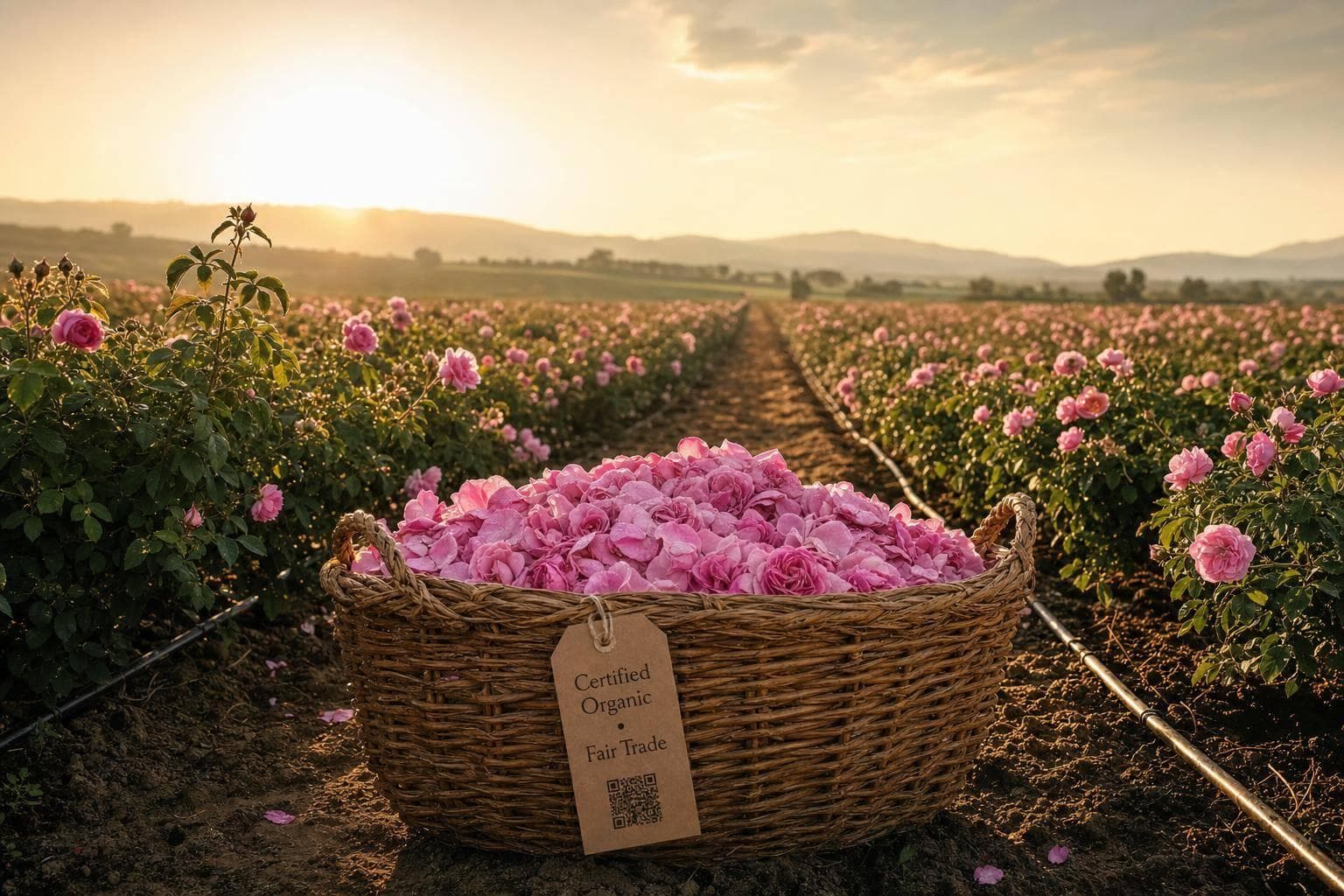
If a perfume brand cannot show where its rose, vanilla, patchouli, or vetiver comes from, I treat its “green” claim with care.
Here’s the short version: in perfumery, farming affects scent quality, supply stability, traceability, and farmer pay. The article shows that I should look past soft claims and check four things instead:
- origin - where the crop was grown, and by whom
- farming method - organic, regenerative, Rainforest Alliance, Fair Trade, or standard farming
- proof - named certification, audits, records, or plot tracking
- farmer support - floor prices, long-term buying, training, and community payments
A few facts stand out:
- Fairtrade’s 2024 living income reference price for green vanilla in Madagascar is about € 10,17 per kg
- Fairtrade research puts a decent living benchmark for vanilla-growing households at roughly € 5.300 per year
- In Sulawesi, one programme trained 1.000 patchouli producers and 320 operators
- Traceable vanilla often depends on plot geolocation and harvest records, which add cost but improve supply-chain visibility
What I take from this is simple: better farming can mean steadier raw materials, less batch drift, and fewer weak sourcing claims. Organic rules focus on inputs. Rainforest Alliance adds land, habitat, and farm rules. Fair Trade focuses more on income and price protection. Industry charters sit above all that, but they do not replace ingredient-level proof.
Quick comparison
| Model | Main focus | What I can usually verify | Main watch-out |
|---|---|---|---|
| Conventional | Yield and cost | Often limited | weak traceability, higher supply risk |
| Organic | No synthetic agrochemicals under set rules | audits, field records, approved inputs | no built-in price floor |
| Regenerative | Soil, water retention, biodiversity | project data, farm practice records | no single universal label |
| Rainforest Alliance | Habitat, land use, climate-smart farming, livelihoods | certification and audit trail | not the same as organic |
| Fair Trade | Farmer income, minimum price, community premium | pricing structure, cooperative model, audits | does not always mean every farm method is the same |
So if I want to judge a perfume brand properly, I ask: Who grew it? How was it farmed? What standard backs the claim? How are growers paid and supported? That gets me much closer to the truth than “natural” ever will.
Core Farming Practices for Perfume Crops
Soil, Water, and Biodiversity Practices That Improve Crop Resilience
Good farming starts with the ground itself. Composting, mulching, cover cropping, low-till cultivation, and intercropping help keep soil productive over time. Compost, mulch, cover crops, low-till methods, contour planting, and vegetative barriers also protect soil structure, reduce erosion, and help the soil hold more water.
Intercropping, hedgerows, and agroforestry can also ease pest pressure, support pollinators, and soften the impact of weather swings. When conditions get less predictable, that kind of farm setup works as practical risk management.
The details change from crop to crop, but the aim stays the same: protect the plant, protect the soil, and protect the aroma.
Crop Examples: Patchouli, Vetiver, Rose, and Vanilla
Patchouli in Sulawesi: Givaudan tested mulching, compost, biochar, and good agronomic practices across nine plots, then trained 1.000 patchouli producers and 320 operators in sustainable cultivation and distillation. DSM-Firmenich supports 300 farmers across three villages through floor-price sourcing, gender-inclusive practices, and training.
Vetiver in Haiti: Vetiver’s deep roots help stabilise slopes, but contour planting and ground cover are still needed to reduce erosion and keep moisture in the soil.
Rose in Grasse: Organic and biodiverse cultivation methods reduce chemical stress on the plants and support pollinators. Organic rose farming in Grasse follows Ecocert standards.
Vanilla in Madagascar: Traceable vanilla supply chains rely on plot geolocation and harvest records to support climate adaptation, farmer livelihoods, and zero-deforestation claims. Geolocation of plots and harvest documentation remain among the largest costs in building this kind of supply chain.
How Better Farming Can Improve Ingredient Quality
These choices don’t stay in the field. They show up in the bottle through steadier yields and a more consistent aroma. Farm practice affects oil yield, aroma stability, and batch consistency. Healthier soil supports steadier root development and more even nutrient access, which can lead to more predictable oil profiles from one season to the next.
Moisture management matters too. When plants face less stress during key growth periods, flower size, biomass, and aromatic compound concentration can all shift in a better direction.
In simple terms, better farming leads to cleaner raw materials, more consistent chemical profiles, and stronger traceability from field to final extract. It also reduces batch variation, which makes formulation easier for perfumers. Farm practice isn’t separate from ingredient quality control. It’s part of it.
Standards and Certifications That Verify Responsible Sourcing
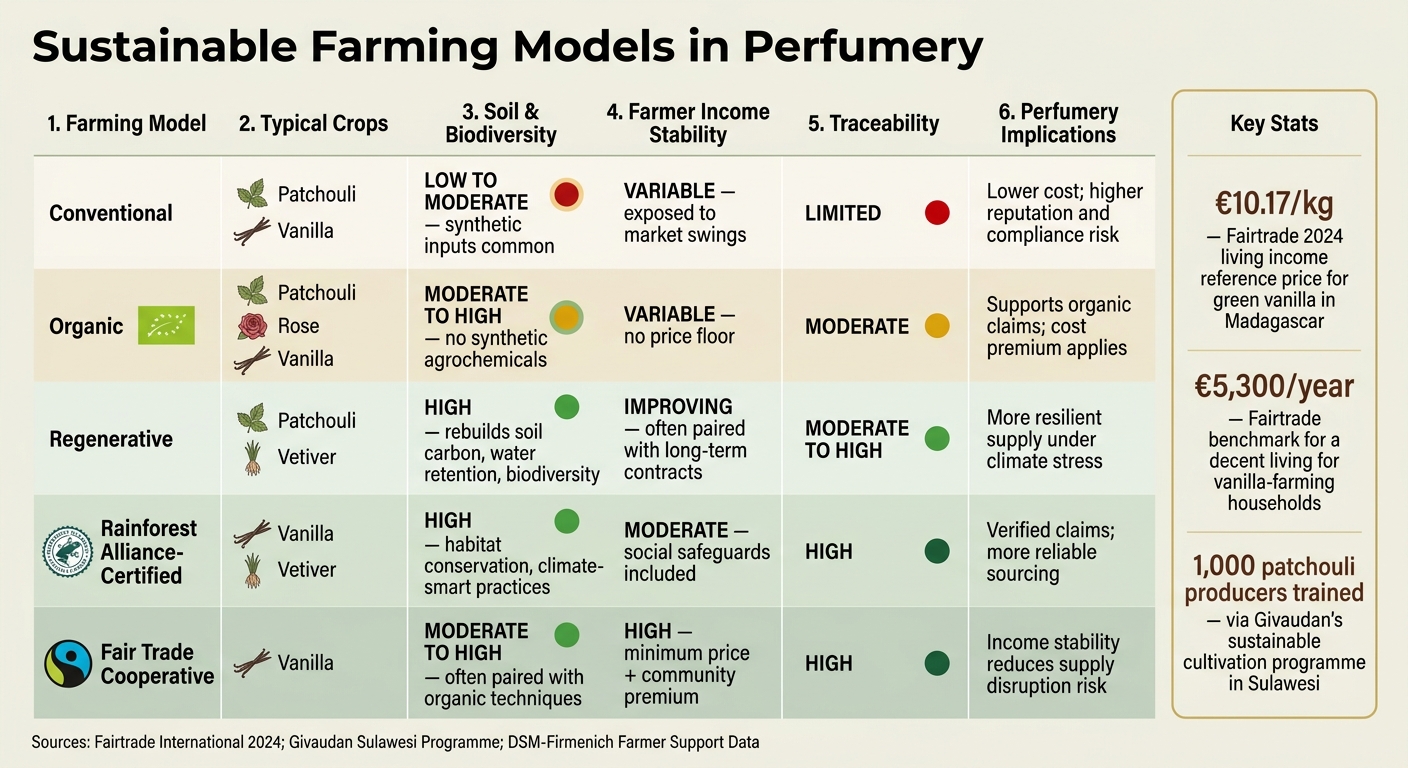
Sustainable Farming Models in Perfumery: A Side-by-Side Comparison
Terms like "eco-friendly", "green", or "sustainably sourced" show up on a lot of fragrance packaging. On their own, they don’t say much. What matters is whether a claim is tied to a named standard, checked through audits, and backed by clear criteria. Certifications do that work: they link brand claims to documented rules, third-party inspections, and repeat checks over time. That’s what helps separate solid proof from polished copy.
The next step is simple: which standards actually show responsible sourcing?
Organic Certification and Ecocert for Aromatic Crops
Ecocert and its COSMOS standard are among the main certification systems for organic and natural cosmetic ingredients in Europe. That includes aromatic crops used in perfumery. COSMOS ORGANIC sets strict thresholds for organic content in certified formulas, and it does not count water or minerals as part of the organic share.
On the ground, this shapes how farmers grow roses, patchouli, and other perfume crops used in certified formulas. They must use approved inputs, keep habitat buffers in place, and maintain field records. For EU shoppers, that gives the label some weight. A certified product can be checked against farm records and audit trails, so the sourcing claim rests on documented practice, not just packaging.
Organic certification checks inputs. Rainforest Alliance goes further by adding land use, biodiversity, and livelihood rules.
Rainforest Alliance, Fair Trade, and Farmer-Focused Sourcing Schemes
Rainforest Alliance certification focuses on biodiversity, climate-smart farming, and farmer livelihoods. Farms in the programme must use practices that prevent deforestation, conserve natural habitats, and protect wildlife.
Fair Trade looks at another part of the picture: economic justice. It sets minimum prices and community premiums to help protect producers from swings in global prices. That matters a lot in vanilla, where prices can move wildly from one season to the next.
Fairtrade has gone a step further for vanilla with Living Income Reference Prices, which aim above a basic floor price. The updated 2024 benchmark for green vanilla in Madagascar is about € 10,17 per kg at farm gate. That figure is based on what a typical household with a viable 1,0 ha farm and a steady yield of about 350 kg of green vanilla would need to earn for a decent living. For context, Fairtrade research puts the cost of a decent standard of living for vanilla farming households in Madagascar at about € 5.300 per year.
For brands buying vanilla or vetiver, Rainforest Alliance- or Fair Trade-certified supply chains give them something concrete to point to. Not vague promises, but audited results.
Beyond farm labels, the fragrance sector also leans on broader industry frameworks.
Industry Frameworks: The IFRA–IOFI Sustainability Charter
The IFRA–IOFI Sustainability Charter, developed by the International Fragrance Association and the International Organization of the Flavor Industry, works at a different level. It does not certify single ingredients. Instead, it sets out a life-cycle framework for the fragrance and flavour sector as a whole.
It is built around five focus areas:
- responsible sourcing
- environmental footprint and climate change
- employee well-being
- product safety and design
- transparency and partnerships
The Charter includes 17 specific commitments, written to be workable for companies of different sizes. It also lines up with the UN Sustainable Development Goals and appears in European Green Deal-related documents as a tool for moving the fragrance sector toward renewable carbon and bio-sourced ingredients.
For readers in Germany and across the EU, the Charter can signal that a brand is operating within a recognised industry framework. In plain terms, it links sourcing choices at farm level with product safety, climate concerns, and transparency. When you assess these claims, look for named certifications, measurable thresholds, and published progress data.
Your Personal Fragrance Expert Awaits
Take our quick scent quiz to discover authentic designer and niche fragrances matched to your taste — explore them as 2ml, 5ml, 8ml & 30ml decants and samples, so you can try each one before committing to a full bottle.
Find Your ScentHow Responsible Farming Shapes Modern Perfumery and Fragrance Discovery
Responsible farming changes perfumery at the source. It affects what ingredients a perfumer can buy, how steady the quality is, and how clearly each material can be traced back to its origin.
From Farm to Formula: Naturals, Traceability, and Performance
When soil is healthier and farms support more biodiversity, raw materials often become more consistent too. That matters in perfumery, where even small shifts in aroma compounds can change how a formula smells from one batch to the next. In patchouli, that includes sesquiterpenes. In vanilla, it includes vanillin. Better farming can lead to richer extracts, steadier performance, and fewer batch-to-batch deviations in the final fragrance.
In Sulawesi, regenerative techniques such as cover crops, reduced tillage, agroforestry, and diversified plantings help improve soil health. They also support a steadier and more secure supply of patchouli for perfumers.
Vanilla shows a similar pattern. In Madagascar, long-term purchase commitments and cooperative sourcing models give perfumers a traceable supply and a more consistent production method.
Traceability also affects formulation choices. If a fragrance house knows exactly where its rose, vanilla, or patchouli comes from, it can select specific lots for a certain olfactory effect. At the same time, synthetic aroma molecules still play a role. A house might use synthetic vanillin to stretch limited volumes of responsibly sourced vanilla, steady the fragrance’s performance, and ease pressure on fragile crops.
Farming Models and Their Impact on Perfumery: A Comparison
These farming models shape three areas that matter most in perfumery: soil health, farmer income, and traceability.
| Farming Model | Typical Crops | Soil & Biodiversity | Farmer Income Stability | Traceability | Perfumery Implications |
|---|---|---|---|---|---|
| Conventional | Patchouli, vanilla | Low to moderate; synthetic inputs common | Variable; exposed to market swings | Limited | Lower cost; higher reputation and compliance risk |
| Organic | Patchouli, rose, vanilla | Moderate to high; no synthetic agrochemicals | Variable; no price floor | Moderate | Supports organic claims; cost premium applies |
| Regenerative | Patchouli, vetiver | High; aims to rebuild soil carbon, water retention, biodiversity | Improving; often paired with long-term contracts | Moderate to high | More resilient supply under climate stress |
| Rainforest Alliance-certified | Vanilla, vetiver | High; habitat conservation and climate-smart practices | Moderate; social safeguards included | High | Verified claims; more reliable sourcing |
| Fair trade cooperative | Vanilla | Moderate to high; often paired with organic techniques | High; minimum price + community premium | High | Income stability reduces supply disruption risk |
How Scento Helps Readers Explore These Ingredients More Intentionally

This becomes easier to understand when you smell it for yourself. Small decants let readers test how naturals show up in finished perfumes without committing to a full bottle. Scento offers small decants, making it simpler to explore the link between sourcing and scent in a more deliberate way.
Conclusion: What to Look for in Responsible Perfumery
After comparing farming methods and verification schemes, the last test is pretty simple: what can the brand actually prove?
Responsible perfumery starts with the soil. The way a crop is grown and harvested shapes ingredient quality, supply reliability, and the brand’s ethical standing.
When you’re judging whether a perfume is made with care, look past broad terms like “natural” or “green.” On their own, those words don’t have a clear legal meaning. The better question is: which standard supports the claim? Look for named certification or documented sourcing transparency, whether that’s organic certification, Ecocert, Rainforest Alliance, Fair Trade, or alignment with the IFRA–IOFI Sustainability Charter. A certification says far more than a vague brand promise. A label helps, but only if it connects to named origins and clear farming methods.
Use these four questions to tell the difference between a specific claim and a fuzzy one:
- Where were the key ingredients grown, and by whom?
- Which farming method was used: organic, regenerative, or conventional?
- Is there third-party certification or named sourcing transparency?
- Does the brand show how it supports farmers beyond the purchase?
Responsible perfumery should answer those questions in plain terms: named origins, verifiable practices, and an honest note on where the supply chain still has gaps.
FAQs
How can I verify a perfume brand’s sourcing claim?
Start by checking third-party certifications like UEBT, COSMOS Organic, NATRUE, or Fair Trade. A logo on the packaging is only the first step, so verify it in the certifier’s official public database.
Then look for sourcing reports, clear traceability from harvest site to bottle, and documents like IFRA Certificates of Conformity or third-party audit summaries. If a brand keeps things vague, ask for direct proof.
Which certification matters most for perfume ingredients?
There’s no single certification that works as the one standard for everyone. Each label points to a different priority.
UEBT is well regarded for biodiversity and human rights. Ecocert, COSMOS ORGANIC, COSMOS NATURAL, and NATRUE back organic and natural claims. IFRA standards and ISO 9235 focus on safety and purity, while FairWild covers responsibly harvested wild plants.
Does sustainable farming change how a perfume smells?
Yes. Farming methods can change how a perfume smells because they affect the quality of natural raw materials.
When growers support soil health and biodiversity, crops often develop in a more steady way. That can lead to richer, more layered aromas in ingredients like rose, jasmine, vetiver, or citrus.
On the flip side, when plants are under stress or the local ecosystem is damaged, ingredient quality can swing from harvest to harvest. And when that happens, the final scent may feel less nuanced, with brands forced into more frequent reformulations.

