If I had to sum it up in one line: in 2026, a perfume that smells like money is quiet, polished, and close to the skin.
I’d look for iris, neroli, aldehydes, vetiver, soft leather, sandalwood, oakmoss, and musk. Those note groups tend to smell more expensive than sugary vanilla, candy-like gourmands, or loud fruity blends. Part of that comes down to raw material cost too: neroli can reach about €3.000 per kg, while high-end iris materials sit near €2.000 per kg.
This guide narrows the field to 8 perfumes that fit that mood:
- Chanel No. 5 – powdery aldehydic polish
- Guerlain L’Heure Bleue – soft powdery floral amber
- Floris White Rose – rose, iris, and aldehydes
- Jean Patou Joy – rich floral with old-school French polish
- Hermès 24 Faubourg – white floral amber with lift
- Penhaligon’s Sartorial – dry fougère with leather and beeswax
- Hermès Terre d’Hermès – citrus, flint, and dry woods
- Prada Infusion d’Iris – clean iris, neroli, and pale woods
A few fast takeaways I’d keep in mind:
- For office wear: Terre d’Hermès and Prada Infusion d’Iris
- For formal evenings: Chanel No. 5, L’Heure Bleue, and Joy
- For a tailored feel: Sartorial
- For floral polish: Floris White Rose and 24 Faubourg
- For testing first: start with 2 ml to 5 ml decants, not full bottles
8 Best Perfumes That Smell Like Money (2026): Old Money Scent Guide
10 Perfumes That Smell Like Old Money
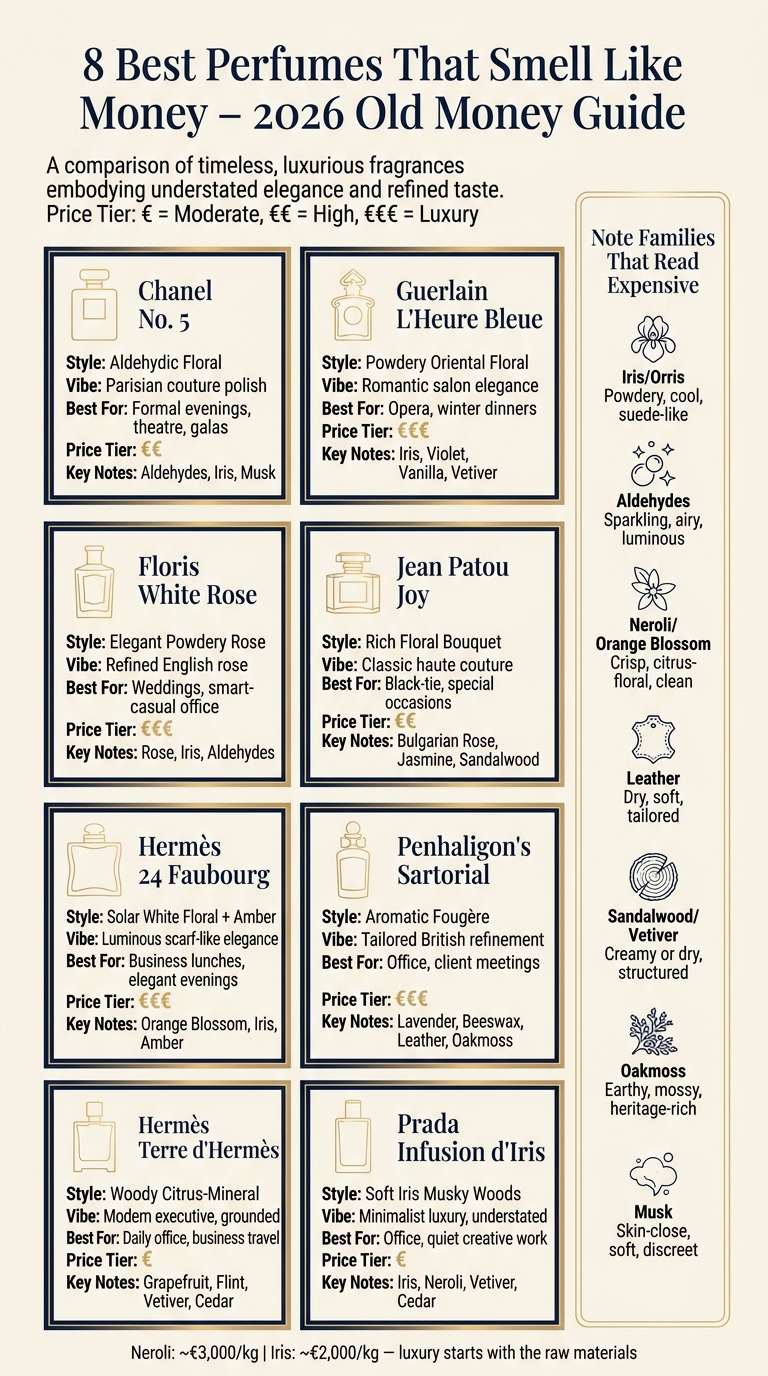
Quick Comparison
| Perfume | Main style | Best use | Wear style | Approx. price level |
|---|---|---|---|---|
| Chanel No. 5 | Aldehydic floral | Theatre, formal events | Powdery, polished | €€ |
| Guerlain L’Heure Bleue | Powdery floral amber | Opera, cool evenings | Soft, romantic | €€€ |
| Floris White Rose | Rose-iris aldehydic floral | Daytime, weddings, office | Light, powdery | €€€ |
| Jean Patou Joy | Rich floral bouquet | Black-tie, special evenings | Plush, close-wearing | €€ |
| Hermès 24 Faubourg | White floral amber | Lunches, dinners, events | Luminous, formal | €€€ |
| Penhaligon’s Sartorial | Aromatic fougère | Office, meetings | Dry, tailored | €€€ |
| Hermès Terre d’Hermès | Woody citrus-mineral | Office, travel, daytime | Dry, stony, clean | € |
| Prada Infusion d’Iris | Iris musky woods | Work, daily wear | Soft, skin-close | € |
If I were choosing fast, I’d do it like this: iris for quiet polish, woods for daily wear, aldehydes for dressy settings, and leather-fougère styles for a sharper, tailored look.
What the Old Money Fragrance Aesthetic Means in 2026
In fragrance, old money is about composition, restraint, and polish. It’s not about paying the highest price or wearing anything loud and logo-heavy. In 2026, a scent that feels affluent doesn’t fill the room. People notice it at close range, then remember it after you’ve gone. That effect usually comes from a small group of note families.
The notes tied to this style have deep roots in European perfumery: iris, neroli, polished woods, aldehydes, soft leather, vetiver, oakmoss, and refined musk. They tend to feel dry, textured, and controlled. You get elegance without syrupy sweetness or too much noise. That sense of restraint is a big part of the appeal, because it makes the scent easy to live with day after day.
Set that against sugary gourmands like caramel, praline, cotton candy, and heavy vanilla, or the juicy fruit accords that showed up in many mainstream launches from the 2000s onward. Those profiles can feel dated or simply too sweet. In work settings, low-sillage perfumes often come across as more discreet and easier to wear. One or two sprays is often enough to last through a full workday and into the evening.
They also suit the whole year. In warmer months, lighter florals do the job. When the weather turns cold, woody scents and iris-led styles feel right at home. The same bottle can move from office to dinner, from a casual afternoon to a formal event, without feeling out of place. Those are the traits to look for in the perfumes below.
The Note Families That Read Expensive
Knowing these materials makes it much easier to spot the right bottle. These are the note families that tend to do that job best.
Iris is probably the most luxury-coded note here. It comes from aged iris root, which takes years to mature and costs a lot to extract. On skin, it smells powdery, cool, and faintly suede-like. Think heirloom face powder or a pair of fine leather gloves. Aldehydes often sit next to iris in classic compositions. They add a sparkling, almost fizzy brightness that lifts the whole scent, a bit like the clean shimmer of a pressed white blouse. Chanel No. 5 made that pairing famous.
Neroli and orange blossom bring a different sort of elegance. They sit in the clean Cologne tradition, where citrus-floral notes feel polished instead of sugary. In a luxury blend, they smell more like freshly laundered linen in a grand hotel than a body spray from the chemist.
Leather, sandalwood, and vetiver shape the structure. Leather here is soft and dry, closer to polished leather than anything harsh. Sandalwood adds creamy, smooth warmth. Vetiver pulls the other way: dry, rooty, and almost architectural, like a pared-back office with wooden furniture. Oakmoss gives depth with an earthy, forest-floor tone that defines the classic chypre style. Modern formulas use less oakmoss, but that dry, mossy feel still comes through clearly on skin.
At the base, musk ties everything together. It stays soft, close to the skin, and discreet, with that freshly laundered cashmere feel that keeps a scent polite in shared spaces.
Use the table below as a quick shopping guide.
| Note family | How it reads | Scenario |
|---|---|---|
| Iris / Orris | Powdery, cool, suede-like | Opera, auction, formal lunch |
| Aldehydes | Sparkling, airy, luminous | Theatre night, formal event |
| Neroli / Orange blossom | Crisp, citrus-floral, clean | Daytime meetings, hotel brunch |
| Leather | Dry, soft, tailored | Boardroom, law office |
| Sandalwood / Vetiver | Creamy or dry, structured | Architect’s studio, client dinner |
| Oakmoss | Earthy, mossy, heritage-rich | Traditional family events, gallery visits |
| Musk | Skin-close, soft, discreet | Shared offices, trains, cafés |
These note families are the code. The fragrances below show how each one wears in practice. When you read note lists on brand pages or German retailer sites, watch for terms like iris, orris, neroli, aldehydes, cuir, vetiver, chypre, or white musk. Those usually point to quiet elegance rather than instant impact.
How to Try Before You Buy in Germany
Aldehydic and powdery fragrances can smell sharp right after the first spray, then turn much heavier on skin after 30 to 60 minutes. That’s why they’re worth testing for several days before you buy anything blind.
Once you know which notes feel expensive to you, the next step is simple: test them the right way before you commit to a full bottle. If you’re in Germany and do most of your shopping online, decants are the easiest route.
Scento offers 2 ml, 5 ml, and 8 ml decants shipped from the EU, which helps you avoid customs delays and extra import VAT. Each decant also includes the original batch code on the label, so you can check it before deciding whether to size up.
Here’s a simple way to think about the sizes:
- 2 ml: about 3 to 5 wears
- 5 ml: about 10 to 15 wears
- 8 ml: about a month of daily wear
The price per ml drops as the size goes up. That gives you enough time to see how each scent changes on your skin, not just how it smells in the first five minutes.
There’s also an optional subscription from €12,90 per month for each 8 ml decant. It’s billed per fragrance, not as one flat monthly fee, and free shipping starts at €75. A smart way to use it is to order an iris, a leather, and a woody scent, then wear them across a few weeks before you decide on a full bottle.
1. Chanel No. 5
Chanel No. 5 is the archetype. It’s the clearest example of old-money polish in perfume form, and that reputation comes from its aldehydic-iris structure.
The 2026 EDT leans on synthetic aldehydes and pairs them with powdery iris, which gives the scent a clean, powdery lift and a steady, orderly character. It doesn’t try to take over a room. Its close-range projection keeps it near the skin, so it feels polished and office-safe, while still leaving enough of a trace to be noticed up close.
That’s why it works so well as a daily office scent. It also fits neatly into a formal lunch or an evening setting where closeness matters more than volume.
Price and value
In 2026, the EDT costs about €163 for 75 ml. The smaller bottle size marks a shift from the old standard, but the scent still gives you the classic No. 5 effect in a lighter, easier-to-wear form.
2. Guerlain L’Heure Bleue
Created in 1912 by Jacques Guerlain, L’Heure Bleue is one of those rare classics that still feels polished, not dated. Where No. 5 comes across as crisp and structured, L’Heure Bleue leans softer, warmer, and more romantic.
Old-money note palette
It opens with anise, bergamot, neroli, and coriander, which gives it a bright start with a slight liquorice twist. Then it settles into heliotrope, violet, iris, and jasmine, over a base of vanilla, benzoin, tonka bean, sandalwood, musk, and vetiver.
That mix of anise, heliotrope, violet, iris, and vanilla gives the scent a soft, powdery richness that smells expensive without trying too hard. Some old-money fragrances lean woody or leathery. L’Heure Bleue goes in a different direction. It sits in the powdery floral–amber space, closer to a Belle Époque powder room than a modern dessert bar.
Quiet luxury projection
The Eau de Parfum lasts about 7–9 hours and stays fairly close to the skin, with moderate sillage. That said, this is not one to spray heavily. Too much, and the heliotrope–vanilla accord can get cloying in a hurry.
Best for cool weather and formal settings
That softness is exactly why it feels intimate rather than grand. It fits moments like theatre nights, gallery openings, formal dinners, and the opera. In work settings, it makes the most sense in conservative, client-facing fields such as law, finance, and academia, where a polished, non-trend-driven signature carries weight.
It makes less sense for casual weekends or warm weather, when a lighter scent usually sits better on the skin.
Value across price tiers
In Germany, L’Heure Bleue sits in the upper designer bracket. It costs more than a mainstream daily fragrance, but far less than many niche options. The Eau de Parfum is richer and lasts longer, while the Eau de Toilette feels lighter and is easier to wear during the day.
For shoppers in Germany, this is a smart bottle to test first if you want vintage elegance without loud projection.
3. Floris White Rose
For the softer, more floral side of aldehydic polish, Floris White Rose is the clearest fit. It was documented in the 19th century and brought back in the early 2000s. That backstory lines up neatly with the old-money mood: inherited, restrained, and quietly formal.
Old-money note palette
It opens with aldehydes, green notes, and a touch of carnation. The effect is clean and lightly sparkling, a bit like crisp linen and well-kept grooming. From there, the heart moves into rose, iris, violet, and jasmine. Iris and violet keep the rose soft and powdery, not loud or syrupy. In the base, amber, musk, and powdery notes stay close to the skin and add a low, gentle warmth. That dry floral structure is what gives it its polished feel.
Quiet luxury projection
Its EDT concentration keeps the sillage moderate and intimate. That matters here. The lighter format stops the florals from turning loud and keeps the whole scent close. It doesn’t fill a room or push for attention. Instead, it leaves a small personal trail, the kind someone notices only when they step near you.
Wearability by occasion
That same restraint makes it strongest in the daytime. Its controlled projection works well in enclosed places such as offices, trains, and restaurants, where heavy sillage can feel a bit inconsiderate. Spring and autumn suit it best, when the green aldehydic opening and powdery base feel balanced in mild weather.
It wears best from day into early evening. Think law firms, museum visits, classical concerts, or quiet dinners. In those settings, discretion and polished presence tend to matter more than volume.
Value across price tiers
Floris sits in the heritage-house price tier: above mainstream designer florals, but often below ultra-luxury niche houses. In Germany, White Rose is sold through specialist perfumeries and online retailers, usually in the mid to upper range for 100 ml.
What you’re paying for is that rose-iris-aldehyde structure, which feels high-end without pushing into top-tier niche pricing. That makes the cost per wear easier to justify if you want one fragrance that can cover work, formal moments, and polished off-duty wear.
Váš osobní odborník na parfémy už čeká
Vyplňte náš rychlý vonný kvíz a objevte autentické designové a nišové parfémy vybrané podle vašeho vkusu – prozkoumejte je jako 2–8ml dekanty a vzorky, abyste si každý mohli vyzkoušet, než se rozhodnete pro celou lahvičku.
Najděte svou vůni4. Jean Patou Joy
If Floris White Rose feels restrained and airy, Joy is the richer, more dressed-up counterpart. Jean Patou Joy sits on the plush end of the old-money floral spectrum: dense, polished, and unmistakably French.
Old-money note palette
What sets Joy apart is its high share of natural materials. The formula centres on Bulgarian rose, jasmine, ylang-ylang, and tuberose, with iris and sandalwood in the base. That heavy dose of rose and jasmine gives it a couture-like richness that smells expensive from the first spray. Vintage formulas add a faint animalic touch - soft, dry, and never gourmand - which gives the base more depth without pushing it into sweetness.
Quiet luxury projection
Its sillage is moderate, with a controlled opening in the first hour. Then it settles into a soft rose-jasmine-sandalwood halo that stays close to the skin. Worn lightly - one or two sprays on pulse points - it signals taste without taking over the room. Vintage versions have more animalic depth, while modern batches feel cleaner and a bit soapier. If that shift matters to you, it’s worth checking which version you’re sampling.
Wearability by occasion
Joy feels most at home on formal evenings - opera, theatre, or client dinners in more conservative industries. It also shines in cooler months, when its warm floral base sits naturally against wool and cashmere.
Value across price tiers
Joy now shows up mostly through collector and resale channels rather than standard retail. In Germany, prices start at about €26,95 for a 30 ml Eau de Toilette and go up to €150,00 for a 30 ml parfum, depending on the concentration and seller. A decant first is the smart move, especially since vintage and modern versions can smell quite different.
Joy suits readers who want floral richness and still want to keep things polished.
5. Hermès 24 Faubourg
If Joy leans like a rich French floral, 24 Faubourg feels brighter and more light-filled. It’s formal, white-floral, and never sugary.
Old-money note palette
Hermès 24 Faubourg is a luminous white-floral amber built around orange blossom, jasmine, ylang-ylang, gardenia, iris, amber, sandalwood, and patchouli. It smells expensive in a quiet way. The florals stay polished, the iris keeps that soft powdery touch, and the amber doesn’t drift into dessert-like sweetness.
Quiet luxury projection
24 Faubourg has strong longevity, with reviewers often noting 8–10 hours on skin. It has presence, but it doesn’t shout. For daytime, 1–2 sprays are usually enough. For evening, 2–3 sprays work better.
Wearability by occasion
This is a formal-leaning fragrance that fits best at client lunches, gallery openings, theatre evenings, and fine-dining occasions. Its white-floral and amber profile tends to sit best in spring and autumn, when mild weather gives the scent room to open up without the amber-vanilla base feeling too dense. In high summer heat, it’s smarter to go lighter on application.
Value across price tiers
In Germany, a 100 ml Eau de Parfum typically retails at around €100–€150, depending on the retailer. That puts it firmly in the premium designer tier: above most mainstream florals, but still easier to reach than many niche houses. Its longevity and layered structure help keep the cost per wear in check, especially if you spray with a light hand. If you want something less floral and more tailored, the next scent moves in a sharper direction.
6. Penhaligon’s Sartorial
After the softer florals above, Sartorial sharpens the mood. Penhaligon’s Sartorial, created by Bertrand Duchaufour in 2010, is an aromatic fougère inspired by a Savile Row workroom. It smells like a perfectly cut suit rather than a loud fragrance choice.
Old-money note palette
The opening feels metallic and airy, with a steamed-cloth accord that gives it a pressed, polished feel. Lavender, oakmoss, and tonka form the classic fougère structure underneath. In the heart, beeswax and a polished leather note add texture, while cyclamen and linden blossom soften the edges. The base dries down into honey, vanilla, woods, and more oakmoss.
That mix keeps Sartorial close to the same polished-material world as the iris and neroli scents mentioned earlier. The lavender, oakmoss, and beeswax do a lot of the work here. The overall effect is dry, tailored, and quietly polished. Think quiet status, not showmanship.
Quiet luxury projection
Longevity sits at around 6–8 hours, and the projection stays close enough to feel discreet rather than room-filling.
Wearability by occasion
This is an easy fit for office wear, business meetings, and arts or social events where you want to look put together without drawing too much attention. It works best in spring and autumn, when mild temperatures let the beeswax, leather, and woods unfold in a smooth way.
Value across price tiers
In Germany, a 100 ml eau de toilette sells for about €165,00, which places it in the upper niche tier. The composition centres on aldehydes, metallic accords, lavender, beeswax, leather, oakmoss, honey, and tonka. A 2–5 ml decant is a smart place to start before buying a full bottle.
| Feature | Detail |
|---|---|
| Fragrance Family | Aromatic Fougère |
| Longevity | 6–8 hours |
| Projection | Moderate to Intimate |
| Best Seasons | Spring, Autumn |
| Best Occasions | Office, Business Meetings, Formal Events |
| Price (100 ml, Germany) | ~€165,00 |
7. Hermès Terre d’Hermès
After Sartorial’s tailored polish, Terre d’Hermès moves the old-money mood in a more elemental direction: stone, citrus, and dry woods.
Created by Jean — Claude Ellena and launched in 2006, Hermès Terre d’Hermès is a woody–citrus–mineral classic with a dry, elegant, understated feel.
Old-money note palette
It opens with bitter orange and grapefruit. The citrus is sharp, but it leans more toward peel than juice, which keeps the effect dry and natural.
In the heart, you get pepper, pelargonium, and the fragrance’s signature flint accord. That stony mineral note gives Terre d’Hermès its rain-washed character. As it dries down, vetiver, cedar, patchouli, and benzoin bring in an earthy, resinous finish that feels polished without turning dense. The overall effect is simple to picture: citrus peel, wet stone, and dry woods.
That flint accord is unusual in mainstream perfumery, and it’s a big part of why this scent stands apart from sweeter, trend-led releases.
Quiet luxury projection
Longevity sits at around 6–10 hours, depending on skin chemistry and concentration, and it holds a 4,7/5 user rating. Projection is moderate at 4,4/5, with 7.621 users describing it that way rather than room-filling.
So while it doesn’t shout, it does leave a polished impression at close range. That makes it a smart fit for settings where subtlety matters.
Wearability by occasion
Terre d’Hermès is, above all, a daytime fragrance. It has 6.772 daytime votes, and 3.694 users place it among their top office picks.
It works best for:
- Office wear
- Client meetings
- Smart-casual daytime use
Autumn and spring are its strongest seasons. In milder weather, the citrus and woods stay in balance and come through cleanly.
Value across price tiers
Terre d’Hermès sits in the upper designer tier. It costs more than many mainstream designer scents, but still less than most niche options.
The Parfum concentration feels warmer and more cedar-led. The EDT is often a bit more affordable and slightly easier to wear across different seasons. If you want to try it without committing to a full bottle, 2 ml or 5 ml decants from about €5,90 are the simplest entry point.
It sits on the cleaner, more mineral side of the old-money spectrum.
| Feature | Detail |
|---|---|
| Fragrance Family | Woody–Citrus–Mineral |
| Longevity | 6–10 hours |
| Projection | Moderate |
| Best Seasons | Autumn, Spring |
| Best Occasions | Office, Daytime, Business Meetings |
| Sample Entry Price | from ~€5,90 (2 ml decant) |
8. Prada Infusion d’Iris
If Terre d’Hermès feels like stone and citrus, Infusion d’Iris leans cleaner and softer. You get iris, neroli, and soft woods, with a polished, almost freshly pressed feel.
Old-money note palette
The opening brings mandarin orange, neroli, and orange blossom. It gives the scent a bright citrus lift, but not a sugary one. At the centre sits iris pallida, which gives the fragrance its cool, powdery, slightly root-like finish.
Galbanum and mastic stop it from feeling dense. Instead, they add a green, cut-stem sharpness that feels current, not old-fashioned. In the base, vetiver, Virginia cedar, benzoin, and a soft touch of incense bring dry warmth. Think clean linen and pale woods - crisp, never sweet.
Quiet luxury projection
This is a close-to-skin scent. Longevity is usually 6–8 hours, with soft to moderate projection, though some wearers report 3–5 hours. That low-volume style is part of the appeal. It wears more like polished skin and fine fabric than a loud perfume.
That’s also where the old-money mood comes from: quiet wear, clean lines, no need to announce itself.
That same restraint makes it easy to wear in a lot of settings.
Wearability by occasion
It works best for daytime, meetings, and quiet evenings around art, dinner, or the theatre. Spring and early autumn suit it best, but it also wears well year-round in Germany’s temperate climate.
Value across price tiers
A 100 ml bottle costs about €180, which puts it in the premium designer tier. For someone who wants an easy daily scent with a refined feel, the cost per wear is strong.
Comparison Table
Before you pick a sample, use this quick map to narrow the field. It gives you a fast read on style, wear, and price point.
The table below compares note style, vibe, occasion, and price tier.
| Perfume | Main Note Style | Overall Vibe | Best Occasion | Approx. Price Tier |
|---|---|---|---|---|
| Chanel No. 5 | Floral aldehyde | Parisian couture polish | Formal evenings, galas, theatre | €€ |
| Guerlain L’Heure Bleue | Powdery oriental floral | Romantic salon elegance | Opera, winter dinners, cultural evenings | €€€ |
| Floris White Rose | Elegant powdery rose | Refined English rose | Garden parties, weddings, smart-casual office | €€€ |
| Jean Patou Joy | Rich floral bouquet | Classic haute couture; glamorous but restrained | Black-tie events, special occasions | €€ |
| Hermès 24 Faubourg | Solar white floral with amber | Luminous scarf-like elegance | Business lunches, city shopping days, elegant evenings | €€€ |
| Penhaligon’s Sartorial | Barbershop fougère with metallic/woody facets | Tailored British refinement | Office, client meetings, professional networking | €€€ |
| Hermès Terre d’Hermès | Woody citrus-mineral | Modern executive; grounded, quietly charismatic | Daily office, business travel, smart-casual weekends | € |
| Prada Infusion d’Iris | Soft iris musky woods | Minimalist luxury; clean, cultured, understated | Office, university, quiet creative work | € |
Think of € as the easiest way in, while €€€ points to the more heritage-led, higher-priced end of the group.
A simple pattern shows up fast:
- Florals tend to feel more formal
- Woods and mineral styles fit daily wear best
- Sartorial is the clearest tailored, masculine pick
Use the table as your shortlist, then match the scent to your style below.
How to Pick the Right Old Money Scent for Your Style
Start with the table, then line the scent up with your dress code and the moment. The four style buckets below make it much easier to sort the eight bottles already on your shortlist.
If your wardrobe leans formal - think evening events, theatre, or galas - aldehydic classics are the clearest fit. Chanel No. 5 sits right at home here. The modern EDT stays closer to the skin, so it’s easier to control for evening wear. Put simply: wear No. 5 with evening restraint, not daytime volume.
For daily office and professional wear, woody-musky and mineral scents tend to work best from 10 °C to 30 °C. Hermès Terre d’Hermès and Prada Infusion d’Iris both suit office and smart-casual settings without taking over shared spaces.
Powdery white florals fit daytime polish, weddings, and smart-casual wear from 10 °C to 25 °C. Floris White Rose, Hermès 24 Faubourg, and Chanel No. 5 all belong in this lane, but each brings a different feel in weight and projection.
Soft leather and iris scents tend to feel most luxe in cool weather. If you want leather-led polish, go with Penhaligon’s Sartorial.
Temperature matters because these scents shift fast in heat and cold. Match the bucket to the way you dress, then test the closest bottle on skin.
| Style Family | Ideal Temp. Range | Best Occasion |
|---|---|---|
| Aldehydic | Below 15 °C | Formal evenings, theatre, galas |
| Powdery White Floral | 10 °C to 25 °C | Daytime, weddings, smart-casual |
| Woody — Musky / Mineral | 10 °C to 30 °C | Office, daily professional wear |
| Leather / Iris | Below 20 °C | Autumn/winter evenings, galas |
That leaves the clearest matches from this article: Chanel No. 5, Floris White Rose, 24 Faubourg, Sartorial, Terre d’Hermès, and Infusion d’Iris.
Conclusion
In 2026, smelling expensive is about restraint, not volume. Every bottle in this list handles that idea in its own way - floral, powdery, leathery, or woody - while staying close to the skin.
Pick the note family that fits your style, then test it on your skin before you buy.
FAQs
What notes make a perfume smell expensive?
For an expensive, old-money feel in 2026, go for restraint, quality, and a skin-like finish instead of loud projection.
A few notes fit that mood especially well:
- Iris: powdery, dry elegance
- Sandalwood and vetiver: calm, refined depth
- Aldehydes: a crisp, polished feel
- Bergamot and neroli: fresh, unsweetened brightness
- Amber and musk: soft warmth close to the skin
Skip heavy gourmands, synthetic sweetness, and spices that take over the room.
How can I test an old money perfume before buying?
Skip paper blotters. Apply the perfume straight to your pulse points instead.
Why? These scents come to life with your body heat. The opening can be pretty, but it’s the dry-down that tells you what the fragrance is actually like on skin.
If you want a clearer read, wear a 2 ml to 8 ml decant over a few days. Try it in different settings and in different weather. Then watch how it shifts across 8 to 10 hours, with extra attention on the base notes.
Which old money perfume suits daily wear best?
For daily office and professional wear in Germany, three scents stand out:
- Tom Ford Grey Vetiver
- Hermès Eau des Merveilles
- Chloé Nomade
Each has a polished profile built around woods, citrus, or earthy notes. The effect is neat, understated, and refined, which makes them a smart fit for meetings, shared workspaces, and day-to-day office wear.
For work, stick to one to three sprays on the chest or the back of the neck. That keeps the scent close to the skin and helps it feel present, not intrusive.