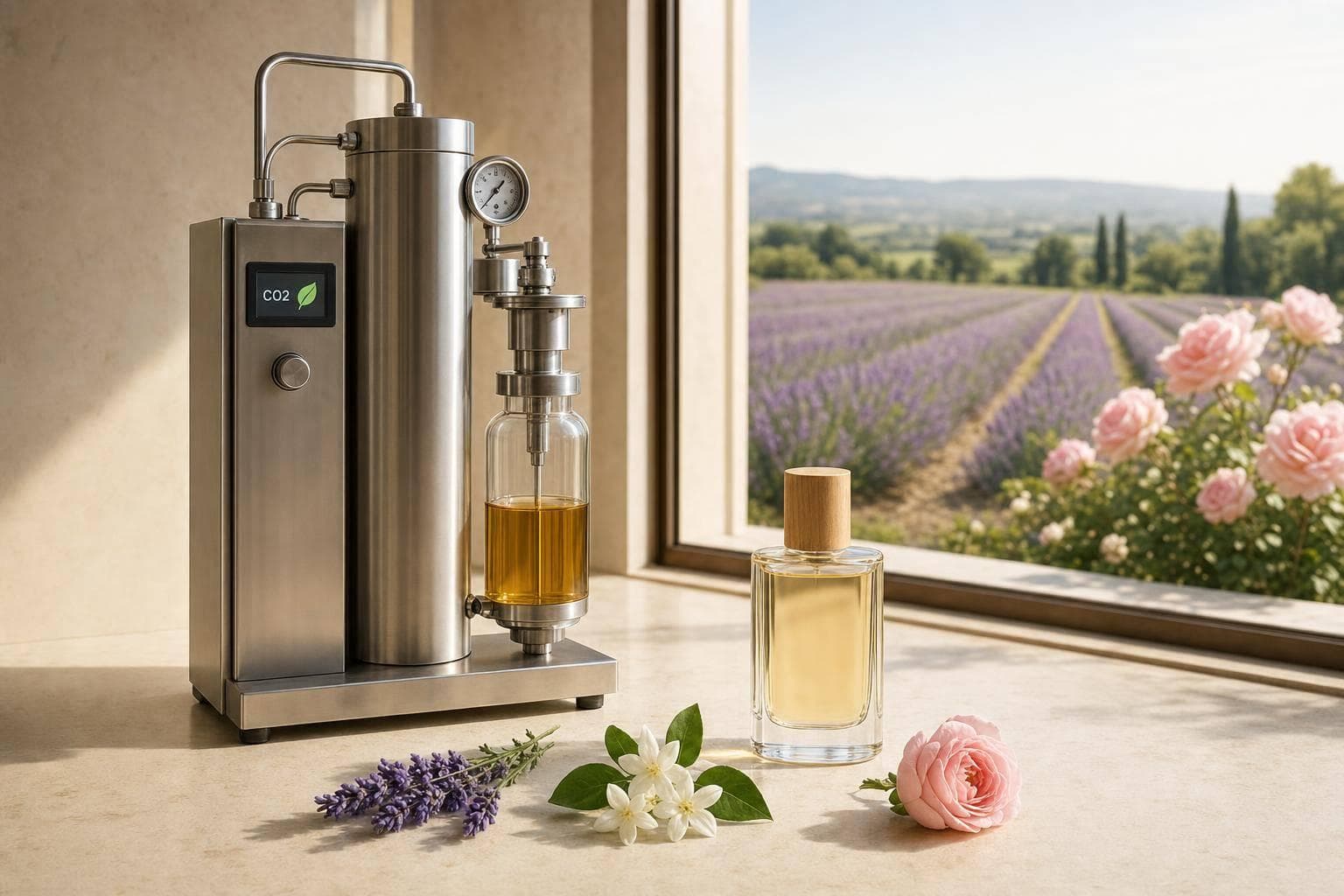
Die französische Dufthandwerkskunst vollzieht einen Wandel: Weg von heißem Wasserdampf und Hexan, hin zu schonenderen, lösungsmittelarmen Verfahren. Im Zeitraum von 2018 bis 2026 lässt sich die bedeutendste Entwicklung in Richtung überkritischem CO₂ beobachten – gestützt durch Daten, die einen geringeren Energiebedarf, reduzierte Emissionen und minimierte Rückstandsrisiken im Vergleich zu klassischen Methoden belegen.
Auf den Punkt gebracht, sind dies die entscheidenden Erkenntnisse:
- Die Wasserdampfdestillation bleibt bedeutsam, erfordert jedoch Temperaturen nahe 100 °C und einen höheren Energieeinsatz.
- Die Hexan-Extraktion liefert weiterhin opulente Blütenextrakte, birgt jedoch Herausforderungen bezüglich des Lösungsmittel-Handlings, VOC-Emissionen und möglicher Rückstände.
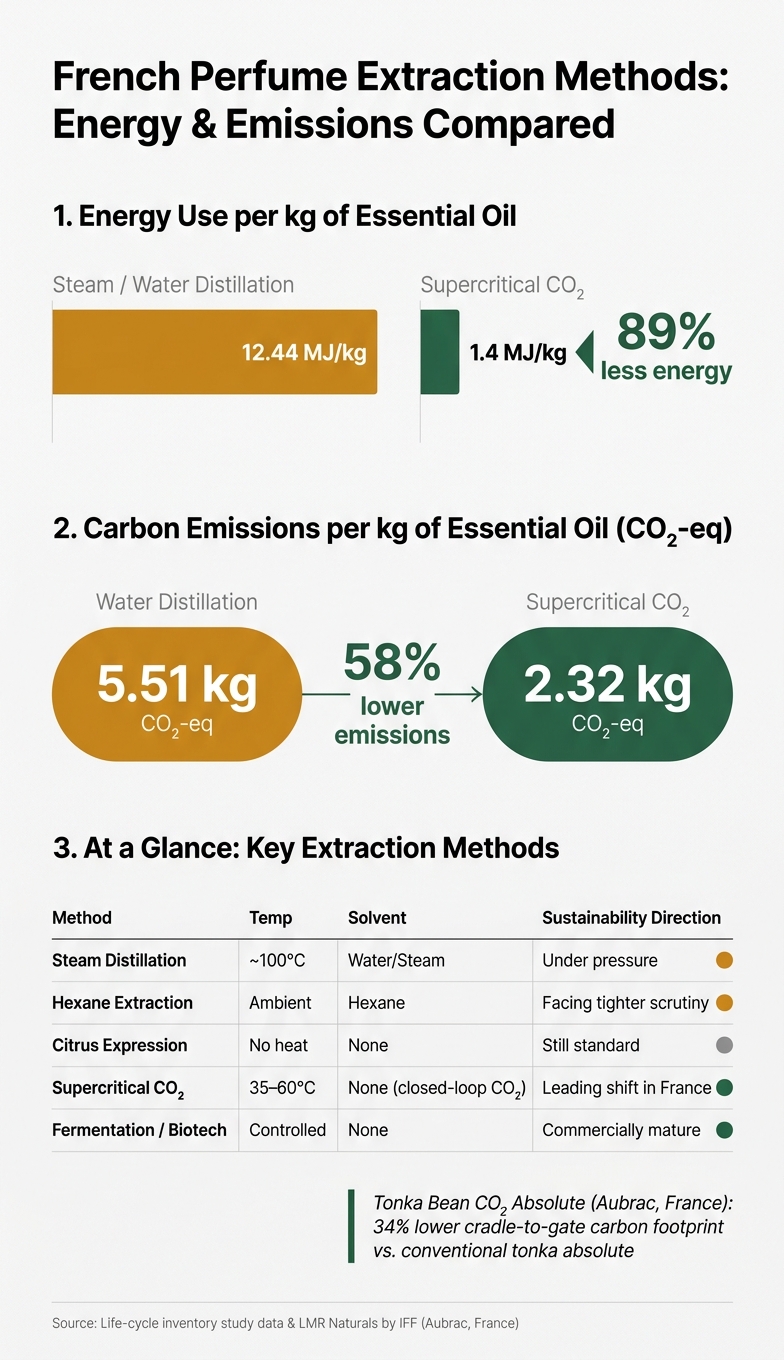
- Die CO₂-Extraktion arbeitet bei schonenden 35–60 °C und verbrauchte in einer referenzierten Studie 1,4 MJ pro Kilogramm Öl – verglichen mit 12,44 MJ bei der Wasserdestillation.
- Dieselbe Studie verzeichnete 2,32 kg CO₂-Äq. pro Kilogramm für überkritisches CO₂ gegenüber 5,51 kg CO₂-Äq. bei der Wasserdestillation.
- In Frankreich erklärt LMR Naturals by IFF, dass sein Tonka Bean CO₂ Absolute den Cradle-to-Gate-Fußabdruck im Vergleich zu einem herkömmlichen Tonka-Absolue um 34 % reduziert.
- Weitere zukunftsweisende Entwicklungen in Frankreich umfassen die NaDES-Fraktionierung, die Mikrowellen- und Ultraschallextraktion, Fermentation sowie Upcycling-Rohstoffe.
- Für Duftkenner in Deutschland und ganz Europa gilt ein klares Kriterium: benanntes Verfahren, ausgewiesene Herkunft, messbare Wirkung.
Das wichtigste Fazit lautet: Grüne Begrifflichkeiten allein genügen nicht. Wer Nachhaltigkeitsversprechen beurteilen möchte, sollte darauf achten, wie der Rohstoff gewonnen wurde, wo er verarbeitet wurde und welche Daten den Anspruch stützen.
Quick comparison
| Verfahren | Typische Bedingungen | Hauptherausforderung | Größter Vorzug | Aktuelle Entwicklung |
|---|---|---|---|---|
| Wasserdampfdestillation | Rund 100 °C; oft über 1 Stunde | Hoher Energiebedarf und thermische Belastung | Etabliertes Verfahren für Hölzer und Lavendel | Weiterhin im Einsatz, jedoch zunehmend hinterfragt |
| Hexan-Extraktion | Lösungsmittel-Extraktion mit anschließender Verdampfung | Lösungsmittel-Handling, VOC-Emissionen, Rückstandsrisiko | Sehr authentisches, naturgetreues Blütenprofil | Unterliegt strengeren Kontrollen |
| Kaltpressung (Zitrusfrüchte) | Mechanische Pressung ohne Hitzezufuhr | Schalenabfälle und Energieaufwand | Bewahrt lebendige, strahlende Zitrusnoten | Weiterhin der Standard für Zitrusöle |
| Überkritisches CO₂ | Ab ca. 31,0 °C und 73 bar; im Einsatz meist 35–60 °C | Höhere Anlagenkosten und Hochdrucksysteme | Schonende Temperaturen, keine Hexan-Rückstände, geschlossener CO₂-Kreislauf | Wichtigste Innovation in Frankreich |
| NaDES / Grüne Fraktionierung | Schwerflüchtige Lösungsmittelgemische | Skalierung und Lösungsmittelrückgewinnung | Selektive Extraktion mit reduziertem Einsatz flüchtiger Lösungsmittel | Erste kommerzielle Anwendungen |
| Mikrowelle / Ultraschall | Kürzere Extraktionszeiten und geringere Hitzebelastung | Grenzen bei Ausrüstung und industrieller Skalierung | Geringerer Lösungsmittelverbrauch, verkürzte Prozessdauer | Von der Pilotphase zur ersten industriellen Nutzung |
| Fermentation | Biobasierte Herstellung | Investitionsaufwand und präzise Prozesssteuerung | Konsistente Duftmoleküle von hoher Reinheit | Bereits kommerziell etabliert |
| Upcycling-Rohstoffe | Rohstoffe aus Neben- und Abfallströmen | Schwankungen im Ausgangsmaterial | Verwandelt Nebenprodukte in erlesene Parfüminhaltsstoffe | Wachsender Einsatz |
Die Quintessenz ist eindeutig: Die französische Parfümerie bricht nicht über Nacht mit bewährten Methoden, doch die CO₂-Extraktion führt den Wandel an – und anspruchsvolle Käufer sollten fundierten Daten mehr vertrauen als bloßen Werbeversprechen.
Klassische Extraktionsmethoden und die Gründe des Umdenkens
Die französische Parfümerie stützt sich seit jeher auf drei traditionelle Verfahren: Wasserdampfdestillation, Lösungsmittel-Extraktion und die Kaltpressung von Zitrusfrüchten. Sie sind bewährt und haben die Welt der Düfte über Jahrzehnte hinweg geprägt. Doch jede dieser Methoden stößt heute an ihre Grenzen – sei es durch hohen Energieverbrauch, regulatorische Vorgaben für Lösungsmittel oder Abfallmengen.
Bei der Wasserdampfdestillation durchströmt heißer Wasserdampf das Pflanzenmaterial; das Kondensat wird anschließend gekühlt und in Öl sowie Hydrolat getrennt. Für Lavendel und Hölzer ist dieses Verfahren ideal. Die Herausforderung liegt in der Hitze: Temperaturen um 100 °C über oft mehr als eine Stunde hinweg bedeuten einen erheblichen Energieaufwand und können zarte Duftfacetten verändern. Aus diesem Grund wendet sich das Interesse zunehmend kühleren Extraktionswegen zu.
Die Extraktion mit flüchtigen Lösungsmitteln nutzt Hexan, um zarten Blüten wie Jasmin und Rose ihre kostbaren Duftstoffe zu entlocken. Zunächst entsteht das Concrète, aus dem nach einer Alkoholwäsche das reine Absolue gewonnen wird. Parfümeure schätzen Absolues bis heute, da sie besonders reichhaltig duften und der lebenden Blüte ungemein nahekommen. Allerdings steht dieses Verfahren zunehmend unter Druck: Der Umgang mit Hexan, VOC-Emissionen und das Risiko von Rückständen lassen sich – insbesondere vor dem Hintergrund europäischer Umwelt- und Sicherheitsstandards – kaum noch rechtfertigen.
Die Kaltpressung bleibt der unangefochtene Standard für Bergamotte, Zitrone und Orange. Die Schalen werden ohne Hitzeeinwirkung mechanisch gepresst, wodurch die spritzigen, leuchtenden Kopfnoten vollkommen unverfälscht erhalten bleiben.
Klassische Verfahren: Stärken und Grenzen im Überblick
Ein direkter Vergleich verdeutlicht die jeweiligen Besonderheiten:
| Verfahren | Typische Bedingungen | Lösungsmittel | Ökologische Herausforderung | Duftprofil | Industrielle Reife |
|---|---|---|---|---|---|
| Wasserdampfdestillation | Dampf/Wasser bei ca. 100 °C; oft >1 Stunde | Ausschließlich Wasser/Dampf | Hoher Energie- und Wasserbedarf; Hitze kann fragile Moleküle verändern | Klares, klassisches Profil ätherischer Öle; optimal für robuste Rohstoffe | Vollkommen ausgereift; industrielle Kernmethode |
| Extraktion mit flüchtigen Lösungsmitteln | Mazeration mit Lösungsmittel, anschließende Evaporation und Alkoholwäsche | Hexan | Umgang mit brennbaren/reproduktionstoxischen Lösungsmitteln; VOC-Emissionen; Rückstandsrisiko | Opulent, tiefgründig, blütennah; ideal für empfindliche Floralia | Industriell vollkommen ausgereift |
| Kaltpressung (Zitrusfrüchte) | Mechanisches Pressen der Schalen; ohne Hitze | Keines | Geringere chemische Belastung, jedoch mechanischer Energieaufwand und Schalenabfälle | Strahlender, frischer Kopfnoten-Charakter bleibt bewahrt | Vollkommen etablierter Standard für Zitrusnoten |
Die Abwägung liegt auf der Hand: Diese Methoden sind zuverlässig, tief in der Duftkultur verwurzelt und fester Bestandteil der Parfumherstellung. Gleichzeitig machen strenge Regulierungen, steigende Energiekosten und Sicherheitsauflagen für Lösungsmittel ein unverändertes Festhalten an den alten Strukturen zunehmend schwierig. Dies veranlasst französische Dufthersteller, vermehrt auf die überkritische CO₂-Extraktion und andere ressourcenschonende Alternativen zu setzen.
Ihr persönlicher Duftexperte erwartet Sie
Machen Sie unser kurzes Duftquiz und entdecken Sie authentische Designer- und Nischenparfums, die zu Ihrem Geschmack passen – als 2, 5, 8 & 30 ml Dekants und Proben, damit Sie jeden Duft testen können, bevor Sie sich für einen ganzen Flakon entscheiden.
Finden Sie Ihren DuftCO2-Extraktion: Der zentrale Wandel in der französischen Rohstoffgewinnung
French Perfume Extraction Methods: Energy, Emissions & Sustainability Compared
Als Antwort auf die Limitationen von Wasserdampf und Hexan setzt die französische Haute Parfumerie auf überkritisches CO₂. Vereinfacht ausgedrückt ersetzt diese Technologie energieintensive Lösungsmittelwäschen durch eine druckgesteuerte Fluidextraktion. Kohlendioxid erreicht den überkritischen Zustand oberhalb von etwa 31,0 °C und 73 bar – ein Zustand, in dem es die Eigenschaften von Gas und Flüssigkeit vereint: gasähnliche Diffusionsfähigkeit gepaart mit flüssigkeitsähnlicher Lösekraft.
Das Prinzip ist elegant: Das Pflanzenmaterial wird in einen Hochdruckbehälter gegeben. Das überkritische CO₂ löst die wertvollen Duftkomponenten heraus. Sobald der Druck gesenkt wird, gibt das gasförmig werdende CO₂ den reinen Extrakt frei und wird in einem geschlossenen Kreislauf wiederaufbereitet. Auf diese Weise entfällt eine thermische Lösungsmittelabtrennung vollständig – und es bleiben keinerlei Hexan-Rückstände zurück.
Olfaktorische und ökologische Vorzüge von überkritischem CO2
Der entscheidende Vorteil für die Duftqualität liegt in den niedrigen Temperaturen. Die Extraktion mit überkritischen Fluiden (SFE) erfolgt in der Parfümerie typischerweise bei 35–60 °C und erreicht nur für bestimmte Botanicals gelegentlich rund 80 °C. Dies liegt weit unter den über 100 °C einer Wasserdampfdestillation. Die geringere thermische Belastung schont die empfindlichen Essenzen; frische Kopfnoten und filigrane Blütenakkorde bleiben in ihrer ursprünglichen Reinheit erhalten.
Auch die ökologische Bilanz spricht eine deutliche Sprache: Eine Lebenszyklusanalyse ergab, dass die überkritische CO₂-Extraktion etwa 1,4 MJ und 2,32 kg CO₂-Äq. pro Kilogramm ätherischem Öl beansprucht – im Vergleich zu 12,44 MJ und 5,51 kg CO₂-Äq. bei der Wasserdestillation. Da CO₂ unbrennbar und ungiftig ist, minimieren geschlossene Kreislaufsysteme zudem lösungsmittelbedingte Abfälle und vereinfachen die Arbeitssicherheit erheblich.
Führende französische Manufakturen nutzen diese Vorzüge längst im industriellen Maßstab.
Französische Pionierprojekte und aktuelle Praxiseinblicke
Ein herausragendes Beispiel liefert LMR Naturals by IFF mit seinem Extraktionszentrum im südfranzösischen Aubrac. LMR gilt als Vorreiter bei der Gewinnung natürlicher Duftstoffe mittels überkritischem CO₂ und setzt dort erneuerbares und recyceltes CO₂ bei niedrigen Temperaturen ein, um erlesenste Ingredienzen für die Feinparfümerie zu kreieren.
Ihr Tonka Bean CO₂ Absolute veranschaulicht diesen Fortschritt eindrucksvoll. Gewonnen in Aubrac aus frisch geernteten Tonkabohnen, bewahrt es die warme Cumarin-Süße, mandelartige Nuancen und die typischen Heu- und Würznoten des Rohstoffs in vollendeter Klarheit. LMR verzeichnet dabei eine Reduktion des Cradle-to-Gate-CO₂-Fußabdrucks um 34 % im Vergleich zu einem herkömmlichen Tonka-Absolue – ermöglicht durch reduzierten Energieverbrauch, den Verzicht auf petrochemische Lösungsmittel und das interne CO₂-Recycling.
| Aspekt | Konventionelles Tonka-Absolue | Tonka Bean CO₂ Absolute (LMR/IFF Aubrac) |
|---|---|---|
| Lösungsmitteltyp | Petrochemisches Lösungsmittel, meist Hexan | Überkritisches CO₂ (erneuerbar/recycelt) |
| Lösungsmittelrückstände | Mögliche Spurenrückstände im Endextrakt | Keine; CO₂ verflüchtigt sich gasförmig und hinterlässt keine Rückstände |
| Temperaturprofil | Erhöhte Temperaturen bei der Lösungsmittelentfernung | 35–60 °C; minimale thermische Belastung für flüchtige Noten |
| Nachhaltigkeitsgewinn | Höherer Energiebedarf und lösungsmittelbedingter Fußabdruck | Rund 34 % geringere Cradle-to-Gate-Umweltauswirkungen |
| Duftprofil | Opulent, kann jedoch leicht gekochte Facetten aufweisen | Näher an der frischen Bohne; reineres Gourmand-Profil mit perfekt erhaltenen Mandel-, Heu- und Würzfacetten |
Über CO₂ hinaus forscht die französische Duftindustrie intensiv an grüner Fraktionierung, innovativen Lösungsmitteln und Upcycling-Rohstoffen.
Jenseits von CO₂: Grüne Fraktionierung, neue Lösungsmittel und Upcycling
Die Transformation beschränkt sich nicht allein auf CO₂. Französische Forschungs- und Entwicklungsteams erschließen parallel mehrere Wege: umweltverträgliche Lösungsmittel, zeitsparende Extraktionsverfahren, Biotechnologie und upgecycelte Rohstoffe. Jeder dieser Ansätze löst spezifische Hürden – von der Wahl des Solvens über Hitzeexposition bis hin zu Ausbeute und Rückstandsvermeidung.
NaDES und grüne Fraktionierung in der französischen Forschung
NaDES (Natural Deep Eutectic Solvents) sind tiefschmelzende Lösungsmittelgemische aus pflanzlichen Verbindungen wie organischen Säuren, Zuckern, Aminosäuren oder Cholinderivaten. Sie weisen eine äußerst geringe Flüchtigkeit auf, basieren auf nachwachsenden Quellen und sind im Handling wesentlich sicherer als Hexan. Für Parfümeure eröffnen sie die Möglichkeit, spezifische Duftfraktionen präzise zu isolieren und unerwünschte Nebengerüche gezielt zu eliminieren.
Ein führendes Beispiel in Frankreich ist das Green Fractionation Centre of Excellence von Givaudan in Avignon. Hier nutzen Wissenschaftler NaDES-basierte Technologien, darunter das proprietäre Verfahren Eutectys™, um botanische Aktivstoffe wie Hydranellys™ und Eliorelys™ zu extrahieren. Die hervorragende biologische Abbaubarkeit minimiert zudem Umweltrisiken und aquatische Toxizität.
Mikrowelle, Ultraschall, Biotechnologie und Upcycling
Die Optimierung von Lösungsmitteln ist nur ein Aspekt. Französische Labore arbeiten ebenso intensiv an Verfahren, die den Extraktionsprozess beschleunigen oder traditionelle Naturstoffe nachhaltig neu interpretieren.
Die mikrowellen- und ultraschallgestützte Extraktion senkt sowohl den Zeitaufwand als auch den Lösungsmittelbedarf drastisch. Bei Studien zur Gewinnung von Lavandinöl konnte die Extraktionszeit von 220 auf 30 Minuten verkürzt werden – bei gleichbleibend exquisitem Duftprofil und vergleichbarem Ertrag. Französische Anlagenbauer bieten inzwischen kombinierte Mikrowellen-Ultraschall-Systeme für die Kosmetik- und Duftstoffindustrie an. Der Gewinn: höhere Ausbeute, maximaler Erhalt hitzeempfindlicher Nuancen und minimaler Lösungsmittelverbrauch.
Auch die weiße Biotechnologie ist aus der europäischen Duftstoffherstellung nicht mehr wegzudenken. Givaudan gewinnt das renommierte Duftmolekül Ambrofix™ mittels Fermentation aus nachhaltig angebautem Zuckerrohr; es ist biologisch leicht abbaubar und bietet das geschätzte, facettenreiche Ambra-Profil. Das Prinzip des Upcyclings gewinnt ebenfalls rasant an Bedeutung: TechnicoFlor veredelt Weintrub, Eichenholzspäne, Kakaoschoten, Clementinenschalen und bereits extrahierte Rosenblätter zu edlen Essenzen. La Bouche Rouge entwickelte eine Zedernholzessenz aus Sägespänen sowie ein petrochemiefreies Damaszener-Rosen-Destillat in Grasse.
Die folgende Übersicht veranschaulicht, wie sich diese modernen Ansätze im Vergleich zu klassischen Verfahren in der Praxis schlagen:
| Technologie | Nachhaltigkeitsvorteil | Relevanz für die Parfümerie | Marktreife | Wichtigste Limitation |
|---|---|---|---|---|
| NaDES / Grüne Fraktionierung | Reduziert die Abhängigkeit von flüchtigen organischen Lösungsmitteln; biobasiert und potenziell biologisch abbaubar. | Ideal für die selektive Extraktion pflanzlicher Wirk- und aromatischer Duftfraktionen. | Aufstrebend; in französischer F&D bereits kommerziell genutzt. | Skalierung, Lösungsmittelrückgewinnung und Prozessoptimierung erfordern Feinarbeit. |
| Mikrowellengestützte Extraktion | Verkürzt Extraktionsdauer und Energiebedarf signifikant; senkt den Lösungsmittelverbrauch. | Hervorragend geeignet für ätherische Öle und flüchtige Duftkomponenten. | Pilot- bis frühe Industriephase. | Herausforderungen beim Scale-up und hohe Anlageninvestitionen. |
| Ultraschallgestützte Extraktion | Schonende Temperaturen und geringerer Lösungsmitteleinsatz; verbesserter Stoffaustausch. | Wertvoll für fragile Duftmoleküle; häufig mit Mikrowellensystemen kombiniert. | Pilot-/Versuchsstadium in der Parfümerie. | Komplexität industrieller Reaktoren und anspruchsvolle Prozesssteuerung. |
| Biotechnologie / Fermentation | Nutzt erneuerbaren Kohlenstoff und optimiert die Ressourceneffizienz. | Liefert hochreine, olfaktorisch konsistente Duftbausteine mit exzellenter Ökobilanz. | Kommerziell etabliert. | Erfordert erhebliche Investitionen, biotechnologische Expertise und laufende Prozesskontrolle. |
| Upcycling-Rohstoffe | Verwandelt Neben- und Restströme in kostbare Duftessenzen. | Fördert zirkuläre Duftkompositionen und authentische Nachhaltigkeitsgeschichten. | Kommerziell erfolgreich im Einsatz. | Schwankungen in Qualität und Verfügbarkeit des Ausgangsmaterials. |
Für Duftliebhaber ist ein Aspekt wesentlich: Ein Nachhaltigkeitsversprechen kann sich auf das Verfahren, den Rohstoff oder die Ökobilanz beziehen. Es empfiehlt sich daher, Werbeaussagen stets anhand transparenter Prozesse und messbarer Werte zu hinterfragen.
Was dies für Duftliebhaber in Europa bedeutet
Olfaktorische Exzellenz und Umweltversprechen treten im Marketing heute meist im Doppelpack auf. Für Duftliebhaber in Deutschland und Europa stellt sich jedoch eine zentrale Frage: Kann die Marke ihre Behauptungen auch transparent belegen?
Nachhaltigkeitsversprechen richtig lesen und fundierte Angaben erkennen
Während sich die Parfümerie von übermäßiger Hitze und petrochemischen Lösungsmitteln löst, müssen anspruchsvolle Kunden in der Lage sein, die Aussagen auf Flakons und Produktseiten kritisch einzuordnen. Laut Marktforscher Mintel trugen im Jahr 2023 bereits 41 % aller Duftneuheiten ein ethisches oder ökologisches Label – gegenüber 18 % im Jahr 2019. Eine beachtliche Zunahme, die jedoch nicht automatisch bedeutet, dass auch die Qualität der Nachweise im selben Maße gestiegen ist.
Eine Aussage gewinnt an Glaubwürdigkeit, wenn sie das Verfahren, die Produktionsstätte und den Ursprung des Rohstoffs präzise benennt. Modewörter wie natural, clean oder eco-friendly klingen verlockend, besitzen für sich allein jedoch kaum Aussagekraft. Mit den strengeren EU-Vorgaben gegen Greenwashing wird sich die Kluft zwischen fundierten Belegen und reinem Marketingvokabular künftig noch deutlicher abzeichnen.
Die überzeugendsten Nachweise sind sachlich, präzise und quantifizierbar. Sie erklären exakt, welche Methode gewählt wurde und welche messbaren Vorteile daraus resultieren. Ein Paradebeispiel hierfür ist LMR Naturals von IFF: Ihr Tonka Bean CO₂ Absolute aus Aumont-Aubrac wird mit erneuerbarem, recyceltem CO₂ extrahiert und überzeugt mit einem nachgewiesen um 34 % reduzierten Cradle-to-Gate-CO₂-Fußabdruck.
Als Orientierungshilfe dient ein einfacher Dreiklang:
- Welches Extraktionsverfahren wurde konkret eingesetzt?
- Wo und aus welchem Ausgangsmaterial wurde der Stoff gewonnen?
- Gibt es einen messbaren, verifizierten ökologischen Vergleichswert?
Kann eine Marke diese Punkte nicht schlüssig beantworten, bleibt das Versprechen meist nur wohlklingendes Marketing.
Fazit: Die wichtigsten Erkenntnisse aus Forschung und Duftpraxis
Die französische Parfümerie verabschiedet sich schrittweise von hitzeintensiven und lösungsmittelbelasteten Methoden. Die überkritische CO₂-Extraktion markiert dabei den derzeit ausgereiftesten Schritt, während grüne Fraktionierung, Biotechnologie und Upcycling das Spektrum moderner Haute Parfumerie auf faszinierende Weise erweitern.
Für Duftkenner in Deutschland und ganz Europa zählt am Ende nicht das Etikett, sondern die Substanz dahinter. Der Prüfstein bleibt unverändert: benanntes Verfahren, ausgewiesene Herkunft, messbare Wirkung. Nur so wird aus einem Werbeversprechen ein echter olfaktorischer und ökologischer Mehrwert.
Häufig gestellte Fragen (FAQs)
Warum gilt die CO₂-Extraktion als besonders nachhaltig?
Die CO₂-Extraktion gilt als besonders umweltschonend, da sie vollständig ohne petrochemische Lösungsmittel auskommt. Überkritisches CO₂ fungiert während der Extraktion als hochwirksames Lösungsmittel; sobald der Druck abfällt, verflüchtigt es sich rückstandslos in die Gasphase.
Zudem arbeitet das Verfahren bei schonenden Temperaturen von meist 35–60 °C. Dies schützt empfindliche Duftmoleküle vor thermischer Zersetzung und verringert Verluste. Da das Kohlendioxid in modernen Anlagen in geschlossenen Kreisläufen aufgefangen und wiederverwendet wird, weist das Verfahren eine herausragende Ressourceneffizienz auf.
Verändert die CO₂-Extraktion das Duftprofil eines Rohstoffs?
Ja, die CO₂-Extraktion hat einen spürbaren Einfluss auf den Duftcharakter eines Rohstoffs.
Der Grund: Da sie bei deutlich niedrigeren Temperaturen als die Wasserdampfdestillation arbeitet, bleibt das natürliche olfaktorische Spektrum der Pflanze intakter erhalten. Zudem kann überkritisches CO₂ ein breiteres Spektrum an Duftstoffen aus dem Rohstoff lösen.
Parfümeure schätzen CO₂-Extrakte daher, weil sie dem Duft der lebenden Pflanze erstaunlich nahekommen. Sie bieten oft mehr Tiefe, Lebendigkeit und filigrane Nuancen als herkömmliche Destillate – ganz ohne lösungsmittelbedingte Störnoten.
Wie kann ich die Nachhaltigkeitsaussagen eines Parfums überprüfen?
Achten Sie auf anerkannte, unabhängige Zertifizierungen wie UEBT, Fair Trade, COSMOS Organic oder NATRUE. Die Gültigkeit lässt sich in den öffentlichen Datenbanken der jeweiligen Organisationen verifizieren. Ein Siegel auf der Verpackung ist ein erster Schritt; ein aktiver Eintrag in der offiziellen Datenbank bietet echte Sicherheit.
Zudem lohnt ein genauer Blick auf die Transparenz der Marke: Werden detaillierte Lieferkettenberichte, vollständige Inhaltsstoffangaben und verbindliche Beschaffungsrichtlinien offengelegt? Bleiben die Angaben vage, fordern Sie weiterführende Informationen an. Vertrauenswürdige Belege sind beispielsweise unabhängige Audit-Zusammenfassungen oder ein offizielles IFRA-Konformitätszertifikat.

