Las marcas de perfumes de lujo están replanteando sus envases para equilibrar la conciencia ecológica con el atractivo de la alta gama. El tradicional vidrio pesado y los diseños intrincados están siendo reemplazados por frascos rellenables, vidrio ligero, soluciones monomaterial y materiales de origen vegetal. Estos cambios buscan reducir los residuos y el impacto ambiental, sin renunciar a la sensación premium que los clientes esperan.
Los enfoques clave incluyen:
- Frascos rellenables: Reducen los residuos mediante el uso de recipientes permanentes y materiales de recarga más ligeros.
- Vidrio ligero: Reduce el uso de materiales y las emisiones del transporte, preservando al mismo tiempo la calidad del diseño.
- Embalaje monomaterial: Simplifica el reciclaje al evitar diseños complejos compuestos por múltiples materiales.
- Materiales de origen vegetal: Opciones biodegradables como el micelio y los plásticos de base biológica ofrecen alternativas más sostenibles.
Marcas como Prada, Chloé y Givenchy están liderando el camino, demostrando cómo la sostenibilidad puede armonizar con el lujo sin comprometer la calidad ni la estética.
Capítulo 9: Lujo sostenible en STORIES Parfums | La historia detrás del diseño
1. Refillable Bottle Systems
Los frascos rellenables están transformando las reglas del juego al reducir los residuos y convertir lo que antes era desechable en algo duradero y significativo. En lugar de desechar los envases vacíos, estos frascos se convierten en una parte permanente de tu colección, listos para rellenarse una y otra vez. Las recargas se presentan en materiales más ligeros y sencillos, como bolsas o vidrio simple, lo que no solo reduce los residuos, sino que también disminuye el peso del transporte.
El impacto ambiental de este cambio es notable. Por ejemplo, rellenar un frasco de Prada Paradoxe ahorra un 44 % de vidrio, un 67 % de plástico, un 100 % de metales y un 61 % de cartón en comparación con la compra de uno completamente nuevo. En noviembre de 2022, Chloé Rose Naturelle Intense se convirtió en la primera fragancia rellenable en obtener la certificación Cradle to Cradle Certified Silver. Un análisis del ciclo de vida comparó un frasco de 100 ml con una recarga de 150 ml frente a cinco frascos tradicionales de 50 ml, mostrando enormes reducciones: 65 % menos emisiones de gases de efecto invernadero, 67 % menos uso de agua, 66 % menos energía y 75 % menos consumo de recursos minerales.
Las marcas también están ampliando los límites con diseños de recarga innovadores. Actualmente, tres sistemas principales dominan el mercado:
- Cuello roscado clásico: Una opción sencilla y económica, aunque puede ser propensa a los derrames.
- Direct-to-valve: Conecta el frasco de recarga directamente al vástago de la válvula del frasco principal, a menudo con sensores para evitar derrames, garantizando un proceso de recarga limpio y sin complicaciones.
- Cartucho insertable: La opción más lujosa, con una carcasa exterior permanente que alberga un cartucho sellado reemplazable, ofreciendo una experiencia elegante y sin desorden.
Estos sistemas avanzados no solo facilitan la recarga, sino que también elevan toda la experiencia del consumidor, convirtiéndola con frecuencia en algo interactivo y cautivador.
La tecnología de recarga llega incluso a los espacios de venta. Las marcas recuperan las fuentes de fragancia, inspiradas en tradiciones del siglo 18, como parte de su oferta en tienda. Empresas como Mugler, Lancôme e YSL han incorporado estas estaciones de recarga y han convertido la sostenibilidad en un ritual inmersivo. Pernod Ricard también ha experimentado con el sistema EcoSpirits, que ha desplegado en más de 80 bares de Singapur y Hong Kong. Este sistema usa barriles de vidrio de 4,5 litros que se pueden reutilizar hasta 150 veces, lo que subraya aún más el giro hacia prácticas sostenibles.
El interés de los consumidores por las opciones rellenables es sólido. Las encuestas muestran que el 59 % de los compradores de lujo prefieren envases modulares o rellenables, y el 68 % valora una "sensación premium" en sus compras. Como expresa LOM Glassworks:
El futuro de la fragancia es permanente, y el nuevo símbolo de estatus es el frasco de perfume rellenable.
Las recargas no solo son mejores para el planeta, sino también más amables con el bolsillo. Cuestan menos que comprar un frasco nuevo y ofrecen ventajas tanto económicas como medioambientales.
2. Diseños de vidrio ligero
La transición hacia el vidrio ligero está transformando la manera en que las marcas de perfumes de lujo abordan la sostenibilidad sin perder su atractivo de alta gama. Al reducir el grosor de las paredes y aprovechar técnicas avanzadas de moldeo, las marcas disminuyen el uso de materias primas, el consumo energético y las emisiones del transporte. El impacto es contundente: en junio de 2024, Estée Lauder redujo en un 22 % el peso del vidrio de sus frascos de fragancia Aerin mediante moldeo de precisión, ahorrando 340 toneladas métricas de materia prima al año. Del mismo modo, el rediseño del frasco Gentleman de Givenchy en 2021 dio lugar a una reducción del 30 % de vidrio para el tamaño de 100 ml (3,38 oz) y del 16 % para el formato de 60 ml (2 oz).
Las ventajas van más allá del ahorro de material. Las paredes de vidrio más finas requieren menos energía durante la producción y reducen de forma significativa las emisiones derivadas del transporte, una ventaja crucial para el comercio electrónico. Anne-Sophie Legras, Product Marketing Manager en Pochet du Courval, destaca este punto:
Las paredes más finas pesan menos, un criterio importante para el transporte y el comercio electrónico. Esta innovación es una característica de los frascos de 15 mm utilizados para Gabrielle de Chanel e Idôle de Lancôme.
Algunas marcas están llevando los límites aún más lejos. Una casa de perfumería nicho logró una reducción de peso del 15 % utilizando vidrio ultrafino moldeado con gas argón, una técnica tomada del packaging farmacéutico. Sin embargo, estos avances conllevan desafíos, especialmente en lo relativo a la durabilidad.
A pesar del menor peso, el lujo puede seguir transmitiéndose a través de acabados meticulosos y detalles de diseño. Aunque el lujo tradicional solía apoyarse en la contundencia del frasco para indicar calidad, los diseños ligeros contemporáneos están redefiniendo este estándar. Una claridad impecable, cierres precisos y elementos táctiles garantizan que un vidrio más fino no comprometa la sensación premium .
La durabilidad sigue siendo una preocupación clave. Los frascos ligeros son más fáciles de transportar y manipular, pero también más propensos a sufrir daños. Para mitigarlo, los fabricantes recurren a embalajes secundarios reforzados, como bandejas de pulpa moldeada o insertos corrugados, con el fin de proteger los productos durante el envío. Por ejemplo, el rediseño de la línea Le Soin Noir de Givenchy redujo el peso del vidrio en un 44 %, disminuyendo el impacto ambiental total en un 60 %. Chanel también colaboró con Pochet du Courval en 2021 para crear un frasco de vidrio reciclado con motivo del 100.º aniversario de Nº5. Este frasco logró una "transparencia cercana al cristal" al tiempo que cumplía con exigentes estándares de durabilidad.
El vidrio ligero no consiste únicamente en aligerar peso, sino en reimaginar el lujo con la sostenibilidad en mente. Al combinar avances técnicos con un diseño reflexivo, las marcas están demostrando que las experiencias premium no necesitan depender de un volumen extra. En su lugar, están allanando el camino hacia un futuro más refinado y consciente del medioambiente.
3. Embalaje reciclable monomaterial
Tras innovaciones como los diseños rellenables y ligeros, el embalaje monomaterial ha emergido como un verdadero punto de inflexión para hacer que las fragancias de lujo sean más respetuosas con el medioambiente.
Los frascos de perfume tradicionales son notoriamente difíciles de reciclar. Suelen combinar cuerpos de vidrio con bombas de plástico, resortes metálicos y tapas de materiales mixtos, todo ello ensamblado de formas que hacen que la separación sea casi imposible. Como resultado, la mayoría de estos frascos terminan en vertederos o son incinerados porque las plantas de recuperación de materiales no pueden gestionar de manera eficiente montajes tan complejos. El embalaje monomaterial aborda este problema al ceñirse a un único material reciclable, permitiendo que todo el envase pase por los sistemas de reciclaje sin requerir desmontaje manual.
Los beneficios medioambientales son claros. En 2022, Aveda introdujo una muestra en sobre de papel monomaterial con un recubrimiento de alcohol etileno-vinílico (EVOH) para sustituir los laminados convencionales multicapa de plástico y aluminio. Certificada como reciclable en el contenedor doméstico en Europa y el Reino Unido, esta innovación redujo el uso de agua entre un 36 % y un 68 % y recortó las emisiones de CO₂ entre un 37 % y un 64 % en comparación con los sobres tradicionales. Del mismo modo, en el ejercicio fiscal 2021, Aveda desarrolló un tubo monomaterial de 350 ml fabricado con un 65 % de polipropileno reciclado posconsumo, el porcentaje más alto de material reciclado que habían conseguido jamás en un tubo. Otro ejemplo proviene del Grupo Albéa, que creó el "EcoFusion Top", un pulverizador fabricado íntegramente con plástico reciclado posconsumo. Este diseño se alinea con la normativa de la UE que exige que el 65 % de los residuos de envases se recicle para 2025.
Sin embargo, persiste un reto: mantener el atractivo lujoso. Los productos premium suelen juzgarse por sus cualidades táctiles y auditivas. Los plásticos monomateriales a veces carecen del peso y la sensación del embalaje tradicional, pero los materiales avanzados están ayudando a cerrar esa brecha. Por ejemplo, en enero de 2023, LVMH Beauty se asoció con Dow para incorporar polímeros SURLYN de base biológica en las tapas de perfume de "La Petite Robe Noire" de Guerlain. Este material ofrece la transparencia cristalina que los compradores de lujo esperan, al tiempo que elimina los plásticos fósiles vírgenes. Claude Martinez, Executive President and Managing Director de LVMH Beauty, reforzó este compromiso:
En LVMH... tomamos la decisión de que nuestros envases contendrán cero plástico procedente de recursos fósiles vírgenes en un futuro próximo... sin ningún compromiso en cuanto a calidad.
La industria está cambiando con claridad. Los materiales reciclados ya están presentes en el 48 % de los nuevos prototipos de fragancias de lujo, frente al 27 % en 2020. Olibanum, una marca nicho, muestra cómo la lógica monomaterial se extiende más allá de los frascos. Su embalaje secundario utiliza cartón reciclado sin procesar ni blanquear, evitando celofán, colas y tintas a base de disolventes. Esto garantiza que toda la caja sea reciclable como un solo material. Para los consumidores más jóvenes, especialmente Millennials y Gen Z, este grado de responsabilidad ambiental se percibe cada vez más como un símbolo de estatus. De hecho, el 54 % de los compradores de fragancias de lujo está dispuesto a pagar entre un 8 % y un 12 % más por envases que incorporen elementos reciclados o reutilizables.
Aun así, la transición no es del todo fluida. Philippe Ughetto, vicepresidente de Doro packaging, señala:
La tendencia general se orienta hacia el ecodiseño para reducir el gramaje del papel, abandonar los acolchados de espuma en favor del cartón y considerar ensamblajes monomaterial que sean más fáciles de reciclar.
Lograr el equilibrio adecuado exige una ingeniería meticulosa para preservar las cualidades sensoriales que definen el lujo. Las marcas que triunfan en este terreno están redefiniendo lo que significa "premium": no solo en términos estéticos, sino a través de diseños cuidadosamente concebidos que honran tanto al consumidor como al planeta. Este equilibrio en evolución entre conciencia ecológica y atractivo sensorial prepara el terreno para las concesiones que se exploran en la siguiente sección.
Tu experto en fragancias personal te espera
Haz nuestro test olfativo rápido y descubre auténticos perfumes de diseñador y de nicho elegidos según tu gusto: explóralos en decants y muestras de 2, 5, 8 y 30 ml para probar cada uno antes de decidirte por un frasco completo.
Encuentra tu fragancia4. Materiales de origen vegetal y biodegradables
Las marcas de perfumes de lujo se aventuran ahora más allá del embalaje reciclable para explorar alternativas de base biológica. Estos materiales, obtenidos de plantas, hongos o incluso de emisiones de carbono capturadas, buscan reducir la dependencia de los combustibles fósiles y prometen una biodegradación más rápida. Sin embargo, también afrontan el reto de mantener la elegancia táctil y visual que los consumidores esperan de las fragancias de alta gama.
Las ventajas medioambientales son difíciles de ignorar. Por ejemplo, en 2021, Seed Phytonutrients introdujo espuma de micelio a base de hongos para el embalaje interior. Este material, cultivado a partir de filamentos fúngicos, se descompone en solo 45 días, frente al siglo que tarda el poliestireno en degradarse. Del mismo modo, en noviembre de 2022, LVMH Beauty se asoció con Origin Materials para utilizar PET con balance de carbono negativo en marcas como Christian Dior, Parfums Givenchy y Guerlain. Este innovador PET, elaborado a partir de residuos de madera que capturan carbono, sustituye a los plásticos derivados del petróleo. Claude Martinez, Executive President and Managing Director de LVMH Beauty, destacó su importancia:
Las tecnologías de bioplástico de Origin están desempeñando un papel crucial para ayudar a LVMH a alcanzar nuestros objetivos de sostenibilidad sin ningún compromiso en cuanto a calidad.
En otro avance notable, Coty presentó "Where My Heart Beats" dentro de la colección Gucci Alchemist’s Garden en abril de 2023. Esta fragancia es la primera en utilizar alcohol elaborado íntegramente a partir de emisiones de carbono recicladas. Desarrollado con LanzaTech, el proceso captura emisiones industriales de acerías y las transforma en alcohol de alta calidad, reduciendo significativamente la necesidad de tierra y agua en comparación con la producción tradicional de etanol. Aunque estas innovaciones son prometedoras desde el punto de vista ambiental, plantean desafíos singulares para garantizar que estén a la altura de los estándares estéticos del mercado del lujo.
Los materiales de base biológica a menudo carecen de la apariencia refinada asociada al lujo. Por ejemplo, el cartón sin blanquear y el micelio en bruto no alcanzan la "blancura inmaculada" o el "vidrio cristalino" que definen el packaging premium. Jan Berbee, CEO de Grown, señaló que estos materiales todavía se están perfeccionando para responder a las expectativas de la alta gama. El coste es otro obstáculo. Los ec-materiales premium pueden incrementar de forma considerable los costes de producción, con cajas de envío sostenibles que cuestan 2,00 $ por unidad frente a 0,40 $ de las estándar. A pesar de ello, alrededor del 75 % de los consumidores concienciados con el medioambiente está dispuesto a pagar más por un embalaje sostenible. El mercado refleja este interés, y se prevé que los polímeros de origen vegetal en el packaging de belleza crezcan a una tasa anual del 13,7% hasta 2028.
Algunas marcas están demostrando que la sostenibilidad puede elevar el prestigio. Abel, por ejemplo, utiliza "Vivomer" para las tapas de sus frascos, un material de base biológica que se mantiene resistente durante el uso, pero se biodegrada en el suelo en un plazo de 20 semanas tras su eliminación. Diptyque también ha abrazado la innovación con su vela de edición limitada "Baies", que incorpora recipientes de fibra de lino con semillas de bayas integradas, permitiendo a los consumidores plantar el envase cuando ya no lo necesiten.
Estos ejemplos demuestran que, cuando los materiales de base biológica se elaboran para equilibrar la responsabilidad ambiental con la estética del lujo, no solo respaldan la sostenibilidad, sino que también realzan el atractivo y el estatus de una marca.
Ventajas e inconvenientes
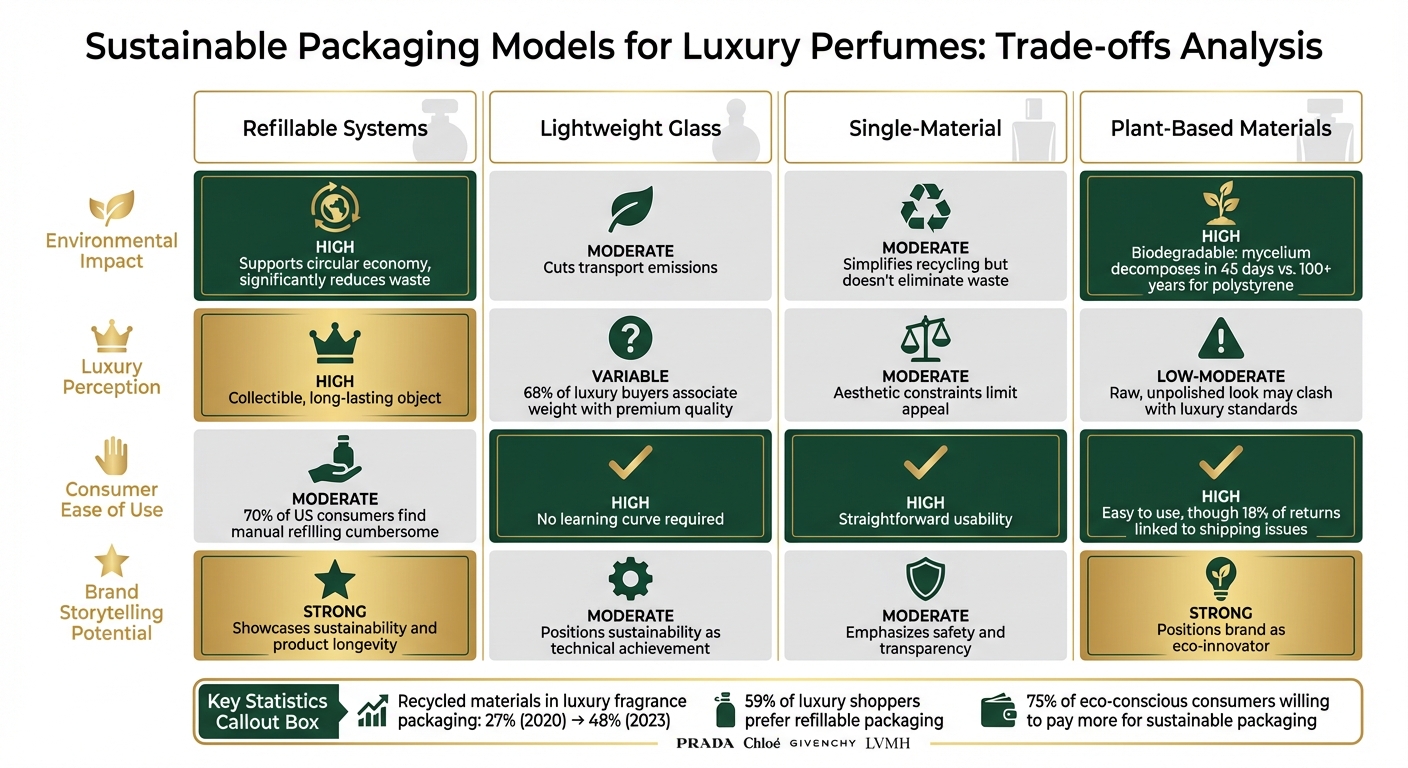
Embalaje sostenible de perfumes de lujo: comparación entre impacto ambiental y atractivo para el consumidor
Las marcas de perfumes de lujo afrontan un delicado ejercicio de equilibrio: fusionar la innovación ecológica con la estética de alta gama que sus clientes esperan. Cada enfoque de embalaje sostenible conlleva su propio conjunto de concesiones, y estas decisiones deben evaluarse cuidadosamente para alinearse con los valores de la marca y las expectativas del consumidor. La siguiente tabla destaca las consideraciones clave de varios modelos de embalaje sostenible.
| Modelo de embalaje | Impacto ambiental | Percepción de lujo | Facilidad de uso | Narrativa de marca |
|---|---|---|---|---|
| Sistemas rellenables | Alto - favorece una economía circular y reduce significativamente los residuos | Alto - convierte el frasco en un objeto coleccionable y duradero | Moderado - la recarga manual puede resultar incómoda; el 70 % de los consumidores en EE. UU. la considera engorrosa | Fuerte - pone de relieve la dedicación a la sostenibilidad y a la longevidad del producto |
| Vidrio ligero | Moderado - reduce las emisiones del transporte | Variable - un peso más ligero puede parecer menos premium para el 68 % de los compradores de lujo | Alto - no requiere aprendizaje; es fácil de usar para los consumidores | Moderado - presenta la sostenibilidad como un logro técnico |
| Monomaterial | Moderado - simplifica el reciclaje, pero no elimina los residuos por completo | Moderado - las limitaciones estéticas reducen su atractivo | Alto - uso sencillo y directo | Moderado - enfatiza la seguridad y la transparencia |
| De origen vegetal | Alto - biodegradable (por ejemplo, el micelio se descompone en 45 días frente a más de 100 años del poliestireno) | Bajo a moderado - su apariencia cruda y sin pulir puede entrar en conflicto con los estándares del lujo | Alto - fácil de usar, aunque el 18 % de las devoluciones se relaciona con problemas de envío de estos materiales | Fuerte - posiciona a la marca como ecoinnovadora |
Los sistemas rellenables destacan por sus beneficios ambientales, especialmente al prolongar la vida útil de componentes complejos del packaging, como cuerpos de vidrio y bombas de plástico. Este enfoque evita las dificultades de reciclaje propias de los ensamblajes multimaterial. Sin embargo, como muestra la tabla, la comodidad para el consumidor sigue siendo un punto sensible, ya que muchos consideran el proceso demasiado engorroso.
El vidrio ligero ofrece otra vía hacia la sostenibilidad al reducir el uso de materia prima y recortar las emisiones del transporte. No obstante, este enfoque enfrenta desafíos en el mercado del lujo, donde el 68 % de los compradores asocia el peso táctil de un producto con la calidad premium. La clave reside en reformular el vidrio más fino como una señal de pericia técnica, y no de reducción de costes.
Los materiales de origen vegetal, como el micelio y los polímeros de base biológica, aportan ventajas medioambientales sustanciales y, al mismo tiempo, abren la puerta a narrativas de marca poderosas. Sin embargo, como señala Jan Berbee, CEO de Grown, el "aspecto crudo y orgánico" de estos materiales aún necesita perfeccionarse para responder a los estándares del lujo. Además, los mayores costes de producción (entre un 20 % y un 30 % más) y las preocupaciones sobre la durabilidad durante el transporte añaden obstáculos adicionales.
Muchas marcas exitosas están encontrando formas de combinar estas estrategias. Por ejemplo, Coty se ha comprometido a reducir su huella global de packaging en un 23 % para 2025, aprovechando una combinación de soluciones ligeras y rellenables. Sue Nabi, CEO de Coty, resumió este enfoque a la perfección:
Coty sigue demostrando que sostenibilidad y deseabilidad coexisten y se elevan mutuamente.
Conclusión
Las marcas de perfumes de lujo están redefiniendo su identidad a través del embalaje sostenible. El paso de diseños desechables a opciones duraderas y rellenables está transformando la forma en que los consumidores perciben el lujo. Los frascos rellenables, antes considerados una concesión, hoy se celebran como símbolos de estatus. Entre 2020 y 2023, el porcentaje de materiales reciclados y reciclables en los nuevos envases de fragancias de lujo aumentó del 27 % al 48 %, lo que demuestra que las soluciones respetuosas con el medioambiente pueden armonizar con la estética de alta gama. Esta evolución abre el camino a estrategias que combinan eficiencia y lujo.
Las marcas están adoptando una combinación de enfoques, apoyándose en los avances en diseños rellenables, ligeros y monomaterial. Entre ellos, el reciclaje molecular destaca por ofrecer una transparencia con calidad de material virgen, garantizando que el envase conserve su aspecto premium. Además, los sistemas rellenables son cada vez más fáciles de usar, con cartuchos insertables sin derrames que elevan la experiencia de recarga. Robert Peterson, Senior Vice President, Global Packaging & Engineering en The Estée Lauder Companies, destaca este progreso:
Lo fascinante de las resinas recicladas avanzadas es que tienen, en teoría, las mismas propiedades que el plástico virgen, por lo que hay muy poco compromiso en términos de calidad y rendimiento.
Los formatos discovery también desempeñan un papel clave en la reducción de residuos sin perder la sensación de lujo. Estos formatos, como los decants curados de Scento, ofrecen a los clientes una forma de descubrir fragancias antes de comprometerse con frascos de tamaño completo. Scento ofrece opciones como viales de 2 ml, 5 ml y 8 ml, y un decant en frasco de 30 ml para la mayoría de los perfumes, permitiendo a los compradores explorar tanto aromas de diseñador como nicho sin el impacto ambiental o financiero de frascos completos no utilizados. Este enfoque refinado equilibra indulgencia y responsabilidad, garantizando que el lujo siga siendo tan deseable como sostenible.
Preguntas frecuentes
¿Cómo fomentan la sostenibilidad los frascos de perfume rellenables?
Los frascos de perfume rellenables ofrecen una manera inteligente de reducir los residuos al reutilizar el mismo envase múltiples veces. Esto elimina la necesidad constante de nuevos materiales como vidrio, plástico y metal con cada compra, reduciendo de forma significativa el impacto del embalaje de un solo uso sobre el planeta.
Los beneficios son notables: los frascos rellenables utilizan 44 % menos vidrio, 67 % menos plástico, 100 % menos metal y 61 % menos cartón en comparación con el embalaje tradicional. Al prolongar la vida del frasco original, este enfoque no solo respalda los ideales de la economía circular, sino que también combina el lujo con la creciente preferencia del consumidor por elecciones más conscientes con el medioambiente.
¿Qué desafíos afrontan las marcas de perfumes de lujo al utilizar vidrio ligero para el embalaje?
Las marcas de perfumes de lujo encuentran obstáculos importantes al pasar al embalaje en vidrio ligero. Un desafío clave radica en la asociación tradicional entre el peso de un frasco de perfume y su sensación de lujo y calidad. Un frasco más ligero podría no evocar la misma percepción premium, afectando potencialmente la forma en que los consumidores perciben la marca. Otro problema es replicar la estética icónica de las fragancias de alta gama —piensa en vidrio cristalino y diseños sofisticados— utilizando materiales más ligeros y sostenibles. Alcanzar un equilibrio entre atractivo visual y objetivos ecológicos es una tarea compleja. Por último, diseñar vidrio ligero que conserve durabilidad, claridad y brillo plantea dificultades técnicas considerables. Por ejemplo, incorporar vidrio reciclado suele exigir técnicas de vanguardia para mantener los rigurosos estándares por los que se distinguen las marcas de lujo.
Estos desafíos ponen de relieve la fina línea entre preservar la imagen lujosa de una marca, avanzar en los objetivos medioambientales y salvaguardar la maestría artesanal que define el embalaje premium de perfumes.
¿Pueden los materiales de origen vegetal mantener el atractivo lujoso del embalaje de perfumes?
Los materiales de origen vegetal están demostrando ser una excelente elección para mantener —e incluso elevar— la sensación de lujo en el embalaje de perfumes. Opciones como papeles texturizados sin blanquear o fibras recicladas aportan una estética natural y sofisticada que seduce a los consumidores más exigentes. Estos materiales ofrecen la misma riqueza táctil y el mismo atractivo visual asociados a los productos de alta gama, al tiempo que subrayan un compromiso con la sostenibilidad.
Los nuevos materiales de base biológica, como los polímeros con balance de carbono negativo, imitan el peso y el acabado suave de los plásticos o el vidrio tradicionales. Esto garantiza que la experiencia sensorial lujosa permanezca intacta. Los compradores de lujo de hoy valoran cada vez más estas alternativas responsables con el medioambiente, viéndolas como una señal de sofisticación contemporánea. Gracias a los continuos avances en reciclabilidad, el embalaje de origen vegetal logra un equilibrio armonioso entre elegancia y responsabilidad ambiental.

