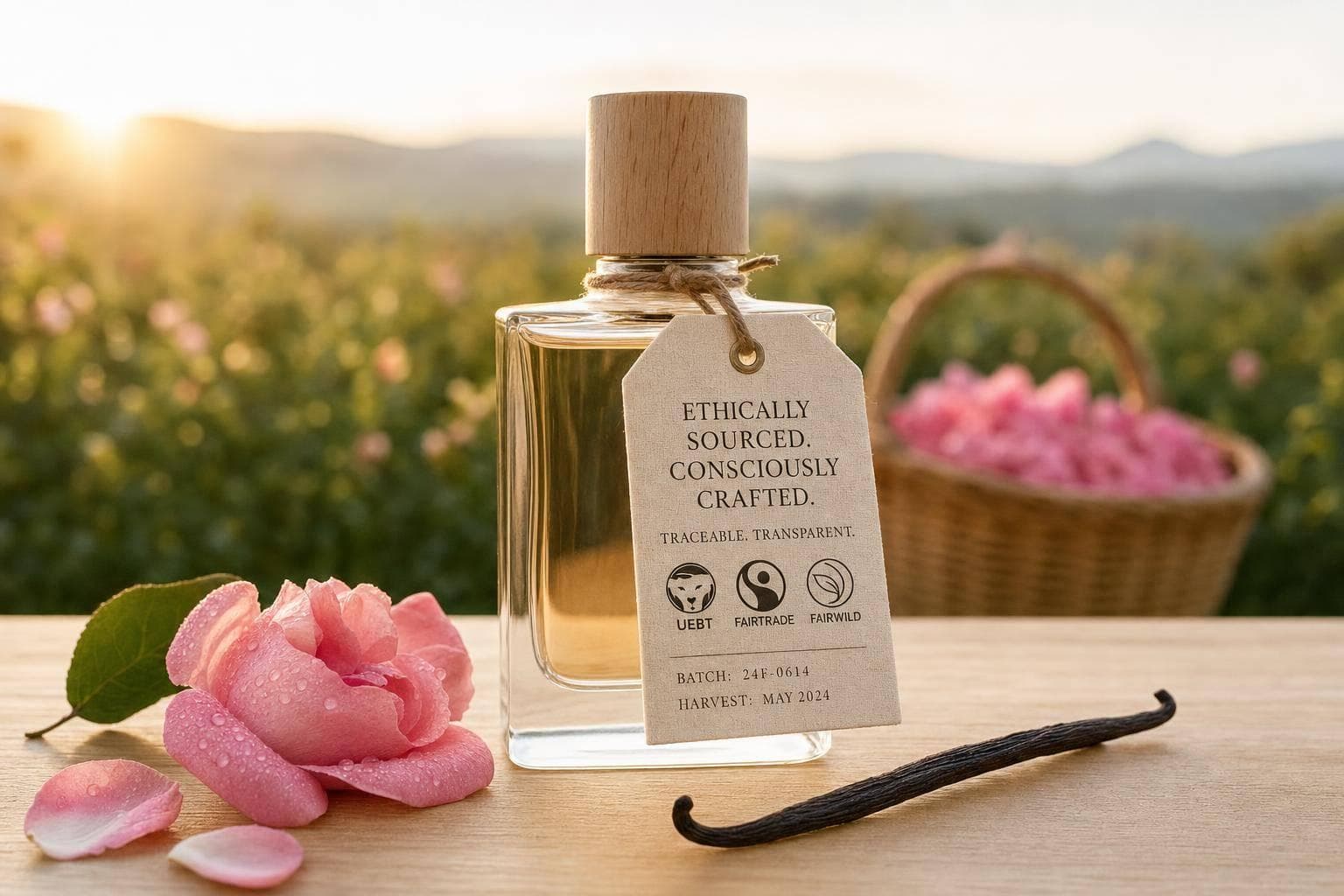
Ethical sourcing in perfume comes down to four checks: fair pay, safe work, low harm to nature, and clear traceability. If a brand cannot show audits, supplier rules, and source-level proof, the claim is weak.
I’d boil this guide down like this: vanilla, sandalwood, florals, citrus, and wild resins carry the most risk. That risk usually means low pay, child labour, illegal harvesting, overuse of land or trees, or poor traceability. In Europe, this matters more than ever: 51 % of Germans put sustainability first, and 36 % expect cruelty-free products.
If I were checking a perfume brand, I’d look for:
- Named standards such as UEBT, Fairtrade, Fair for Life, Rainforest Alliance, COSMOS, or FairWild
- Proof of audits and supplier checks
- Farm-, forest-, or cooperative-level traceability
- Clear sourcing notes for higher-risk materials like vanilla and sandalwood
- Straight product-page disclosure on allergens, vegan status, and whether a key note is natural, biotech, or synthetic
A few points stand out:
- Vanilla often links to poverty wages, child labour risk, and sharp price swings
- Sandalwood is tied to poaching, illegal logging, and slow regrowth
- Frankincense and myrrh need harvest limits and rest periods for trees
- Rose, jasmine, neroli, and bergamot depend on stable grower ties and better seasonal labour conditions
- Cruelty-free labels only cover animal testing, not worker pay or land use
Quick comparison
| Ingredient group | Main issue | What I’d want to see |
|---|---|---|
| Vanilla | Poverty, child labour risk, price swings | Long-term farmer ties, Fairtrade or similar, plot-level traceability |
| Sandalwood | Illegal logging, overharvesting | Legal source proof, audits, plantation or controlled forestry |
| Wild resins | Tree damage, weak traceability | FairWild or similar, harvest rules, forest-to-factory records |
| Florals | Low picker wages, high water and land pressure | Cooperative sourcing, audits, source disclosure |
| Citrus | Seasonal labour pressure, price instability | Regional grower contracts, traceability, sourcing notes |
The short version: I’d trust proof over brand language. The best sign is not a broad claim. It is specific evidence tied to the ingredient itself.
The Main Standards and Certifications to Know
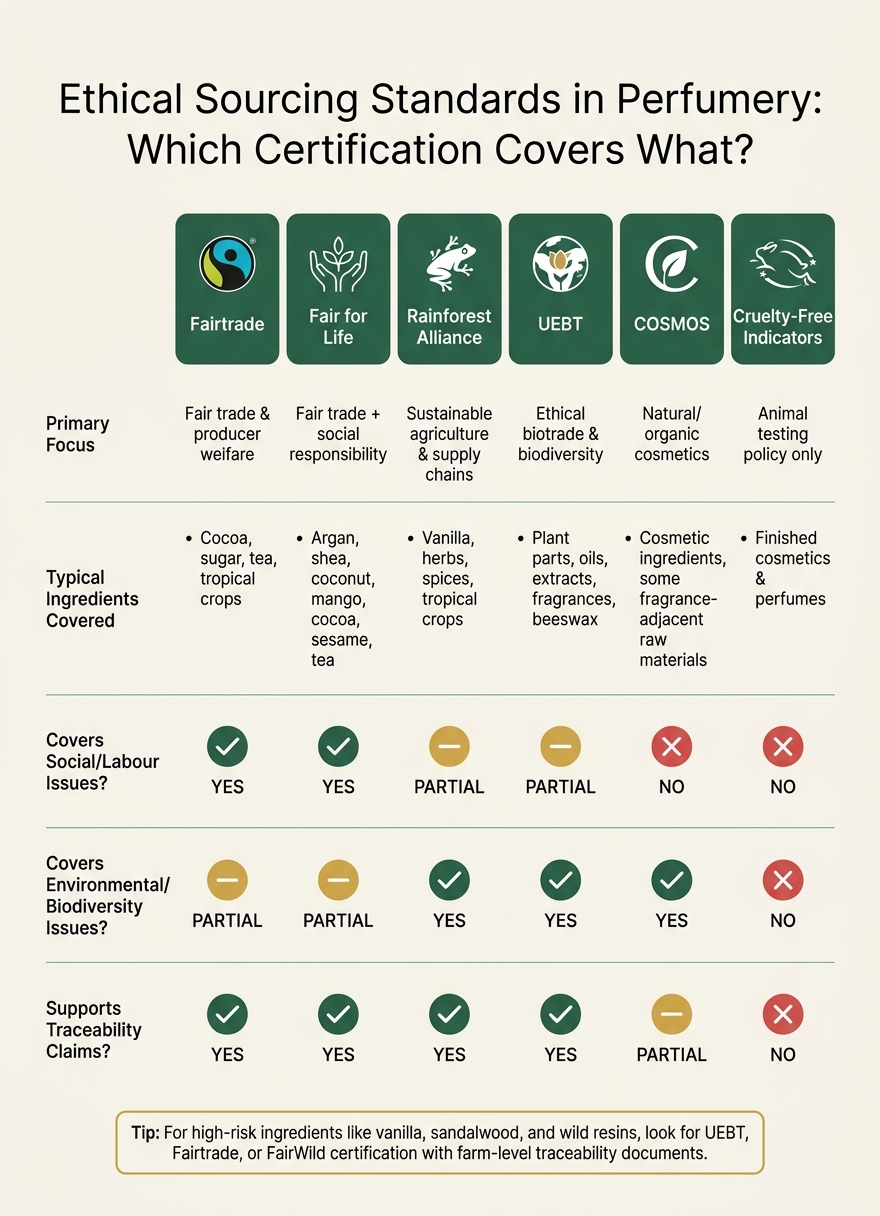
Ethical Sourcing Standards in Perfumery: Which Certification Covers What?
Third-party certification helps turn sourcing claims into something you can actually check. For fragrance ingredients, that matters. You want standards that point to fair pay, biodiversity care, and traceability.
Fairtrade, Fair for Life, and Rainforest Alliance
These schemes don’t do the same job. Each one covers a different part of sourcing.
Fairtrade centres on fair trade conditions and producer welfare for fragrance-adjacent crops. In cosmetics, its policy says that if a Fairtrade standard exists for an ingredient, all of that ingredient used in the product must come from Fairtrade-certified producers, including derivatives. Cosmetic claims are then based on how much Fairtrade ingredient the product contains. It’s most useful for ingredients like cocoa, sugar, tea, and other tropical crops.
Fair for Life has a close fit with cosmetics, detergents, and home perfumes. It covers perfume raw materials such as argan, shea, coconut, mango, cocoa, sesame, and tea. Its claims depend on minimum thresholds for certified ingredients and for the product as a whole. That makes it a practical option for brands that want to make a serious fair trade claim, not just add a small certified input.
Rainforest Alliance is mainly a sign of farm-level social and land-use practices for agricultural crops. Its herbs and spices programme clearly includes vanilla. That matters because vanilla is one of the most watched fragrance-adjacent ingredients. Brands often use certified vanilla to show traceable sourcing at farm level.
UEBT, COSMOS, and cruelty-free indicators
UEBT (Union for Ethical BioTrade) is the standard that often matters most in fragrance when botanical ingredients are involved. It applies to flowers, roots, extracts, waxes, and beeswax. In practice, suppliers need Biodiversity Action Plans for each natural ingredient, due diligence for cultivation and wild collection, time-bound improvement targets, independent audits, and traceability back to the cultivation or collection area. If you’re buying in this space, the simple check is this: does the supplier have a current UEBT audit, and can they say which ingredients sit under that scope?
COSMOS - offered as COSMOS Organic and COSMOS Natural - is the main natural and organic framework for cosmetics in Europe. It covers a broad range of certified raw materials. But it’s not a social ethics scheme. Its role is different. It helps answer whether an ingredient is natural in a meaningful sense and whether it was processed using allowed methods.
Cruelty-free indicators such as Leaping Bunny deal with animal testing policy, not sourcing. In the EU, these logos mostly show that a brand follows a no-testing policy that goes beyond the legal baseline. Put simply: it covers animal testing only.
Certification comparison table
Use the table below to match each standard to its main purpose.
| Standard | Primary scope | Typical ingredient types | Audit style | Claims it can support |
|---|---|---|---|---|
| Fairtrade | Fair trade and producer conditions | Cocoa, sugar, tea, tropical crops, derivatives | Third-party certification under Fairtrade product rules | Fairtrade ingredient claims, producer support |
| Fair for Life | Fair trade plus social responsibility for ingredients and finished products | Argan, shea, coconut, mango, cocoa, sesame, tea | Certification against the Fair for Life standard and product ingredient lists | Fair Trade Product, Made with Fair Trade ingredients |
| Rainforest Alliance | Sustainable agriculture and supply chains | Vanilla, herbs, spices, tropical crops | Farm and supply-chain certification | Sustainable sourcing, certified ingredient claims |
| UEBT | Ethical biotrade and biodiversity | Plant parts, oils, extracts, fragrances, colourants, beeswax | Standard-based sourcing system with independent audits | Ethical biodiversity sourcing, traceable botanical sourcing |
| COSMOS | Natural/organic cosmetics | Cosmetic ingredients and some fragrance-adjacent raw materials | Ingredient and product-level validation | Natural/organic cosmetics claims, permitted processing |
| Cruelty-free indicators | Animal testing policy | Finished cosmetics, perfumes, aftershaves | Varies by scheme; not a sourcing standard | No animal testing claims |
For buyers in Germany and across Europe, the smart move is simple: ask exactly which ingredients are covered, then request the traceability documents.
Next, these standards make more sense when you look at how they apply to vanilla, sandalwood, resins, citrus, and florals.
Your Personal Fragrance Expert Awaits
Take our quick scent quiz to discover authentic designer and niche fragrances matched to your taste — explore them as 2ml, 5ml, 8ml & 30ml decants and samples, so you can try each one before committing to a full bottle.
Find Your ScentHow Ethical Sourcing Works for Key Perfume Ingredients
Ethical sourcing changes from one ingredient to the next. Where it grows, how it’s picked, and who does the work all shape the risk. That’s why vanilla, sandalwood, citrus oils, florals, and wild resins can’t be handled with one blanket policy. The standards above matter most when they’re applied to each material in a concrete way.
Vanilla, sandalwood, and wild-harvested resins
Vanilla is one of perfumery’s most fragile raw materials from an economic point of view. Smallholder farmers in Madagascar still face sharp price swings and low household income. A Fairtrade living income study found that in 2023 the average net income for a Malagasy vanilla farming household was just €854,50, while the living income gap stood at €2.612 per household. Fairtrade’s updated Living Income Reference Price for 2024 puts the farm-gate price for green vanilla at €10,17 per kg.
That gap explains why responsible sourcing programmes tend to focus on long-term ties rather than spot buying. Brands and suppliers work on direct farmer partnerships, multi-year contracts, agroforestry, and support for local communities. Symrise, for example, says it has direct partnerships with around 7.000 farmers from 98 villages in Madagascar, reaching about 40.000 people in total.
Sandalwood comes with a different problem. Here, the pressure is less about income swings and more about overuse and illegal logging. One sandalwood case study connects excess processing capacity with overexploitation and illegal logging. A moratorium helped curb harvesting, but illegal logging still remained high. In practice, better sourcing means plantation supply or controlled farm forestry, clear harvest quotas, legal checks, audits, and harvesting methods that do not remove roots.
Wild resins such as frankincense and myrrh need close control too. If collection is rushed or poorly managed, trees can suffer long-term damage. The FairWild standard is the main framework used here. It requires harvest limits, rest periods for trees, harvester training, fair compensation, and traceability from forest to finished product. Synarome and sites like Wadi Dawkah have reached FairWild recognition for frankincense and myrrh, making them among the first FairWild-certified wild resin sourcing operations in the Arabian Peninsula.
Citrus, flowers, and community-based sourcing models
For ingredients like bergamot, neroli and Damask rose, ethical sourcing depends on steady grower relationships, not one-off deals. Guerlain’s sourcing partnerships in Calabria, Italy, and in Isparta, Turkey / Kazanlak, Bulgaria are presented within UEBT principles. The idea is simple: link luxury perfumery with biodiversity care and local community gains through multi-year partnerships with growers and cooperatives that support organic practices and local value creation.
This community-based model matters because it keeps more value in the region where the ingredient is grown. When a brand backs a cooperative or a local grower network across several seasons, farmers have more room to invest in better farming methods, safer working conditions, and crop diversification instead of running after unstable spot prices.
Ingredient risk comparison table
| Ingredient | Key Environmental Risks | Key Social Risks | Common Sourcing Model | Relevant Certifications / Programmes |
|---|---|---|---|---|
| Vanilla (Madagascar) | Deforestation, monoculture, biodiversity loss | Price volatility, farmer poverty, child labour risk | Direct farmer partnerships, long-term contracts, agroforestry | Fairtrade, Rainforest Alliance, Fair for Life, Sustainable Vanilla Initiative |
| Sandalwood | Overexploitation, illegal logging, root harvesting | Illegal trade, livelihood insecurity | Plantation or controlled farm forestry with harvest quotas and audits | Legal frameworks, UEBT, independent audits |
| Frankincense / Myrrh | Over-tapping, tree mortality, habitat degradation | Harvester exploitation, lack of fair pay | Wild collection with harvest limits and rest periods | FairWild, UEBT |
| Bergamot (Calabria) | Biodiversity and cultivation pressure | Seasonal labour conditions, price instability | Long-term regional contracts, family growers, organic practices | UEBT, organic certification |
| Neroli / Rose | Water and land pressure | Low wages, seasonal labour vulnerability | Cooperative and family-farm models with stable pricing | UEBT, Fair for Life, organic certification |
These ingredient-level models only hold up if brands can show where the material came from, how it was harvested, and who is answerable across the supply chain. The next step is proving that through audits, traceability, and supplier disclosure.
Building Transparent and Responsible Supply Chains
Origin alone doesn’t tell you much. The harder test is whether a brand can show how an ingredient was made, who produced it, and under what conditions - from the farm or forest all the way to the finished fragrance.
Supplier standards, audits, and due diligence
High-risk ingredients need clear supplier rules, audits, and traceability that goes back to the source. The starting point is a clear Supplier Code of Conduct. This code sets the baseline for wages, labour rights, safety, and environmental rules. L’Oréal audits ten areas, including child labour, forced labour, safety, working hours, and pay, and sets a minimum worker age of 16. Suppliers are also expected to apply those same rules to their own subcontractors.
Social audits check whether suppliers meet those rules. These reviews are often done by independent firms, especially for high-risk ingredients and regions. The OECD Due Diligence Guidance says the full supply chain risk review should happen at least every two years, with more frequent checks where the risk is higher. If an audit finds problems, the next step should be a corrective-action plan, a deadline, and a follow-up check. OECD-aligned guidance makes the order clear: first comes engagement and support, while disengagement is kept for severe or repeated failures.
Still, none of that means much if the brand can’t trace the material back to where it started.
Traceability from farm or forest to finished fragrance
Traceability is what turns supplier rules into something a brand can verify. A country-of-origin claim is a weak signal. Farm- or cooperative-level traceability tells you far more.
That extra detail matters most for high-risk ingredients. In Western Australia, the sandalwood industry tracks every single tree from harvest to end use. Givaudan‘s work with Indigenous harvesters is audited independently by the Songman Circle of Wisdom and includes a direct premium payment to harvesters. For vanilla in Madagascar, several projects now use digital tools — QR codes, mobile data collection, and blockchain - to record weight, farmer identity, and location at the point of collection. That creates a tamper-proof chain from farm to fragrance manufacturer. When you assess a sourcing claim, look for farm, cooperative, tree, or plot-level identification, not just a country name.
In cosmetics, traceability means knowing the botanical source, geography, and cultivation method - not only the country.
The table below shows what stronger traceability looks like in practice.
Supply chain maturity comparison table
| Maturity Level | Traceability Depth | Audit Frequency | Supplier Compliance | What This Tells the Customer |
|---|---|---|---|---|
| Basic | Country of origin only | Occasional desk reviews; few on-site audits | Meets legal requirements; limited ethical checks | Ingredients meet legal standards; limited visibility into social or environmental impacts |
| Emerging responsible | Region or key supplier groups identified | Regular audits for high-risk ingredients | Some suppliers aligned with Code of Conduct; corrective actions in place | Brand is actively managing major risks and improving practices for sensitive ingredients |
| Advanced responsible | Cooperative or producer group level for key ingredients | Scheduled third-party audits and follow-ups across main suppliers | Most suppliers meet strong ethical and environmental criteria; documented remediation where issues arise | Customers can be confident that main ingredients are sourced with strong safeguards for people and nature |
| Leading / transformative | Farm or forest plot level for high-risk or flagship ingredients | Independent audits, on-the-ground checks, and public reporting | Suppliers committed to continuous improvement, living wages, and long-term ecosystem protection | Maximum transparency; brand is actively contributing to positive social and environmental change |
Country-level claims give only limited assurance. Farm- or cooperative-level traceability is the stronger signal.
Applying Ethical Sourcing to Fragrance Discovery and Buying Decisions
How perfumers balance ethics, creativity, and ingredient performance
Once supply chains are traceable, the next step is simple: what does that change in the bottle, and what can shoppers check for themselves?
Responsible perfumery tries to keep both scent quality and sourcing standards in view. One practical option is biotech ingredients made through fermentation or engineered microbes. These can produce fragrance molecules that might otherwise put pressure on scarce natural materials. Symrise’s Dreamwood molecule, for example, creates a sandalwood-like effect through fermentation with sugar feedstocks and engineered microbes, which helps reduce pressure on slow-growing sandalwood trees. Biotech vanillin, made by engineering yeast cells to produce vanillin in fermenters, can also ease pressure on land use and raw materials.
That doesn’t mean naturals are disappearing from fine fragrance. Far from it. Many perfumers save certified, fairly traded natural materials for the places where their nuance matters most, such as vanilla, ylang-ylang, or vetiver sourced through clear community partnerships. In practice, that often means using biotech and synthetics for scale, then using certified naturals to add depth and character to the accord.
What transparency should look like in ecommerce fragrance curation
That same level of clarity should show up on the product page.
Most shoppers still don’t get full ingredient data. About 72 % of brands leave out exact fragrance ingredients, and 75 % list ingredients without quantities. Good product pages can narrow that gap by showing three things clearly:
- the natural or synthetic origin of key notes
- whether ingredients are vegan or animal-derived
- the 27 EU-listed fragrance allergens, clearly flagged
Some brands go further and publish full ingredient lists with sourcing notes such as botanical, lab-created, or community-sourced for each scent in their range. That’s far more useful than vague eco-branding.
For European shoppers, details also need to be easy to read in a local format. That means metric volumes in ml, European number formatting like 1.000,50 €, and German-style dates. A discovery platform like Scento can make this easier with filters such as cruelty-free, biotech sandalwood, and vanilla from community-based sourcing.
Conclusion: The key signs of ethical sourcing in perfumery
For shoppers, ethical sourcing should look like proof, not a promise.
The strongest signals are named standards, current audits, and ingredient-level traceability. It’s smart to start with higher-risk materials like vanilla, sandalwood, jasmine, and wild resins. When brands and retailers publish ingredient origins, name their sourcing partners, and explain why they formulated a scent the way they did, customers have something solid to judge: fair pay, ecosystem care, and traceability.
FAQs
How can I verify an ethical sourcing claim?
Look for clear proof, not vague brand language. Check respected third-party certifications such as UEBT, Fair Trade, COSMOS, NATRUE, or Rainforest Alliance, then verify them in the certifier’s official public database.
It also helps to lean toward brands that publish sourcing reports, audit summaries, full INCI ingredient lists, an IFRA Certificate of Conformity, and traceability details. That means concrete information on regions of origin, suppliers, and audit trails - not just broad claims on a product page.
Which perfume ingredients have the highest sourcing risk?
Ingredients face the highest sourcing risk when they’re tied to overharvesting, habitat loss, or exploitative labour. In perfumery, that often includes sandalwood, jasmine, vanilla, rose, vetiver, ylang-ylang, resins, and low-yield materials such as orris.
The pressure comes from both sides. On the land side, these materials can demand large amounts of space and water. On the human side, they’re often linked to unfair wages, child labour, and deep poverty in places where rules are weak or poorly enforced.
Does cruelty-free mean ethically sourced?
No. Cruelty-free and ethically sourced are not the same.
Cruelty-free usually means the finished product or its ingredients were not tested on animals. Ethically sourced goes much further. It covers things like fair working conditions, living wages, responsible harvesting, and protection of biodiversity.
So a cruelty-free label tells you one thing. It does not tell you the full story about how the ingredients were grown, gathered, or traded.
If you want that broader standard, look for certifications such as UEBT or Fair Trade instead of relying on a cruelty-free label alone.

