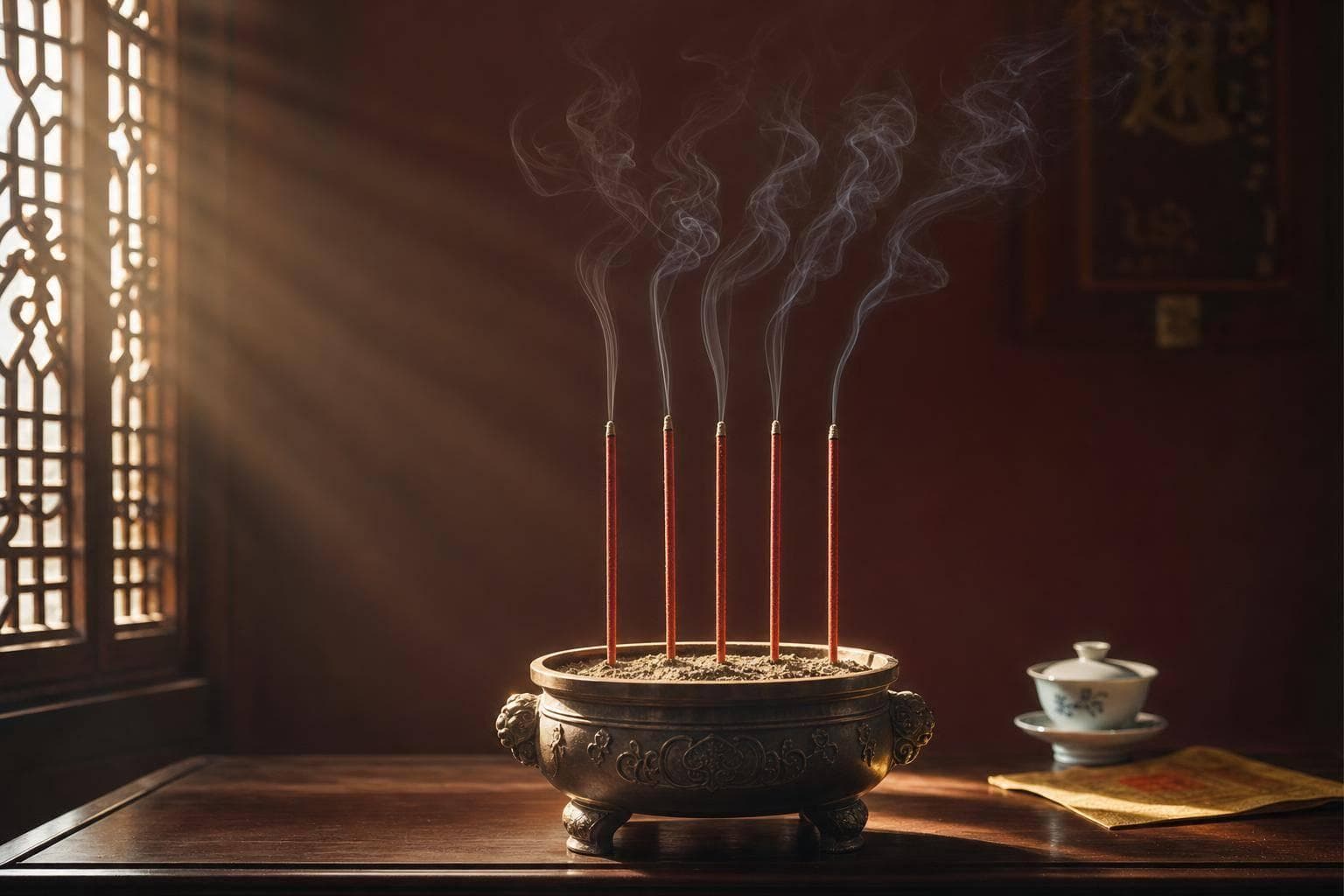
Incense in Chinese life is not one single act. I’d sum it up like this: it is used in 5 main ways - at the family altar, in temples, during Lunar New Year, at Qingming gravesites, and in Buddhist, Daoist, and xiangdao practice.
If you want the short answer, here it is:
- At home, incense keeps family memory close.
- In temples, it goes with prayer and respect.
- At Lunar New Year, it marks the start of the year and hopes for luck.
- At Qingming, it honours the dead at graves.
- In Buddhist and Daoist settings, it supports worship.
- In xiangdao, it is less about prayer and more about stillness and scent.
One simple fact stands out: the same incense stick can serve very different roles depending on place and purpose. In one setting, it is about family duty. In another, it is about worship. In another, it is quiet attention to fragrance itself.
Quick Comparison
| Ritual | Main aim | Usual place | Main mood |
|---|---|---|---|
| Household ancestral offering | Remember family members who died | Home altar | Personal and quiet |
| Temple offering to deities | Prayer and respect | Temple | Shared and reverent |
| Lunar New Year incense | Mark a new start | Home or temple | Hopeful |
| Qingming incense | Honour ancestors at graves | Gravesite | Respectful and solemn |
| Buddhist and Daoist incense | Support worship and rites | Shrine or temple altar | Devotional or formal |
| Xiangdao | Focus on scent and calm | Quiet room, study, or tea setting | Reflective |
In short, I see these rituals as one material, many meanings - and that is what makes incense such a steady part of Chinese life.
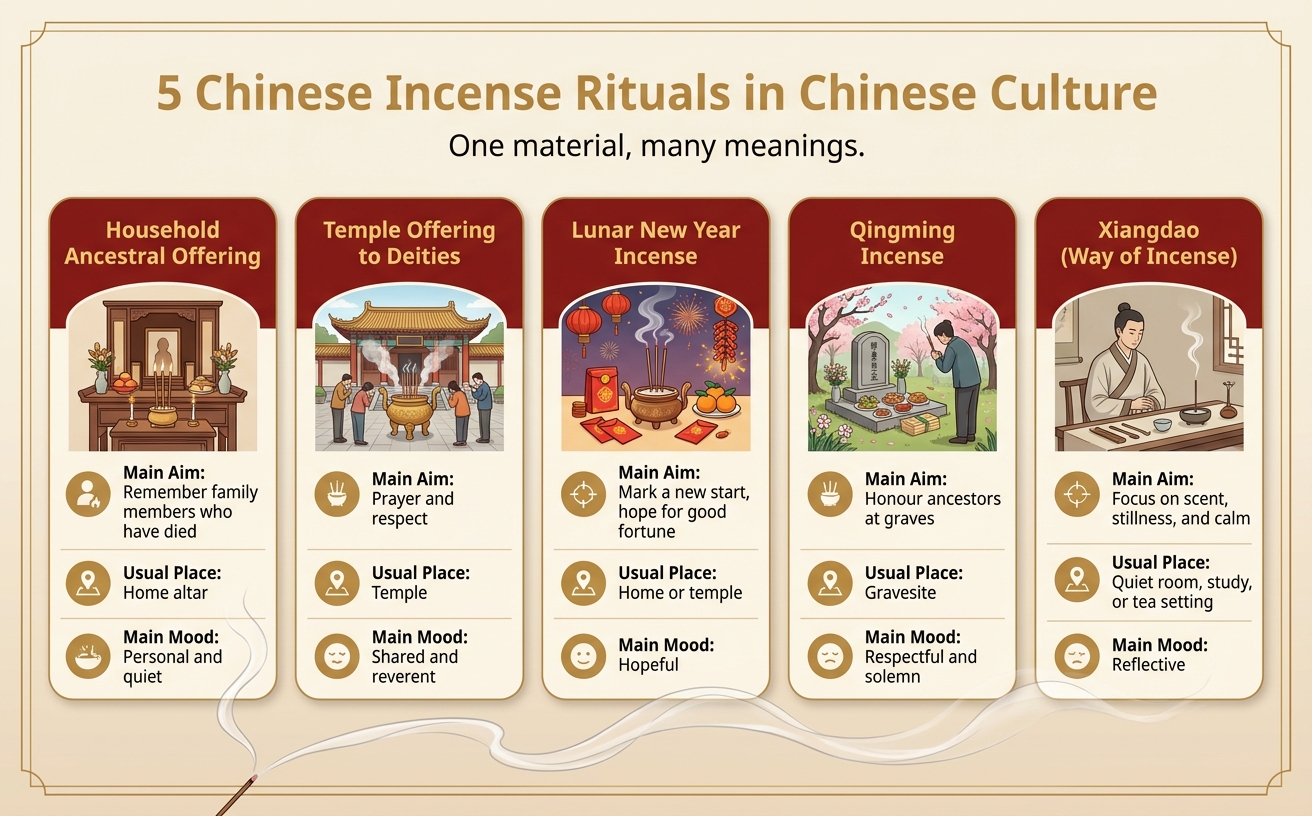
5 Chinese Incense Rituals: Purpose, Place & Mood
1. Household ancestral incense offering
At the family altar, incense is part of everyday remembrance. It keeps the bond with earlier generations present in daily life.
Purpose and symbolism
Lighting incense shows respect and a sense of continuity with those who came before.
How the ritual is performed
At indoor altars, many families choose low-smoke incense, such as sandalwood or agarwood sticks.
When and where it takes place
Some households light incense each day. Others do so on memorial dates and during Qingming.
From the home altar, the same gesture carries over into temple worship.
2. Temple incense offering to deities
From the family altar, incense moves into shared temple worship. In Chinese temples linked to folk religion or Daoist practice, incense sits at the heart of the offering. The setting changes everything. At home, the act is private and close to daily life. In a temple, it happens in a sacred space used by many people at once.
Worshippers usually offer incense before a prayer or petition. The smoke rising from the burner is often seen as carrying those prayers upward. That gives the act two sides at once: it is personal, but it also becomes part of the life of the temple and the crowd gathered there.
Purpose and temple etiquette
Most worshippers light incense soon after arriving, before they pray. The main point is sincerity. Move with care, follow the order used in that temple, and place the incense in the burner set aside for offerings instead of picking your own place.
Temple customs can differ from one place to another. Because of that, the safest approach is simple:
- Watch how others do it
- Follow any signs or staff guidance
- Keep your movements calm and respectful
That small pause to observe can save a lot of awkwardness. Every temple has its own rhythm.
Step-by-step temple practice
The usual sequence is simple. A worshipper lights the incense, holds the sticks upright at chest or forehead level, makes a bow, and then places the sticks upright in the burner.
It’s not a dramatic act. In most cases, the meaning comes from the quiet, steady way it is done.
Regional variation and comparison
Temple practice is not the same everywhere. The number of sticks, the depth of the bow, and the order of worship can all change from one temple to the next. In some places, one stick is enough. In others, several sticks are offered together.
If you’re new to a temple, there’s no need to overthink it. Stand back for a moment, observe the local pattern, and then follow along. Festival rites grow out of this same offering, though the timing and setting give the act a different feel.
3. Festival incense rituals during Lunar New Year and Qingming
In temples and homes, festival rites give incense a clear seasonal role. Lunar New Year and Qingming show this most clearly: one looks to the year ahead, the other turns toward memory and respect.
Lunar New Year’s first incense
The first incense of the Lunar New Year is lit at the start of the new year. It signals a new beginning and carries a wish for good fortune.
Qingming tomb-sweeping incense ritual
During Qingming, incense is part of tomb-sweeping and ancestor remembrance. People place incense sticks at graves to show respect and filial duty.
Lunar New Year vs. Qingming
| Aspect | Lunar New Year incense | Qingming incense |
|---|---|---|
| Setting | Temples and homes at the start of the year | Gravesites during tomb-sweeping |
| Main meaning | Renewal and good fortune | Remembrance and filial duty |
Beyond these festival moments, incense also plays a part in Buddhist and Daoist worship.
Your Personal Fragrance Expert Awaits
Take our quick scent quiz to discover authentic designer and niche fragrances matched to your taste — explore them as 2ml, 5ml, 8ml & 30ml decants and samples, so you can try each one before committing to a full bottle.
Find Your Scent4. Incense in Chinese Buddhist and Daoist worship
After home and temple offerings, incense also sits at the heart of Buddhist and Daoist ritual life.
Buddhist incense offering
In Buddhist worship, incense marks devotion. It accompanies prayer, chanting, and offerings, helping set a calm, focused mood around the altar. The act is simple, but it carries weight: lighting incense becomes a quiet sign of respect and intention.
Daoist incense offering
In Daoist worship, incense supports ritual petitions and altar rites. Here, there is often closer attention to ceremony and sequence, with each step tied to the order of the rite. The mood feels more formal, and the incense works as part of that ritual flow.
Put plainly, Buddhist incense centres on devotion, while Daoist incense centres on ritual ceremony. Next, incense becomes a refined practice in xiangdao.
5. Xiangdao: incense as a refined art form
After the formal rituals of worship, xiangdao presents incense in a different light. Here, incense is less about asking for something and more about stillness, attention, and quiet enjoyment.
Not all incense in Chinese culture is tied to prayer or petitions. Xiangdao - the "Way of Incense" - stands apart from those ritual uses. It is a contemplative, aesthetic practice built around close, patient attention to scent.
What xiangdao involves
Unlike petitionary incense, xiangdao is usually private and reflective. The focus is the scent itself, and the inner state of the person experiencing it. Historically, scholars prized sandalwood and agarwood in study and tea settings. Today, people turn to xiangdao for calm, focus, and reflection.
How a basic xiangdao session works
A session usually begins with a quiet, dedicated space, sometimes paired with tea or another calm activity. The incense material - often a resin or small wood chip - is placed on a heatproof burner filled with ash or sand so the heat spreads evenly. Many practitioners now use electric burners because they allow better heat control and help protect delicate notes.
Once the scent starts to rise, the room settles into silence. The goal is to "listen" to the fragrance. In other words, you give it your full attention instead of letting it fade into the background. You notice how the aroma shifts over time, slowly and without distraction.
That contrast becomes plain when you place ritual incense beside xiangdao:
| Aspect | Ritual Incense | Xiangdao |
|---|---|---|
| Purpose | Petitionary - blessings, guidance, ancestor worship | Contemplative - reflection and emotional balance |
| Setting | Temple, home altar, graveside | Scholarly or tea setting |
| Materials | Standard incense sticks or coils | Sandalwood, agarwood, loose resins |
Conclusion: What these five incense rituals reveal
These five rituals show how incense takes on different roles depending on the setting. At a home altar, it marks remembrance. In temple worship, it signals reverence. During Lunar New Year and Qingming, it follows the rhythm of the season. In Buddhist and Daoist practice, it acts as a bridge to the sacred. And in xiangdao, it becomes a quiet, inward act of attention.
Each one stands on its own, shaped by its purpose, place, and meaning. Ancestral offerings keep a bond alive. Temple incense carries petitions. Festival rites honour the dead. Religious worship gives form to devotion. Xiangdao turns the same material into a contemplative practice.
Seeing these as separate frameworks helps clarify what is happening in each case. A Qingming grave offering and a xiangdao session may use the same incense, but they are not doing the same thing.
FAQs
How do I choose the right incense for each ritual?
Choose incense based on your ritual’s purpose, the time of day, and the season. In Chinese practice, sandalwood and agarwood are often used for meditation, ancestor worship, and study because they help set a calm, quiet mood.
It also helps to match the scent to the feeling you want in the room. Warm notes can feel grounding. Frankincense can work well in the morning when you want a clear head. Myrrh often suits slow, calm evening reflection.
If you’re not sure where to start, try a few blends and pay attention to how each one feels. Over time, you’ll get a sense of what fits your intention best.
Can non-religious people practise xiangdao?
Yes. Although xiangdao began in temple worship and ancestor veneration, it also had practical, secular uses.
In scholars’ studios, incense often marked time and helped with concentration during study. Today, it can also serve as a personal ritual for focus, a more refined atmosphere, and quiet reflection, whether or not you hold spiritual beliefs.
What mistakes should visitors avoid in Chinese temples?
Chinese temples are sacred spaces, so it helps to carry yourself with care. Incense burning is a solemn act tied to honouring ancestors, purifying spaces, and carrying prayers to the heavens. Because of that, respectful behaviour matters.
Keep your voice low and your manner calm. Stay aware of any ceremonial activities taking place around you, and give worshippers the space they need.

