
Polish Fragrance Market Size 2026
The Polish domestic fragrance market reached approximately $0.8 to $1.0 billion at retail in 2025, with the spread reflecting whether the measurement includes the broader fragrance basket or only the prestige and designer tiers. Scento's analysis converges on the higher end as the most representative figure for the broad fragrance basket. The forecast trajectory through 2026 to 2030 holds at 3.6 to 4.5% CAGR for the general consensus, with the Polish luxury-fragrance sub-segment growing materially faster at 6 to 8% CAGR. Per-capita Polish fragrance retail spend in 2025 lands at approximately $18 to $22 per person, meaningfully below Western European benchmarks but the highest in CEE excluding Czech Republic.
The trade flows tell a structural story. Poland imports approximately 19,000 tons of perfumery raw material annually and exports approximately 32,000 tons at an average $24,020 per ton in 2024 (+17% year-on-year). This is the lowest unit-price fragrance export tier in the EU. Polish cosmetics imports source principally from Germany, France, and Italy, which combined account for 44% of Polish cosmetics-import value. The average cosmetics import price reached $23,541 per ton in 2024 (+3.1%), and Polish cosmetics exports overall reached $18,890 per ton in 2024 (+22%).
The low unit-price tier matters because it explains Poland's structural role within the EU fragrance economy. Poland exports more value than it imports on a volume basis, but the unit value is depressed by the country's role in mid-tier mass-market fragrance contract manufacturing. Polish-export fragrance largely services regional CEE retail channels at the mass-market end, with limited high-luxury volume passing through Polish manufacturing infrastructure. Browse the main perfume catalogue to see the broader European house mix that Polish buyers compete with on shelf.
Poland is simultaneously the largest CEE fragrance market by absolute revenue and the lowest unit-price market in the EU on the export side, a profile consistent with a country in mid-stage premium-fragrance transition. Polish wage convergence with Western European levels remains the single most important structural driver of fragrance growth through 2030, and Polish median wages have grown materially in 2024 (+6% year-on-year), pushing fragrance further into the routine-discretionary basket. The 2030 trajectory implied by current macroeconomic conditions points to Polish per-capita fragrance spend approaching $30 per person by the end of the decade, narrowing the gap with Italy and edging toward German benchmarks.
The structural composition of Polish fragrance retail differs meaningfully from Western European norms. Mass-market and entry-designer fragrance still account for a higher share of total retail in Poland than in Italy, Germany, or France, with luxury and niche representing the fast-growing but smaller minority. The mass-market dominance reflects historical wage levels, the Allegro and drogerie-chain distribution infrastructure that anchors low-and-mid-tier fragrance retail, and the gradual nature of Polish premium-buyer migration. The growth trajectory through 2030 will be defined less by overall fragrance-market expansion (which is steady) and more by the composition shift within the existing market: each percentage point of mass-market share that migrates into designer or luxury territory represents disproportionate revenue growth for the houses positioned to capture it.
CEE Context: Why Poland is the Region's Engine
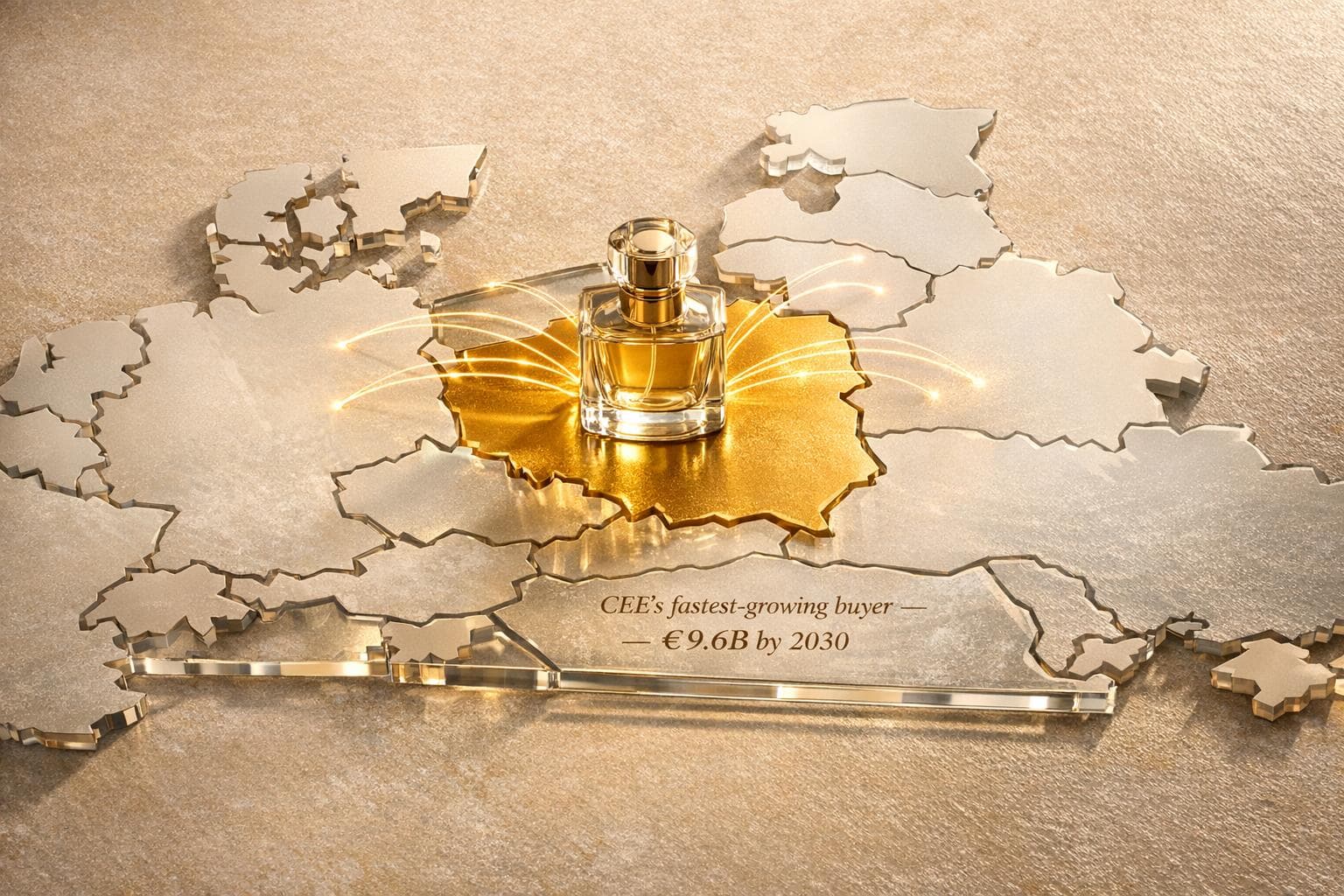
Poland is the largest fragrance consumer in Central and Eastern Europe, ahead of Czech Republic, Hungary, Romania, Slovakia, Croatia, Slovenia, Bulgaria, and the Baltics combined. Population scale is the foundational reason: Poland's 36 million inhabitants represent the third-largest EU population after Germany and France, and the country's economic gravity within CEE makes it the natural anchor for any regional fragrance strategy.
The growth-profile comparison versus CEE peers is instructive. Polish fragrance growth runs at 3.6 to 4.5% CAGR. Czech Republic shows a similar trajectory off a smaller base. Romania runs 4 to 5% CAGR with a steeper premium-buyer mix shift. Hungary runs slower at 2 to 3% CAGR. Baltic markets are small in absolute base but grow fastest in percentage terms. Poland's growth is not the fastest in CEE on a percentage basis, but it is by far the largest in absolute terms, which is why it anchors regional distribution decisions for both designer-mainstream brands and emerging niche houses. The 2026 global fragrance market report sets the international comparison layer.
Five structural advantages explain why Poland leads CEE. The largest absolute population in CEE. Higher per-capita spending power than other CEE markets, with a wage-convergence trajectory toward Western Europe that has accelerated in 2024 to 2025. The most developed e-commerce infrastructure in CEE, with Allegro as the regional standard-setter and a consumer base comfortable with marketplace purchasing of fragrance, cosmetics, and luxury goods. A strong Notino plus Allegro plus Inglot ecosystem covering prestige, marketplace, and Polish-rooted cosmetics. An active premium-buyer migration from mass to designer to selectively niche, visible in Notino.pl shopping-cart compositions across the past three years.
Polish artistic-perfumery emergence is not hypothetical. A 2025 industry survey of European artistic-perfumery operators ranks Poland, Romania, and Hungary as the three top emerging-tier markets for niche and artistic perfumery, an explicit signal that CEE buyer momentum is real and being tracked by the houses competing for share. The same survey ranks France only fifth among growth markets, a striking reordering of the conventional European fragrance hierarchy. Browse Scento's men's fragrance selection and women's fragrance selection to see the brand mix that Polish buyers increasingly engage with as the premium shift accelerates.
The CEE comparative context also matters for understanding distribution decisions. Polish e-commerce maturity gives the country a structural distribution advantage that smaller CEE markets cannot match, and the Allegro plus Notino infrastructure means Polish buyers can access the same international niche houses that buyers in Munich or Vienna access, often at comparable price points after VAT and shipping adjustments. Czech Republic runs a similar e-commerce profile through Notino's home market base in Brno, but the absolute volume is smaller. Romania has growing fragrance retail but with a less mature e-commerce infrastructure outside Bucharest. Hungary, Slovakia, Croatia, Slovenia, and the Baltic states each represent meaningful but smaller fragrance economies with their own distribution dynamics. Poland's leadership within CEE is consequently both quantitative (largest absolute market) and structural (most developed e-commerce). The combination makes Poland the gravitational centre for any niche or luxury fragrance house planning regional CEE distribution.
Polish Buyer Demographics
Polish fragrance buyer behavior breaks down by gender, age, and geography in patterns that broadly mirror Western European norms but with distinctive CEE inflections. The female-to-male buyer split runs approximately 62/38 by buyer count, in line with the broader European pattern. Within that split, male fragrance is the faster-growing sub-segment year-on-year, mirroring patterns visible across Italy, Spain, Germany, and the UK.
Age cohorts show clear differentiation in 2026. The 18 to 24 cohort drives rising fragrance engagement, primarily mass-market and Instagram/TikTok-influenced niche discovery, with social-channel virality of specific niche launches reaching Polish buyers within days of equivalent Western European awareness. The 25 to 34 cohort represents the largest entrant block into niche-buyer territory, with Notino.pl shopping behavior particularly visible in this segment. The 35 to 44 cohort holds the highest — AOV position, representing the luxury-buyer transition where Polish buyers move from designer-mainstream to selective luxury and niche purchases. The 45-plus cohort retains traditional designer-mainstream loyalty, with Hugo Boss, Lacoste, and Calvin Klein as anchor purchases.
Urban versus rural Polish buyer behavior splits sharply. Major-city buyers in Warsaw, Krakow, Wroclaw, Poznan, and Gdansk show the highest niche-fragrance penetration in CEE, comparable with Berlin or Vienna on a relative-share basis. Mid-sized city buyers anchor designer-mainstream and selective niche purchases. Rural and small-town Polish buyers remain mass-market dominant, with drogerie chains (Rossmann, Hebe, Drogerie Natura) and Allegro marketplace as the primary distribution channels. The geographic gradient from Warsaw to small-town Poland is steeper than equivalent gradients in Italy or Germany, reflecting the country's mid-stage premium-fragrance transition.
Income profile dynamics drive the trajectory. Polish median wages have grown materially in 2024, with +6% year-on-year nominal growth and meaningful real-wage gains. Fragrance is a tier of the discretionary basket that is gaining share within Polish household spending. Poland's gradual wage convergence with Western European levels is the single most important demographic driver of fragrance growth through 2030, and the second-most-important is the rising visibility of fragrance content in Polish-language TikTok and Instagram, which has compressed the discovery-to-purchase cycle for niche houses. Polish buyer engagement with decants and discovery formats runs stronger than the EU median, consistent with a market still building niche-fragrance literacy and using sample formats as a low-commitment entry path. Explore Scento's scent discovery quiz for the typical Polish-buyer entry point into international niche curation.
The Polish-language fragrance content ecosystem on social media has matured rapidly through 2024 to 2025. TikTok creators producing fragrance reviews, niche-house comparisons, and seasonal-wardrobe content reach audiences in the hundreds of thousands, with engagement patterns mirroring Western European fragrance-creator dynamics. Instagram fragrance accounts based in Warsaw and Krakow have become important taste-makers within the Polish niche-buyer cohort, often serving as the bridge between international house launches and Polish-language buyer awareness. The compressed discovery-to-purchase cycle, often measured in days from social-content exposure to Notino.pl checkout, is one of the most important features of Polish online-first buyer behavior in 2026. Oud, vanilla, and musk compositions appear disproportionately in Polish fragrance-content trending feeds, partly reflecting the country's preference patterns and partly reflecting the niche-house launch focus on those note categories.
Polish E — Commerce: Allegro and the Online — First Buyer
Polish total e-commerce turnover reached EUR 17.7 billion in 2024 (+7.5% year-on-year), with online share of total retail at 14.6%. The trajectory points to continued runway for the back half of the decade. Polish e-commerce CAGR ran 7 to 11% over 2020 to 2025 and is expected to continue at high single digits through 2030.
The top Polish online retailers in 2024 by approximate order: Allegro, MediaExpert.pl, AliExpress, Amazon, and Temu. Marketplaces account for 50 to 60% of Polish e-commerce volume, an unusually high marketplace concentration by EU standards. Allegro dominates: Allegro is the largest and most entrenched Polish marketplace, with roughly ten times the turnover of Amazon.pl. This is unusual within Europe. Most CEE markets see Amazon dominate, but Poland's local champion has held on.
For cosmetics and fragrance specifically, Allegro is the leading online channel for cosmetics, perfumes, and hygiene products in Poland based on Scento's review of 2024 marketplace data. For prestige and niche fragrance specifically, Notino.pl is the structural leader. The Polish market accounts for 16% of Notino group turnover in FY24, equivalent to approximately EUR 253 million in Polish revenue. Poland is Notino's single largest market globally, ahead of Czech Republic at 12% and Italy at 9% of group turnover. Roughly half of Notino's product mix is fragrance, implying approximately EUR 120 to 130 million in Polish fragrance e-commerce activity routed through Notino alone in FY24, a figure that dwarfs nearly every other prestige-fragrance e-commerce vendor in Poland combined.
Other Polish online players include Inglot, the Polish-headquartered global cosmetics brand with a meaningful Polish online channel for colour cosmetics and adjacent fragrance. Drogerie chains run online channels through Rossmann, Hebe, and Drogerie Natura. El Corte Ingles has minimal Polish presence. Amazon.pl is growing but trails Allegro on cosmetics. The structural implication: Poland is the most e-commerce-mature fragrance market in CEE, with niche-fragrance discovery and decant penetration that exceed broader macroeconomic indicators would suggest. The country's online-first buyer profile makes it disproportionately attractive for niche houses without the capital to build physical-retail distribution at scale. Browse Scento's scent discovery onramp for the Polish-buyer-aligned online discovery format that mirrors Notino's structural role.
Top Brands in Poland 2026
Polish fragrance brand rankings in 2026 split into four tiers, with the upper tiers showing significant momentum compared to 2024 levels. Mass-market leaders by volume: Hugo Boss, Calvin Klein, Lacoste, Tommy Hilfiger, Bruno Banani, Ariana Grande (mass), Ed Hardy, David Beckham, and Naomi Campbell. These brands dominate the EUR 30 to 80 retail price band where Polish mass-market demand concentrates and where drogerie-chain distribution carries the highest shelf turnover.
Designer-mainstream leaders include Carolina Herrera, Rabanne, Jean Paul Gaultier, Yves Saint Laurent, Lancome, Dior, Burberry, and Hugo Boss premium lines. The Puig portfolio is heavily represented in Polish designer-mainstream rankings, mirroring the brand's distribution strength across most EU markets. Dior's Polish presence is anchored by Sauvage and J'adore, with Poison and Dior Homme as second-tier volume drivers.
The luxury tier is gaining share rapidly. Tom Ford is the most internationally visible luxury house in Polish fragrance, with Black Orchid, Tobacco Vanille, and Lost Cherry as the recognisable anchors. Gucci, Dolce & Gabbana, Versace, and Givenchy round out the luxury-tier presence in major-city Polish retail. The luxury tier has grown its Polish share materially since 2022 as wage convergence has opened the EUR 200-plus retail price band for a wider cohort of Polish buyers.
The niche and artistic-perfumery tier is emerging in Polish major cities and dominating online niche discussions. Byredo and Le Labo function as gateways into Polish niche fragrance, often discovered through Instagram and TikTok content. Maison Francis Kurkdjian, Parfums de Marly, Xerjoff, Amouage, Initio Parfums Prives, and Creed represent second-stage niche discoveries for Polish buyers transitioning from designer-mainstream into committed niche territory. Polish top-of-mind niche brand awareness closely mirrors European-median niche awareness, a striking finding for a market still in mid-stage premium-fragrance transition. Tom Ford Private Blend bridges luxury-designer and accessible-niche tiers and is heavily engaged across Polish niche-buyer segments.
Polish-rooted niche houses remain a limited ecosystem versus Italian or French depth, but the bench is emerging. Bohoboco operates as the most internationally visible Polish niche house. Fum Parfum represents small-batch artisanal perfumery from Poland. Mendittorosa operates from Italy but with Polish creative ties. The Polish niche-house bench is expected to grow through 2030 as wage convergence funds boutique creative ecosystems in Warsaw and Krakow. Browse Scento's niche perfumery curation for the international houses that anchor Polish niche-buyer discovery.
Polish Niche Fragrance: The Coming Premium Shift
The Polish niche/artistic-perfumery segment is small in absolute terms, likely under EUR 50 to 80 million in domestic retail value for 2025, but growing 15 to 20% annually. The growth rate is among the highest in any EU country and significantly faster than the broader Polish fragrance market. The structural drivers of this acceleration are well-defined and durable.
Five factors explain why niche is accelerating in Poland. First, income convergence: Polish median wages have crossed thresholds where second-tier discretionary spend (premium fragrance) becomes routine for a meaningful cohort of Polish urban buyers. Second, e-commerce maturity: Notino.pl and Allegro give Polish buyers direct access to global niche houses without requiring physical-retail distribution agreements. Third, TikTok and Instagram fragrance content: Polish-language fragrance-influencer ecosystems mirror European-median patterns, with niche discovery happening primarily through social channels and viral fragrance moments reaching Polish buyers within days of equivalent Western European awareness. Fourth, cross-border travel: Polish buyers travel extensively in the EU (especially Germany, France, and Italy) and import niche-fragrance preferences home. Fifth, boutique chain entry: mainstream perfumeria chains in Polish major cities have begun stocking selective niche (Byredo, Le Labo, MFK), making physical-retail discovery possible alongside online channels.
The most important framing for Poland's niche trajectory is the Italy-2018 analogy. Polish niche-share dynamics in 2026 closely resemble Italian niche-share dynamics circa 2018: roughly 8 to 10% of total fragrance retail at the niche tier, growing faster than the broader market, with Notino-and-equivalent-online channels driving the bulk of discovery, and major-city buyer concentration ahead of broader population coverage. Italian niche reached EUR 450 million in 2025 from roughly EUR 250 million in 2018; if Polish niche follows the same six-to-eight-year trajectory, the segment reaches EUR 150 to 200 million in domestic retail by 2030, a tripling from 2025 levels. The 2026 niche perfume statistics report provides the broader European comparison data.
The buyer-side implication matches the Italian pattern. Polish niche entry runs through decants and discovery formats. A buyer trying Maison Francis Kurkdjian Baccarat Rouge 540 through a 5ml decant before committing to a full bottle is the structural pattern, not the exception. Polish online-first buyer behavior makes the decant model particularly well-suited to the country's discovery dynamics. Browse Scento's niche perfumery curation and decant range for the typical Polish-buyer niche entry path.
The wage-to-niche-fragrance ratio in Poland makes the decant economics structurally compelling. Polish median monthly net wages run approximately PLN 6,200 to 6,600 in 2025, equivalent to roughly EUR 1,400 to 1,500. A full-bottle niche purchase at EUR 250 to 400 represents 17 to 28% of Polish monthly take-home pay, a price tier that sits at the discretionary-luxury threshold for the median Polish urban professional. A 5ml decant at EUR 15 to 20 reduces the same niche fragrance to roughly 1 to 1.4% of monthly take-home pay, transforming niche discovery from a single-purchase commitment into a routine fragrance-rotation behavior. The arithmetic is what makes decant penetration in Poland likely to grow faster than equivalent Western European benchmarks through 2030, and it is the single most-cited reason for the rapid expansion of Notino.pl fragrance-sample SKUs through 2024 to 2025.
Polish Retail Channels and Distribution
Polish fragrance retail splits cleanly across five channel types in 2026. Drogerie chains (Rossmann, Hebe, Super — Pharm) anchor mass-market distribution, with Rossmann as the dominant network covering both major cities and small-town Poland. Specialty perfumery chains (Sephora Polska, Douglas Polska, Marionnaud) serve designer-mainstream demand, primarily in major-city shopping centres and large-format suburban retail. Online prestige routes through Notino.pl, Sephora.pl online, Douglas online, and Allegro marketplace listings.
Boutique perfumery in Poland holds minor share but is growing in Warsaw (Mokotów Plaza, Złote Tarasy, Galeria Mokotów), Krakow, and Wroclaw major shopping centres. The boutique-perfumery share is significantly below Italian or French benchmarks but represents the highest-growth channel within Polish niche fragrance, alongside online direct-from-brand channels. Oud-forward and leather-led launches concentrate in boutique-perfumery distribution.
Marketplace dynamics shape the broader Polish e-commerce experience. The Allegro Smart loyalty program counts approximately 10 million-plus members. Cosmetics and fragrance marketplace listings on Allegro have grown 20 to 30% year-on-year, with the bulk of growth coming from the EUR 30 to 100 retail price band where mass-designer and entry-luxury demand concentrates. The Polish standard VAT rate is 23%, among the higher EU rates and slightly above Italy's 22% and Spain's 21%. The combined effect of high VAT and lower median wages versus Western Europe means that Polish shelf prices on imported fragrance run modestly higher in absolute terms than equivalent French or German shelf prices, even though purchasing power per Polish buyer is structurally lower. The economic squeeze is real but offset by the e-commerce-driven price discovery that allows Polish buyers to shop competitively across Notino.pl, Allegro, Sephora.pl, and direct-from-brand channels.
For Polish buyers wishing to discover international niche brands without the EUR 100 commitment, Scento decant pricing provides an alternative entry path. A 5ml decant at EUR 15 to 20 lets Polish buyers trial Maison Francis Kurkdjian, Parfums de Marly, or Xerjoff before committing to the EUR 200 to 400 full-bottle commitment. Browse Scento's decant range for the Polish-buyer-aligned discovery format. Vanilla and musk compositions are particularly popular in the Polish decant-discovery channel.
2030 Outlook for Polish Perfumery
The Polish domestic fragrance market is forecast to reach approximately $1.0 to $1.2 billion at 3.6 to 4.5% CAGR by 2030, with the luxury sub-segment likely reaching $300 to $400 million by 2030 at 6 to 8% CAGR. The Polish e-commerce share of fragrance retail is forecast at 20 to 25% by 2030 (versus 15 to 18% in 2025), closing toward Western European benchmarks and continuing the trajectory that has made Notino.pl Notino's largest single market.
Five drivers shape Polish fragrance through 2030. First, wage convergence with Western Europe: Polish median wages are forecast to reach 60 to 65% of German equivalents by 2030 (versus 50 to 55% in 2024), opening premium-tier fragrance spend to a substantially larger Polish buyer cohort. Second, Allegro and Notino e-commerce dominance: sustained marketplace concentration accelerates niche-house online penetration without requiring physical-retail distribution. Third, Polish niche-segment acceleration: the Italy-2018-trajectory framing implies Polish niche reaches EUR 150 to 200 million in domestic retail by 2030, a tripling from 2025 levels. Fourth, cross-border tourism: Polish buyer EU travel expands fragrance brand exposure and accelerates niche-buyer migration. Fifth, younger-buyer entry: Gen Z Polish buyers index strongly on online niche discovery via TikTok and Instagram, mirroring Western European patterns and pulling forward the niche-segment growth curve.
Two risks balance the outlook. Polish wage convergence is dependent on EU economic conditions; a sustained downturn delays the premium-buyer shift and compresses the niche-segment growth rate. Second, Poland's heavy Allegro concentration is a single-marketplace vulnerability. If Amazon meaningfully gains share in Polish e-commerce through 2027 to 2028, the distribution dynamics that currently favour Notino.pl and Allegro shift toward Amazon's house-brand and direct-merchant model, with implications for niche-house Polish access strategy.
Poland enters 2026 as CEE's fragrance growth engine, a buyer segment large enough to matter, growing fast enough to attract attention, and structurally well-positioned for online-first niche discovery through 2030. The combination of population scale, e-commerce maturity, niche-segment acceleration, and wage convergence makes Poland the single most important CEE market for any fragrance house planning regional expansion through the end of the decade. The Italy-2018-trajectory framing gives the country a defensible six-to-eight-year roadmap toward niche-segment depth comparable to today's Italian benchmark, and the early indicators across 2025 confirm the trajectory is intact. Explore the full European house mix that Polish buyers increasingly engage with as the premium shift accelerates.
The forward-looking implications for Polish fragrance through 2030 fall into three layers. First, brand-side: international niche houses without Polish distribution agreements should build direct e-commerce-only Polish entry strategies through Notino.pl and Allegro Marketplace listings, not wait for boutique-perfumeria expansion. Second, retail-side: Polish boutique-perfumeria expansion will follow the Italian template with a six-to-eight-year lag, with Warsaw, Krakow, and Wroclaw as the leading markets and Poznan, Gdansk, and Lublin following. Third, buyer-side: Polish niche-buyer cohorts will continue to discover international houses through TikTok and Instagram, with the discovery-to — Notino-checkout cycle compressed to days, then to a smaller window of trials through decant retailers, then to full-bottle commitments. The fragrance economy that Poland will have built by 2030 will look more European-mainstream than CEE-distinctive, which is precisely the consequence of mid-stage premium-fragrance transition working as expected. The discovery-and-decant infrastructure that Scento provides through trial-format pricing and scent discovery aligns directly with the Polish-buyer entry pattern that the country's economic and cultural trajectory makes structurally necessary.
For buyers building a Polish-anchored fragrance wardrobe through 2026 to 2030, the structural sequencing runs from designer-mainstream foundation to selective luxury to emerging niche. Hugo Boss Bottled or Calvin Klein Eternity covers the entry-designer foundation, well-distributed across Polish drogerie chains and online channels. A Carolina Herrera Good Girl or Rabanne One Million provides the Puig-portfolio designer-mainstream layer that anchors most Polish fragrance wardrobes. Tom Ford Tobacco Vanille or Black Orchid functions as the luxury-tier anchor for buyers transitioning into the EUR 200-plus retail band. Maison Francis Kurkdjian Baccarat Rouge 540 typically follows as the first international-niche anchor, with Parfums de Marly Layton, Xerjoff Naxos, or Initio Side Effect as second-stage niche explorations. The progression follows the Italy-2018 trajectory framework: designer foundation, luxury upgrade, niche entry through Notino.pl-and-decant discovery, deeper-niche exploration through Scento and direct-from-brand channels. Polish buyers in 2026 to 2030 will increasingly recognise this pattern as the structural template for premium-fragrance literacy, and the country's e-commerce maturity makes the path materially more accessible than equivalent paths in slower-developing CEE markets.
This analysis is based on Scento's review of the Polish fragrance market, October 2025 – April 2026. A detailed methodology is available to press on request at [email protected].