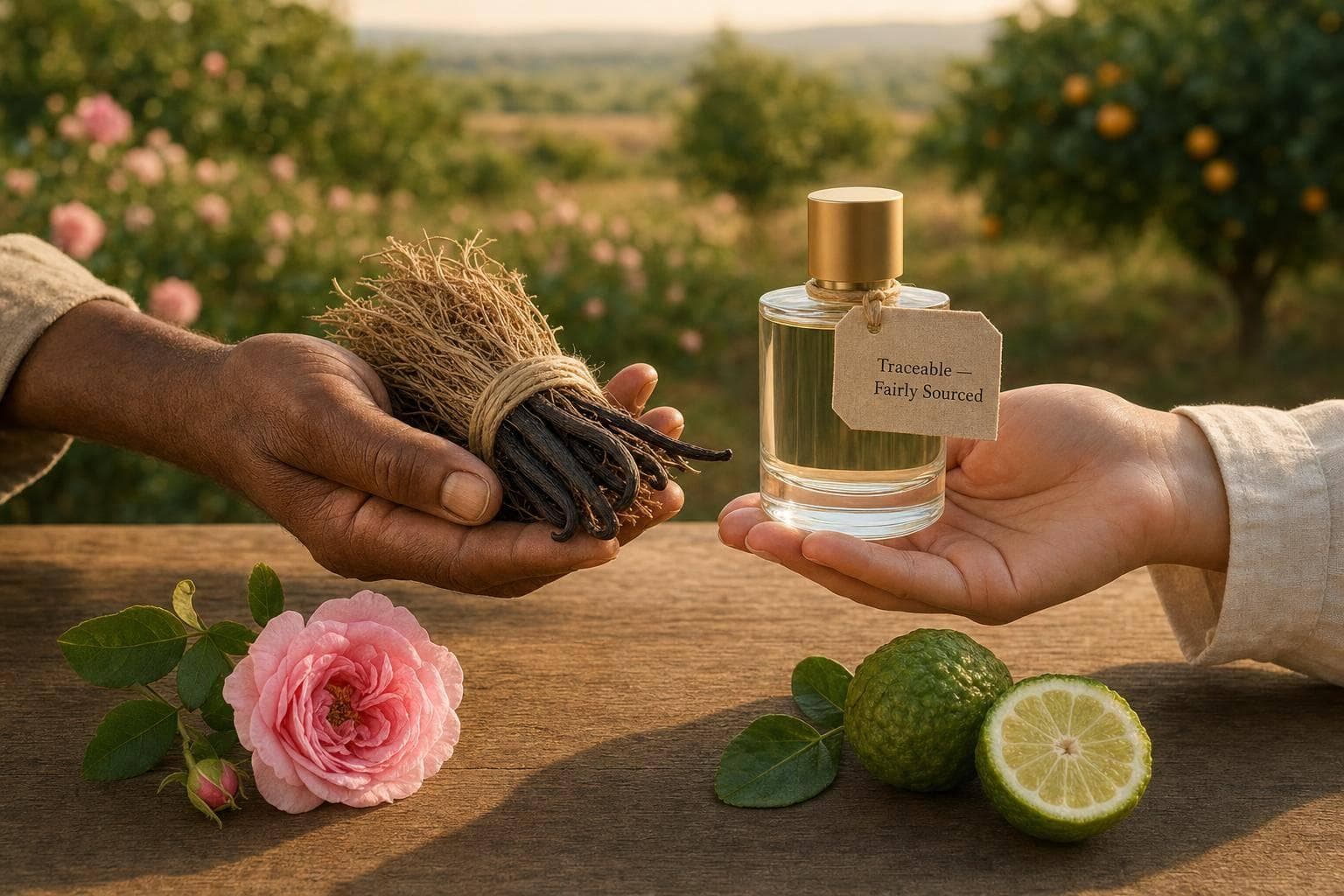
Un perfume de lujo puede tener un aroma exquisito y, aun así, proceder de una cadena de suministro deficiente. Si una fragancia emplea ingredientes naturales difíciles de rastrear, mano de obra mal remunerada o prácticas agrícolas perjudiciales para la tierra y el agua, su elevado precio pierde gran parte de su valor intrínseco.
El problema se divide en tres aspectos fundamentales: la presión medioambiental, los riesgos laborales y la falta de trazabilidad. Este artículo explica por qué esta cuestión cobra cada vez más relevancia en Alemania y en la Unión Europea, donde los compradores exigen pruebas palpables y no meras afirmaciones de sostenibilidad. Asimismo, analiza las medidas que pueden implementar las marcas: aplicar estándares de aprovisionamiento verificados, rastrear los ingredientes desde el origen hasta el frasco y recurrir a moléculas aromáticas de menor impacto cuando las opciones naturales generan una presión excesiva.
Puntos clave del artículo de un vistazo:
- Un precio de lujo no es sinónimo de un abastecimiento responsable
- Los ingredientes naturales no son automáticamente mejores
- El jazmín, el sándalo, la vainilla, la rosa, el vetiver y las resinas pueden conllevar un alto riesgo social y medioambiental
- Alemania es un mercado clave en Europa, donde los consumidores analizan el origen de los productos y la transparencia de las marcas
- Las normativas de la UE exigen cada vez más rigor a la hora de demostrar las declaraciones de sostenibilidad
- Detrás de las fragancias de prestigio pueden esconderse el trabajo infantil, la baja remuneración y una distribución desigual del valor
- La trazabilidad está vinculada hoy tanto a la reputación de la marca como al cumplimiento de las directivas europeas
- Descubrir fragancias en formatos más reducidos, como 2 ml, 5 ml u 8 ml, también contribuye a reducir el desperdicio antes de adquirir un frasco completo
Ciertas cifras reflejan la situación con claridad:
- Más del 70 % de los consumidores alemanes afirma tener en cuenta la sostenibilidad al adquirir cosméticos y productos de cuidado personal
- El 67 % desearía que todos los productos cosméticos fuesen sostenibles
- El sector de la perfumería emplea cerca de 4.000 ingredientes
- El 60 % de ellos se produce en volúmenes inferiores a 1 tonelada métrica anual
- Un perfume de lujo puede alcanzar los 200–300 € sin ofrecer garantías transparentes sobre su origen
La premisa fundamental es inequívoca: en el lujo contemporáneo, una creación olfativa excepcional, una procedencia transparente y una compra consciente deben ir siempre de la mano.
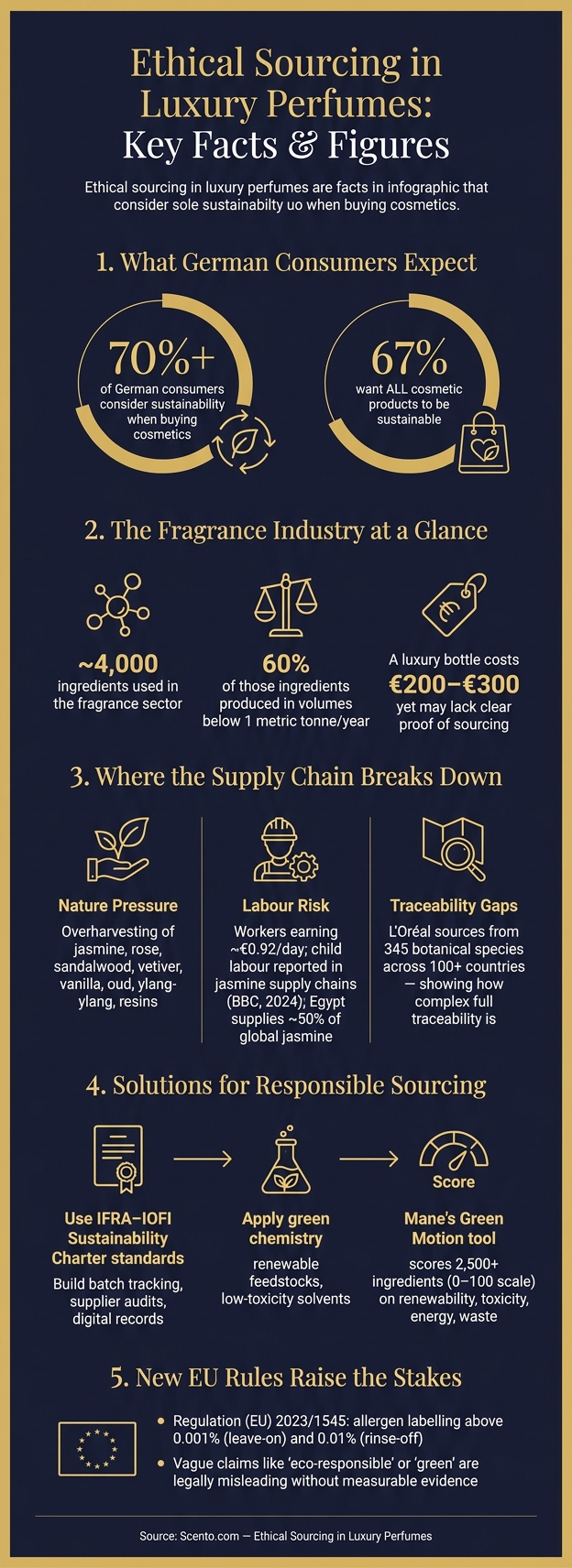
Aprovisionamiento ético en perfumes de lujo: datos y cifras clave
The main sourcing problems behind many luxury fragrances
Estas problemáticas suelen manifestarse en tres vertientes concretas: el impacto en los ecosistemas, la vulnerabilidad laboral y la falta de trazabilidad.
La presión de los ingredientes naturales de alto valor sobre el entorno
La alta perfumería recurre a materias primas naturales escasas como el jazmín, la rosa, el sándalo, el vetiver, el ylang-ylang, la vainilla, el oud y diversas resinas. Estos ingredientes exigen con frecuencia una extensión de tierra, un consumo de agua y un volumen vegetal muy superiores a lo que sugiere la esencia concentrada o el extracto final. Si la demanda crece a un ritmo superior al de un cultivo sostenible, las consecuencias directas son la sobreexplotación, el deterioro del hábitat y la pérdida de biodiversidad.
Es fácil pasar por alto la magnitud del problema. El sector de las fragancias utiliza alrededor de 4.000 ingredientes, y el 60 % de ellos se produce en volúmenes inferiores a 1 tonelada métrica al año. Ese grado de fragmentación dificulta la supervisión, incluso para las marcas que quieren hacer lo correcto.
Además, el impacto ecológico rara vez se presenta de forma aislada: con frecuencia repercute de forma directa en las comunidades situadas al inicio de la cadena productiva.
Riesgos laborales y distribución desigual del valor en las comunidades de origen
Quienes cultivan y recolectan estos preciados ingredientes se encuentran a menudo en una situación de gran desprotección. En 2024, la BBC reveló que flores de jazmín vinculadas a las cadenas de suministro de destacadas firmas de perfumería eran cosechadas por menores en Egipto, donde algunos trabajadores percibían alrededor de 0,92 € al día. Dado que Egipto produce cerca de la mitad del suministro mundial de jazmín, las condiciones laborales en esta región conciernen a una parte sustancial de la producción olfativa internacional.
Esta es la compleja realidad que esconden muchas creaciones exclusivas: un precio de venta elevado en tienda no garantiza una remuneración equitativa ni entornos de trabajo dignos en el lugar de cultivo. Cuando quienes llevan a cabo la labor más ardua reciben la menor proporción del valor generado, la narrativa del verdadero lujo pierde su fundamento.
A medida que las cadenas de aprovisionamiento se extienden a través de múltiples intermediarios y fronteras, demostrar un proceder responsable resulta infinitamente más complejo que simplemente afirmarlo.
Carencias de trazabilidad y reclamos equívocos sobre los ingredientes naturales
Las cadenas de suministro opacas y multieslabón dificultan que las marcas verifiquen la procedencia exacta de sus materias primas, su método de recolección y el estricto cumplimiento de las leyes laborales. Son muchas las firmas que recurren a intermediarios, lo que incrementa la distancia entre el cultivo y el frasco de perfume. L’Oréal informó en 2023 de que sus materias primas de origen biológico provenían de 345 especies botánicas cultivadas en más de 100 países, un dato que ilustra la complejidad intrínseca de garantizar una trazabilidad integral, incluso para los grandes líderes del sector.
Sin una trazabilidad rigurosa, cualquier declaración de prestigio queda en entredicho. Determinados estudios realizados en Alemania indican que el 70 % de los consumidores considera que un producto cosmético es sostenible por el mero hecho de incorporar ingredientes naturales. Esta percepción impulsa a las marcas a utilizar dicha terminología, aun cuando las evidencias sean frágiles. La condición de natural no equivale por defecto a sostenible.
Las autoridades reguladoras de la UE supervisan con creciente rigor las declaraciones ecológicas ambiguas y exigen que cualquier alegación medioambiental esté debidamente respaldada por pruebas concretas. De este modo, si una fragancia se comercializa como natural o sostenible a través de redes opacas, la marca se expone a exigencias legales comunitarias y al deterioro de la confianza de su clientela.
Iniciativas para optimizar las prácticas de aprovisionamiento
El abastecimiento en la perfumería de lujo solo alcanza su plenitud cuando la excelencia, la ética y las garantías verificables avanzan en perfecta sintonía. Las firmas pueden mitigar estos riesgos estableciendo directrices más estrictas, una trazabilidad diáfana y una selección consciente de sus materiales. Este compromiso se inicia en la fijación de estándares rigurosos y se consolida en la acreditación del origen y en la formulación de cada fragancia.
Adopción de estándares reconocidos y programas de colaboración a largo plazo
La Sustainability Charter de IFRA–IOFI proporciona a las casas de perfumería un marco estructurado en materia de abastecimiento responsable, reducción del impacto ecológico y transparencia corporativa, traduciendo declaraciones de intenciones en compromisos medibles.
Asimismo, cultivar vínculos estables con los proveedores resulta determinante para afianzar el suministro y proteger los ingresos en los lugares de origen, un factor indispensable cuando las materias primas están sujetas a los ciclos de las cosechas y al clima. El programa Naturals Together de Firmenich y las redes de agricultores certificados de Symrise combinan primas sobre el precio, asesoramiento agronómico y certificaciones destinadas a consolidar un abastecimiento continuo y de máxima calidad.
No obstante, los estándares por sí solos no bastan: sin la capacidad de certificar el itinerario preciso de un ingrediente, cualquier declaración carece de sustento real.
Garantizar una trazabilidad integral desde el cultivo hasta la fragancia final
El seguimiento por lotes, las auditorías independientes a proveedores y los registros digitales resultan indispensables para respaldar las comunicaciones de marca con hechos objetivos. Diptyque certifica la procedencia de cada ingrediente natural presente en sus concentrados de fragancia, un nivel de rigor que marca la diferencia en el sector.
Este control adquiere aún mayor relevancia en el entorno comunitario. Conforme al Reglamento (UE) 2023/1545, las directivas sobre el etiquetado ampliado de alérgenos exigen detallar individualmente la presencia de sustancias designadas cuando superen el 0,001 % en productos que no requieren aclarado y el 0,01 % en aquellos con aclarado. Por consiguiente, para las casas de perfumería, la trazabilidad trasciende la mera reputación y se convierte en un imperativo legal.
Una vez acreditado el origen de los componentes, el siguiente paso atañe al diseño de la propia fórmula.
Armonizar ingredientes botánicos, moléculas aromáticas y química verde
Las materias primas naturales suelen asociarse a una opción más noble o segura; sin embargo, en numerosas ocasiones los compuestos sintéticos presentan una huella ecológica notablemente inferior. Aquí es donde la química verde adquiere un papel protagonista.
Esta disciplina ofrece soluciones tangibles al servirse de materias primas renovables, catalizadores de alta eficacia y disolventes de baja toxicidad para sintetizar moléculas aromáticas. Su objetivo es inequívoco: reducir el consumo energético, la generación de residuos y los riesgos para la salud sin comprometer la sofisticación olfativa de la composición.
Diversas casas ya integran estos principios en sus cadenas de valor. Symrise aplica la certificación de Cadena de Custodia del Forest Stewardship Council (FSC) a sus insumos forestales, contribuyendo a prevenir los riesgos de deforestación en la obtención de moléculas aromáticas. Por su parte, la herramienta Green Motion de Mane evalúa cerca de 2.500 ingredientes en una escala de 0 a 100, teniendo en cuenta factores como su carácter renovable, el empleo de solventes, la toxicidad, la demanda energética y la huella de carbono residual.
Un aprovisionamiento responsable exige avalar cada decisión técnica con datos contrastables. En la alta perfumería, estas elecciones determinan el prestigio y la credibilidad de una casa tanto como la propia estela de sus perfumes.
Tu experto en fragancias personal te espera
Haz nuestro test olfativo rápido y descubre auténticos perfumes de diseñador y de nicho elegidos según tu gusto: explóralos en decants y muestras de 2, 5, 8 y 30 ml para probar cada uno antes de decidirte por un frasco completo.
Encuentra tu fraganciaLa influencia del abastecimiento ético en la reputación de la perfumería de lujo
Las deficiencias en la cadena de aprovisionamiento no quedan archivadas de manera confidencial: transforman la percepción que el público tiene sobre una firma de lujo. Hoy en día, la integridad en el origen de las materias primas consolida la confianza tanto como el propio perfil olfativo. Cuando las brechas de trazabilidad o los riesgos laborales salen a la luz, el impacto sobre la reputación resulta inmediato.
Confianza del consumidor y percepción del valor exclusivo
Un perfume de 300 € lleva implícita una premisa fundamental: la ética de su abastecimiento debe estar a la altura de su precio. Si una marca certifica que sus ingredientes clave son trazables, libres de deforestación y cosechados en condiciones justas, su narrativa adquiere una solidez incuestionable y deja de ser simple retórica publicitaria.
Los compradores en Alemania exigen evidencias tangibles: las materias primas responsables, la transparencia en los procesos y los reclamos bien documentados son prioritarios. Las declaraciones vacías de contenido debilitan el posicionamiento exclusivo de cualquier firma. De acuerdo con el marco regulatorio europeo, términos genéricos como «ecorresponsable», «verde» o «respetuoso con el medio ambiente» se consideran engañosos a menos que estén respaldados por un desempeño ecológico medible y acreditado.
Esta exigencia es comprensible: en el universo del lujo no se adquiere únicamente un aroma, sino un criterio estético riguroso y la certeza de que cada etapa de elaboración ha sido tratada con el máximo esmero.
Dicha confianza se enmarca actualmente dentro de directivas europeas cada vez más estrictas.
Mitigación de riesgos normativos y de reputación en la Unión Europea
En el territorio de la Unión Europea, las normativas de diligencia debida y contra la deforestación han convertido las garantías de aprovisionamiento en una cuestión de estricto cumplimiento normativo, más allá del valor de imagen. Las irregularidades en la cadena logística trascienden rápidamente los medios especializados para ocupar portadas de la prensa generalista. Investigaciones recientes sobre el trabajo infantil en la cosecha de jazmín o sobre acuerdos colusorios entre proveedores de esencias son claro testimonio de la inmediatez con la que esto sucede.
En mercados como el alemán, donde la sostenibilidad recibe una cobertura mediática constante, estas noticias deterioran el valor de marca con celeridad. Una casa de alta perfumería puede dedicar décadas a forjar su prestigio para verlo comprometido por un solo eslabón vulnerable.
Aquellas firmas que mapean sus orígenes botánicos, auditan rigurosamente a sus colaboradores y comparten datos objetivos reducen su exposición a riesgos y afianzan la lealtad de sus clientes.
Esta misma coherencia cobra un valor decisivo cuando el aficionado a la perfumería decide si una fragancia merece incorporarse en formato completo a su colección.
El impacto del abastecimiento responsable en el descubrimiento olfativo y la compra consciente
Cómo los formatos reducidos disminuyen el desperdicio
El aprovisionamiento ético también transforma el modo en que se descubren y disfrutan las fragancias. Con frecuencia, un perfume se adquiere tras una breve prueba en tienda, para descubrir más adelante que no evoluciona adecuadamente en la piel, no armoniza con el estilo personal o resulta poco afín a la estación del año.
En esos casos, un frasco de 200–300 € queda relegado en el tocador, lo que supone un gasto innecesario, así como un desperdicio de producto y materiales de embalaje. Adquirir exclusivamente las fragancias que se van a disfrutar plenamente es uno de los métodos más eficaces para limitar el desperdicio tras la producción, reduciendo el consumo innecesario y aliviando la presión sobre toda la cadena de abastecimiento.
Cómo favorece Scento una experiencia de compra más consciente
Por este motivo, la etapa de descubrimiento adquiere una importancia capital. Apreciar una composición en presentaciones de menor volumen permite tomar decisiones con absoluta seguridad antes de invertir en el frasco definitivo.
Scento acerca una cuidada selección de fragancias nicho y de diseñador en prácticos decants:
- 2 ml
- 5 ml
- 8 ml
- 30 ml en la gran mayoría de perfumes
Scento es un minorista especializado en muestras y decants de perfume en el que cada creación se encuentra disponible para su adquisición individual, sin compromiso de suscripción. Scento+ es el programa de membresía opcional de Scento: la cuota mensual se reintegra íntegramente como saldo en tienda para utilizar en cualquier fragancia; además, los miembros disfrutan de un 10 % de descuento, una muestra de cortesía con cada pedido, un perfume de regalo cada seis meses y un obsequio de cumpleaños, con la libertad de pausar o cancelar su suscripción en cualquier momento.
Conclusión: la ética en el origen es parte indisociable del nuevo lujo
Un descubrimiento reflexivo convierte el aprovisionamiento ético en un hábito de compra real y no en una simple promesa publicitaria. Para los amantes de la perfumería, representa la oportunidad de elegir con mayor criterio y minimizar el desperdicio. Tanto en Alemania como en el resto de la Unión Europea, esta sensibilidad convierte el descubrimiento responsable en un pilar esencial del lujo moderno.
En la alta perfumería de hoy, el abastecimiento ético y la apreciación consciente a través de formatos de prueba convergen en una misma filosofía de excelencia.
Preguntas frecuentes
¿Cómo comprobar la veracidad de las declaraciones de origen de un perfume?
Busque certificaciones independientes emitidas por entidades de prestigio reconocido como UEBT, Fair Trade, COSMOS Organic o NATRUE. Dé un paso más y contraste estas distinciones en los registros oficiales de los organismos certificadores: un sello en el estuche es una buena señal, pero la confirmación en sus bases de datos ofrece una garantía absoluta.
Asimismo, examine el cartonaje y la página oficial de la marca en busca de desgloses claros de ingredientes, informes de sostenibilidad y códigos de aprovisionamiento responsable. Ante afirmaciones ambiguas, solicite información adicional contrastada, como el Certificado de Conformidad IFRA, informes de auditoría o políticas detalladas sobre sus prácticas de aprovisionamiento.
¿Son los ingredientes sintéticos en perfumería siempre más seguros que los naturales?
No. Los compuestos sintéticos no resultan intrínsecamente perjudiciales, del mismo modo que las sustancias de origen natural no están exentas de riesgos. Lo determinante es el perfil de seguridad de la molécula, con independencia de su método de obtención.
Determinados extractos botánicos, como el jazmín, el musgo de roble o ciertos aceites esenciales, pueden contener alérgenos en su composición. Por su parte, las materias primas sintéticas pueden formularse específicamente para atenuar agentes irritantes o reducir el impacto ecológico. Ambas opciones pueden ocasionar dermatitis o sensibilidad respiratoria, razón por la cual la transparencia analítica de cada componente es fundamental.
¿Qué materias primas conllevan un mayor riesgo ético en la perfumería?
Los componentes de mayor sensibilidad ética suelen vincularse a la sobreexplotación ecológica o a condiciones laborales abusivas. El sándalo se encuentra en peligro crítico, mientras que el incienso y diversas plantas silvestres se enfrentan a la degradación de su entorno natural y a las consecuencias del cambio climático.
Por su parte, la vainilla, el jazmín y la manteca de karité pueden verse expuestos a compensaciones desproporcionadas, fuertes fluctuaciones de precio e incluso a explotación laboral. Ingredientes de rendimiento extractivo muy reducido, como la rosa y el lirio de Florencia, demandan ingentes recursos agrícolas que pueden propiciar el agotamiento de los suelos.

