Bambus, eine synthetische Schöpfung der Parfümerie, ist zu einem Eckpfeiler asiatisch inspirierter Düfte geworden. Trotz seines natürlichen Vorkommens lässt sich aus Bambus kein ätherisches Öl gewinnen; daher bilden Parfümeure sein Aroma mithilfe grüner Moleküle (cis-3-hexenol), ozonischer Elemente (Calone) und leichter holziger Basen nach. Das Ergebnis? Ein Duft, der an taubenetzte Blätter, zarte Triebe und eine reine, wässrige Frische erinnert.
Die wichtigsten Höhepunkte des Artikels:
- Symbolik: Bambus verkörpert in der ostasiatischen Kultur Widerstandskraft, Anmut und Ausgewogenheit und wird oft mit Zen — Gärten und Teeritualen in Verbindung gebracht.
- Olfaktorisches Profil: Typischerweise 75 % grün, 45 % frisch und 10 % holzig – Bambusakkorde sind leicht und luftig, was sie ideal für Unisex-, aquatische und grün-florale Düfte macht.
- Duftbeispiele:
- Haiku — Sillage de Thé (Masakï Matsushima): Bambusblatt, Bergamotte, Matcha, Tiaré — Blüte, Moschus und Vanille.
- Bamboo & Lavender (Sweet Nothings Perfumery): Die Frische des Bambus, gepaart mit der krautigen Wärme des Lavendels.
- ZHUFU (Baroma): Grüne, wässrige Bambus — Kopfnoten, inspiriert von ostasiatischer Ästhetik.
- Trends: Bambus definiert grüne Düfte neu, wobei Nischenmarken den Wandel hin zu leichteren, transparenteren Kompositionen anführen, die hervorragend mit Zitrusfrüchten, weißem Tee und sanften Moschusnoten harmonieren.
- Preise: Die Düfte decken eine breite Preisspanne ab, wie etwa Akatsuki (160,00 €/50 ml) oder Bamboo Forest (37,00 €/50 ml).
Bambus verleiht der modernen Parfümerie neue Impulse, indem er eine klare, subtile Alternative zu traditionellen Hölzern bietet. Seine wachsende Beliebtheit spiegelt die steigende Nachfrage nach naturinspirierten Unisex — Düften wider, die Eleganz mit Schlichtheit verbinden.
5 erschwingliche BAMBUS — Düfte für einen reinen & grünen Sommer!
Haiku — Sillage de Thé von Masakï Matsushima
Lanciert im Jahr 2017, ist Haiku — Sillage de Thé das Werk des Parfümeurs Jean Jacques, kreiert für das japanisch inspirierte Haus Masakï Matsushima. Dieser Unisex — Duft ist eine Hommage an die meditative Atmosphäre ostasiatischer Teezeremonien und fängt die Harmonie und Einfachheit dieser Rituale ein. Der Duft entführt in einen friedvollen Garten, in dem die reine Eleganz des Bambus im Mittelpunkt steht und Tradition mit zeitgemäßer, universeller Anziehungskraft verbindet.
Hauptnoten und Komposition
Der Duft eröffnet mit einer erfrischenden Liaison aus Bambusblatt und Bergamotte. Das Bambusblatt bringt eine zarte, grüne Frische ein, während Bergamotte eine spritzige, zitrische Klarheit verleiht – ein Auftakt, der gleichermaßen beruhigend und belebend wirkt.
Im Herzen der Komposition vereinen sich Matcha und Tiaré — Blüte. Matcha verleiht eine erdige, teeartige Tiefe, meisterhaft ausbalanciert durch die cremige, tropische Süße der Tiaré.
Die Basis vollendet das Dufterlebnis mit Moschus, solaren Noten und Vanille, die eine wärmende, sonnendurchflutete Aura schaffen, die sanft auf der Haut nachklingt.
Duftprofil und Inspiration
Beschrieben als „eine erfrischende Pause in einer hektischen Welt“, fängt dieser Duft das Wesen frischer, grüner, aquatischer und zitrischer Akkorde ein. Seine Komposition spiegelt die zeitgenössische Hinwendung zu naturnahen Düften wider. Mit seinem Unisex — Charakter trifft Haiku — Sillage de Thé den Nerv der Zeit und spricht den Wunsch nach Düften an, die traditionelle Geschlechtergrenzen überwinden und stattdessen auf botanische Reinheit und Eleganz setzen.
Bamboo & Lavender von Sweet Nothings Perfumery
Bamboo & Lavender von Sweet Nothings Perfumery vereint die klare, botanische Frische synthetischen Bambus mit der krautigen Wärme von Lavendel zu einem kontemplativen Dufterlebnis. Während Bambus oft mit aquatischen, frischen Profilen assoziiert wird, wählt dieser Duft einen anderen Weg. Durch das Zusammenspiel mit den beruhigenden, aromatischen Qualitäten des Lavendels interpretiert die Komposition die Rolle des Bambus in der modernen Parfümerie neu.
Duftübersicht
Die Bambusnote, synthetisch komponiert, um lebendiges Grün und ein Gefühl von „Freiraum“ zu evozieren, bringt eine klare, aquatische Frische ein. Lavendel schenkt ihr eine sanfte, krautige Tiefe, die die Schärfe des Bambus mildert. Gemeinsam bilden sie einen frischen, grünen, aromatischen und floral-krautigen Duft. Bambus dient als struktureller Kern, während Lavendel eine behagliche Wärme spendet – ein vollendet ausgewogenes und raffiniertes Profil.
Diese Kombination harmoniert perfekt, da sich die wandelbare Natur des Bambus nahtlos sowohl mit frischen als auch mit warmen Facetten verbindet. Lavendel unterstreicht den klaren, reinen Charakter des Bambus, ohne ihn zu dominieren, und verleiht dem Duft eine Eröffnung von bemerkenswerter Finesse und Vielschichtigkeit.
Moderne asiatisch-botanische Einflüsse
Inspiriert vom Zen — Minimalismus schöpft der Duft aus der Symbolik des Bambus und erinnert an ostasiatische Gärten und Teerituale. Er spiegelt Motive spiritueller Reinheit und Harmonie wider und verbindet traditionelle Ästhetik mit einem avantgardistischen Anspruch.
ZHUFU von Baroma
ZHUFU von Baroma fängt die Essenz des Bambus in seinen Kopfnoten ein und entfaltet eine natürliche Eleganz, die der vergänglichen Schönheit dieser ikonischen Pflanze huldigt. Inspiriert von der tiefen kulturellen Verankerung des Bambus in Ostasien, balanciert der Duft Kraft und Zartheit meisterhaft aus und schafft eine Duftsignatur von zeitloser Vergänglichkeit.
Die Rolle des Bambus in ostasiatischen Traditionen
In der ostasiatischen Kultur ist Bambus weit mehr als eine Pflanze – er ist ein Symbol für Standhaftigkeit und Grazie. Berühmt für seine Fähigkeit, sich im Wind zu wiegen, ohne zu brechen, verkörpert Bambus Tugenden wie Ausdauer und Anpassungsfähigkeit. Diese Wesenszüge sind tief im kulturellen Bewusstsein verankert und spiegeln sich in der Zen-Ästhetik wider. Bambus prägt Gärten und Teezeremonien gleichermaßen und steht für Einfachheit, Stille und Einklang. ZHUFU kanalisiert diese Symbolik und präsentiert einen Duft voller Gelassenheit und Zurückhaltung, fernab jeder Schwere.
Das Duftprofil
ZHUFU verwandelt die kulturelle Bedeutung des Bambus in eine sensorische Reise. Der Duft eröffnet mit einer reinen, grünen und wässrigen Frische, die die Unberührtheit der Pflanze nachzeichnet. Da ein natürliches ätherisches Öl aus Bambus nicht existiert, greifen Parfümeure auf Synthetika wie cis-3-hexenol und Calone/Helional zurück, um seine luftigen, belebenden Facetten nachzubilden. Dieser Kunstgriff erschafft das, was Duftexperten als „olfaktorisches Äquivalent von Freiraum“ bezeichnen – ein Gefühl von Weite und Minimalismus. Premiere Peau beschreibt diese Nuance treffend als das prägende Element der ätherischen Kopfnote.
Ihr persönlicher Duftexperte erwartet Sie
Machen Sie unser kurzes Duftquiz und entdecken Sie authentische Designer- und Nischenparfums, die zu Ihrem Geschmack passen – als 2–8ml Dekants und Proben, damit Sie jeden Duft testen können, bevor Sie sich für einen ganzen Flakon entscheiden.
Finden Sie Ihren DuftBambussprossen in zitrisch-grünen Parfums
Bambus besitzt eine traditionsreiche symbolische Bedeutung in der asiatischen Duftkunst. In Kombination mit zitrischen und grünen Noten entstehen Parfums von lebendiger Ausgewogenheit. Seine wässrige Frische unterstreicht die Strahlkraft von Zitrusnoten, während holzige Untertöne der Komposition Tiefe verleihen und eine harmonische Brücke zwischen diesen Elementen schlagen.
Klassische zitrisch-grüne Duftkombinationen
Asiatisch inspirierte Parfums zelebrieren gerne die Harmonie zwischen Bambus und Zitrusfrüchten. Ein herausragendes Beispiel ist Akatsuki von Tada Parfumeur (Thailand). Dieser Duft vermählt Bambus mit Grapefruit und aquatischen Noten, veredelt durch Tomatenblatt und Galbanum zu einem ausgesprochen frischen, grünen Profil. Die Kreation erinnert an einen Spaziergang durch einen morgendlichen Bambuswald. Ein 50-ml — Flakon liegt bei 160,00 $.
Ein weiteres Glanzlicht ist Poème de Sagano von Ella K, eine Komposition aus einer Zitrus — Melange aus Yuzu, Bergamotte und Grapefruit, vereint mit Bambus, Matcha — Tee und Shiso — Blättern. Die Parfümeurin Sonia Constant beschreibt ihren kreativen Prozess:
„Um dieses Gefühl der Frische und das Leuchten des Grüns einzufangen, habe ich an einem Akkord aus Matcha — Tee, fein geschnittenen Shiso — Blättern und Nana — Minze gearbeitet... Das Strahlen der Sonne fing ich mit Hesperidien, leuchtender Yuzu und Bergamotteöl ein.“
Dieses Parfum ist für 222,69 € im 100-ml — Flakon erhältlich.
Das in Singapur ansässige Haus KIRI Scents präsentiert Bamboo Forest, das Bambus und Zitrone in der Kopfnote mit weißem Tee und Mandarine im Herzen kombiniert. Dieses Parfum mit einer Konzentration von 30 % erlesener Duftöle (Extrait de Parfum) wird für 37,00 $ pro 50 ml angeboten. In ähnlicher Weise verbindet Bamboo Harmony von Kilian Bambus mit Bitterorange und Neroli und erinnert an die Erhabenheit einer Teezeremonie.
Diese Schöpfungen zeigen das wachsende Interesse an der Rolle des Bambus innerhalb grüner Kompositionen, wo sein feingliedriger Charakter auf brillante Zitruselemente trifft.
Trends bei grün-holzigen Kompositionen
Bambus definiert den Zugang zu grünen Noten in der Haute Parfumerie neu. Kate Shulga unterstreicht diesen Wandel:
„In einem Markt, der von lauten, opulenten Düften dominiert wird, ist die subtile und zugleich ausdrucksstarke Bambusnote die Speerspitze der modernen Bewegung für grüne Düfte.“
Anders als traditionelle synthetische Grasnoten bringt Bambus eine „aquatische Transparenz“ und ein „taufrisches, lebendiges Grün“ mit sich – ganz ohne die Bitternis klassischer grüner Parfums.
Asiatische Nischenmarken nehmen hierbei eine Vorreiterrolle ein. Aufstrebende Häuser aus Thailand (Tada Parfumeur), Singapur (KIRI Scents) und Vietnam (d’Annam) kreieren Parfums, die konkrete Landschaftsbilder wie den Bambuswald von Arashiyama in Kyoto heraufbeschwören, anstatt auf gewöhnliche grüne Noten zu setzen. Diese Kreationen setzen auf subtile, beruhigende Düfte, die eine ganz persönliche Aura der Stille schaffen – perfekt für das Büro und warme Klimazonen.
Vergleichstabelle bambusbetonter Parfums
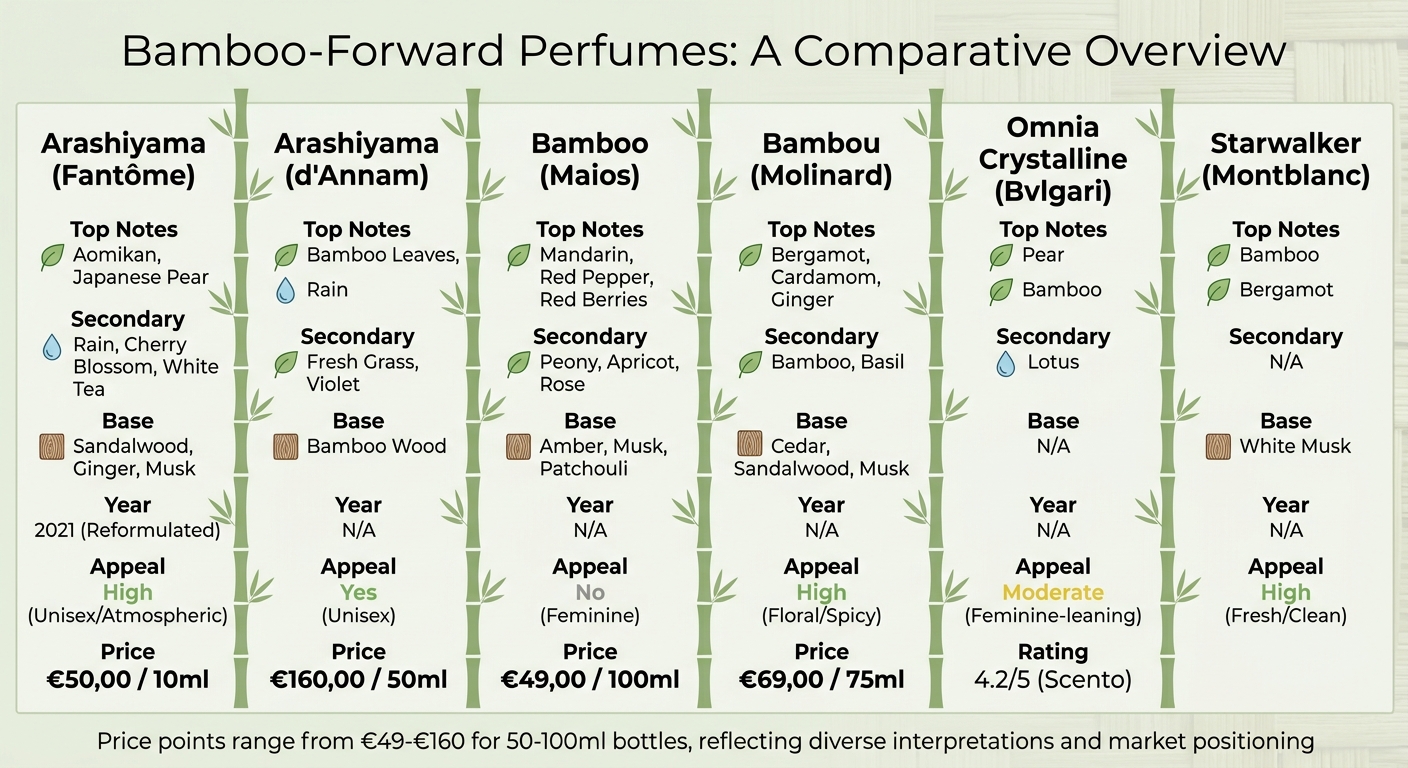
Asiatische Parfums mit Bambusnote: Komposition und Profil im Vergleich
Vergleichskriterien
Diese Übersicht zeigt die charakteristischen Merkmale asiatisch inspirierter Düfte mit dominanter Bambusnote:
| Parfum | Kopfnoten | Herzakkorde | Basisnoten | Erscheinungsjahr | Unisex — Charakter |
|---|---|---|---|---|---|
| Arashiyama (Fantôme) | Aomikan, Nashi — Birne | Regen, Kirschblüte, Weißer Tee | Sandelholz, Ingwer, Moschus | 2021 (Reformuliert) | Hoch (Unisex/Atmosphärisch) |
| Arashiyama (d’Annam) | Bambusblätter, Regen | Frisches Gras, Veilchen | Bambusholz | N/A | Ja (Unisex) |
| Bamboo (Maios) | Mandarine, Roter Pfeffer, Rote Beeren | Pfingstrose, Aprikose, Rose | Amber, Moschus, Patchouli | N/A | Nein (Feminine Ausrichtung) |
| Bambou (Molinard) | Bergamotte, Kardamom, Ingwer | Bambus, Basilikum | Zeder, Sandelholz, Moschus | N/A | Hoch (Floral/Würzig) |
| Omnia Crystalline (Bvlgari) | Birne, Bambus | Lotus | N/A | N/A | Moderat (Eher feminin) |
| Starwalker (Montblanc) | Bambus, Bergamotte | N/A | Weißer Moschus | N/A | Hoch (Frisch/Klar) |
Die Interpretationen des Sagano — Bambuswaldes in Kyoto durch Fantôme und d’Annam schlagen ganz unterschiedliche Richtungen ein. Fantôme verbindet fruchtige und florale Noten mit einer regennassen Atmosphäre, während d’Annam auf einen puristischen, grün-holzigen Duft setzt, der die Ursprünglichkeit des Bambus und frisch aufgeschnittener Sommerfrüchte einfängt.
Maios Bamboo richtet sich mit süßen Frucht- und Blütennuancen wie Pfingstrose und roten Beeren an eine feminine Zielgruppe. Molinard’s Bambou hingegen überrascht mit einem würzig-zitrischen Akzent aus Kardamom und Ingwer. Bvlgari’s Omnia Crystalline besticht durch sanfte aquatische Femininität, während Montblanc’s Starwalker eine frische, moschusartig-holzige Note für Herren bietet.
Auch preislich zeigen sich deutliche Unterschiede: Das Parfümöl von Fantôme liegt bei 50,00 € für 10 ml, d’Annam’s Eau de Parfum kostet 160,00 € für 50 ml, Molinard’s Bambou liegt bei 69,00 € für 75 ml und Maios Bamboo bei 49,00 € für einen 100-ml — Flakon. Diese Vielfalt unterstreicht das facettenreiche Spektrum bambusinspirierter Düfte, das sowohl künstlerische Visionen als auch individuelle Vorlieben widerspiegelt.
Aktuelle Trends in der Bambus — Parfümerie
Social — Media- und Nischenduft — Trends
In Duft — Communitys hat sich Bambus zu einem Sinnbild für grün-holzigen Minimalismus entwickelt. Seine natürliche, luftige Leichtigkeit harmoniert perfekt mit dem Trend zu „Skin Scents“, bei denen Sanftheit und Transparenz wichtiger sind als raumfüllende Projektion. Parfümeure verfeinern Bambusakkorde gezielt, um einen beinahe schwerelosen Effekt zu erzielen.
Nischenhäuser wie Vilhelm Parfumerie, d’Annam und Fantôme sind hier führend und entführen mit ihren Parfums in friedvolle asiatische Landschaften. Poets of Berlin von Vilhelm kombiniert beispielsweise Bambus mit Blaubeere und Zitrone und erreicht eine beachtliche Bewertung von 4,3/5 auf Scento. d’Annam’s Arashiyama wiederum glänzt mit einer perfekten 5,0/5 — Bewertung aus sechs Rezensionen, wobei Kenner den Duft als „sanft, grün und tröstlich“ beschreiben.
Moderne Bambusdüfte integrieren zudem typisch asiatische Botanicals wie Aomikan, weißen Tee, Kirschblüte und Nashi — Birne. Diese Kompositionen wecken Assoziationen an nebelverhangene Wälder und kontemplative Zen — Gärten – Ausdruck eines klaren Wunsches nach unverfälschten, von der Natur inspirierten Duftwelten.
Zukunftsperspektiven für Bambusdüfte
Während Nischenmarken stetig neue Wege gehen, rücken auch renommierte Designerhäuser den Bambus vermehrt in den Fokus. Molinard’s Bambou (69,00 € für 75 ml) aus der Kollektion La Fraîcheur verbindet Bambus mit Kardamom, Ingwer und Zeder zu einem würzigen und dennoch frischen Erlebnis. Bvlgari’s Omnia Crystalline (bewertet mit 4,2/5 auf Scento) verdeutlicht, wie etablierte Maisons die lichten Qualitäten des Bambus mit Birne und Lotus in floral-aquatische Bouquets einweben.
Die symbolische Verbindung von Bambus zu Zen-Ästhetik und dezenter Eleganz bleibt der Kern seiner Faszination. Einst eine feine Begleitnote, avanciert er heute zum Hauptdarsteller der modernen Duftkreation. Wie Première Peau treffend bemerkt: „Die besten Bambusakkorde erzeugen eine stille, fast unhörbare Frische – ein minimalistischer, luftiger Akkord.“ Diese Entwicklung lässt erwarten, dass künftig noch mehr Luxushäuser Bambus in ihre Frische — Kollektionen aufnehmen werden, um jene Liebhaber anzusprechen, die zeitgemäße, pflanzliche Unisex — Kreationen schätzen.
Bambus: Eine Note von stiller Eleganz
Bambus ist weit mehr als nur eine grüne Note in der Duftwelt – er ist eine Hommage an die ostasiatische Ästhetik und beschwört Bilder von erhabenen Zen — Gärten, meditativen Teezeremonien und tiefer innerer Ruhe herauf. Als kunstvoll komponierter Akkord vereint er grüne, wässrige und feine holzige Nuancen und bereichert Kopf-, Herz- und Basisnoten gleichermaßen. Er geht eine wunderbare Symbiose mit Zitrusnoten, weißem Tee und zartem Moschus ein und verströmt zeitlose Frische.
Die hier vorgestellten Kreationen belegen die Vielseitigkeit des Bambus auf eindrucksvolle Weise. Von der würzigen Eleganz in Molinard’s Bambou (69,00 € für 75 ml) bis zur atmosphärischen Tiefe von d’Annam’s Arashiyama (bewertet mit 5,0/5) beweist Bambus, wie mühelos er zwischen kristalliner Aquatik und sanftem Blattgrün changiert. Vilhelm Parfumerie’s Poets of Berlin bietet eine transparente Hautduft — Qualität, während Bvlgari’s Omnia Crystalline aquatische und florale Noten meisterhaft verschmilzt. Diese Bandbreite lädt dazu ein, diese Düfte selbst zu entdecken.
Das Entdecken durch Duftproben ist der schönste Weg, die Facetten des Bambus kennenzulernen. Mit Duftabfüllungen in 2-ml-, 5-ml- und 8-ml — Größen von Scento können Sie die verschiedenen Kreationen ganz in Ruhe vergleichen, bevor Sie sich für einen ganzen Flakon entscheiden. So erleben Sie hautnah, wie unterschiedlich Parfümeure das Wesen des Bambus interpretieren – von aquatischer Frische über klares Grün bis hin zu zarten Holznuancen.
Die wachsende Präsenz von Bambus in der Parfümerie spiegelt die Vorliebe für naturnahe Unisex — Kreationen und minimalistische Kompositionen wider, die Subtilität über pure Duftstärke stellen. Indem Nischen- wie Designerhäuser weiterhin mit dieser facettenreichen Note experimentieren, erobert sich Bambus einen festen Platz in der modernen Duftwelt. Er schenkt eine erfrischende, zeitlose Alternative zu schweren klassischen Hölzern – ein neues Kapitel hoher Duftkunst, das handwerkliches Können mit Innovation vereint.
Häufig gestellte Fragen
Warum wird Bambus in Parfums meist synthetisch nachgebildet?
Bambus wird in Parfums nahezu ausschließlich synthetisch kreiert, da die natürliche Pflanze so gut wie kein ätherisches Öl liefert. Durch synthetische Akkorde fangen Parfümeure seinen unverwechselbaren Charakter ein und schaffen ein Zusammenspiel aus aquatischer Frische, knackigem Grün und holziger Leichtigkeit. Dieser Ansatz ermöglicht es, die typische Essenz des Bambus einzufangen, die auf natürlichem Wege nicht gewonnen werden kann.
Wie duftet eine Bambusnote auf der Haut?
Auf der Haut entfaltet eine Bambusnote ein reines, grünes und wässriges Aroma mit dezenten holzigen Untertönen. Sie erinnert an einen Morgenspaziergang durch einen Hain voller taufrischer Triebe und schenkt ein klares, luftiges Dufterlebnis von belebender Leichtigkeit.
Welche Duftnoten harmonieren am besten mit Bambus für einen reinen Unisex — Charakter?
Bambus harmoniert perfekt mit zitrischen, aquatischen, grünen und holzigen Noten zu einem ausgewogenen, reinen Unisex — Profil. Essenzen wie Bergamotte, Mandarine, Zeder und Sandelholz kommen dabei besonders schön zur Geltung. Sie unterstreichen die frischen, klaren und luftigen Facetten des Bambus und machen ihn zur idealen Wahl für Liebhaber dezenter Eleganz.

