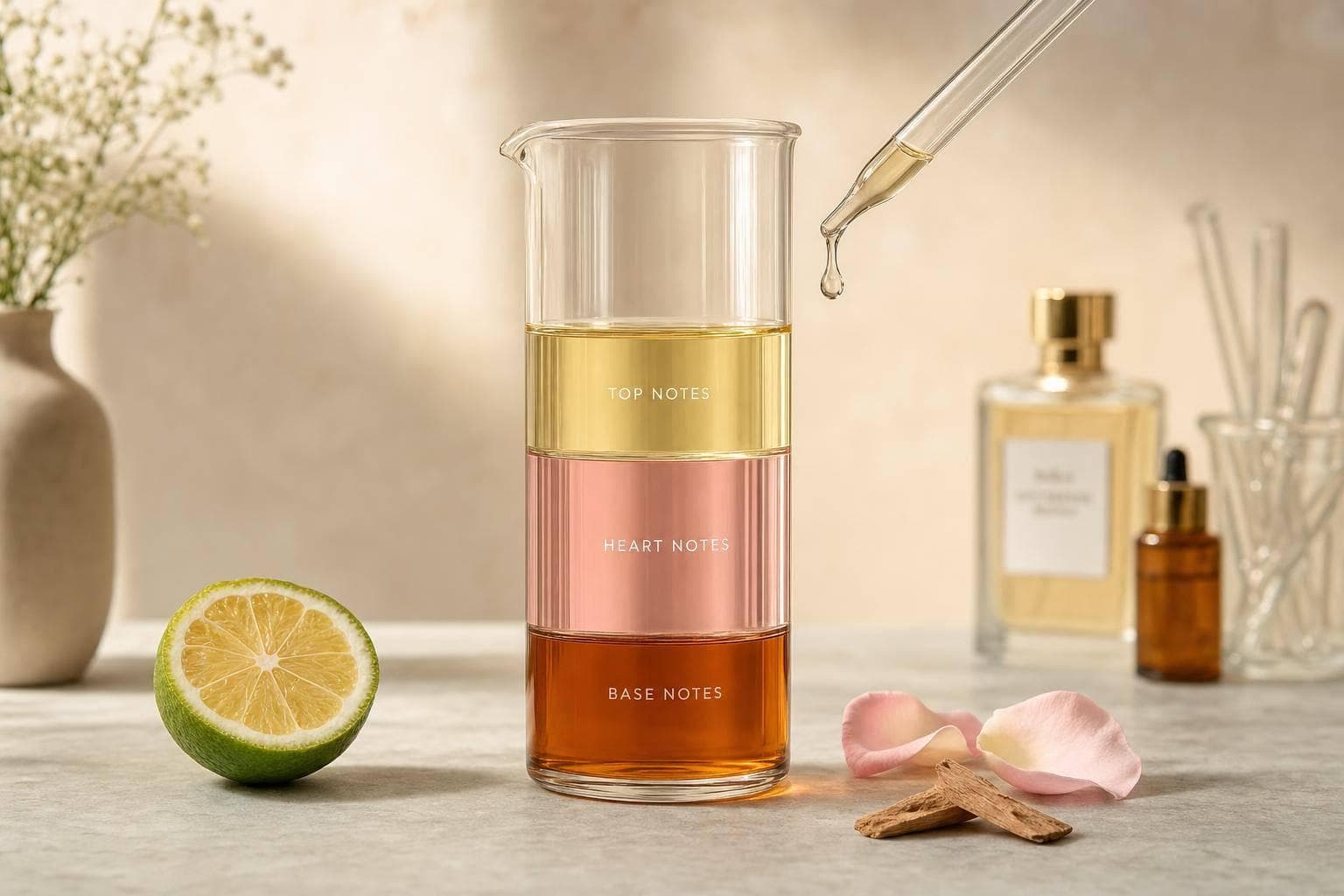
If I had to boil perfume work with plant oils down to four points, it would be this: pick the right extract, place it in the right note slot, blend in small test batches, and check safety before skin use.
Many perfume blends fail for simple reasons. A citrus oil fades fast. A floral absolute feels too heavy. A base note takes over the whole drydown. And a nice-smelling formula can still break IFRA or EU allergen rules. That’s why I look at extraction, note structure, blend ratio, and compliance as one system.
Here’s the short version:
-
Extraction changes smell and performance
- Steam distillation makes up over 90 % of global oil volume
- Cold expression is used mainly for citrus peels
- CO₂ extracts often smell closer to the source plant
- Solvent extraction is common for delicate florals like jasmine and tuberose
-
Perfume structure follows evaporation speed
- Top notes: about 15 minutes to 2 hours
- Heart notes: about 1 to 5 hours
- Base notes: about 4 to 12 hours or more
-
Starting concentrations are simple
- Eau de Toilette: 8–12 %
- Eau de Parfum: 15–20 %
- Parfum/Extrait: 20–40 %
- Oil roller for daily wear: 1–5 %
-
A basic accord can start at 30/50/20
- 30 % top
- 50 % heart
- 20 % base
-
Safety is not optional
- Facial leave-on products often stay around 0,5–1,0 %
- Body leave-on products often stay around 1–2 %
- EU allergen labelling can apply from 0,001 % in leave-on products
- Expressed citrus oils need extra care for sun exposure
Quick comparison
| Area | What I check first | What changes most |
|---|---|---|
| Extraction | Steam, cold expression, solvent, CO₂ | Smell, cost, shelf life |
| Note role | Top, heart, base | Opening, body, drydown |
| Blend strength | % of aromatic concentrate | Wear, diffusion, skin feel |
| Safety | IFRA Category 4, allergens, supplier documents | Max use level, labelling, skin risk |
One number says a lot about why material choice matters: rose otto yields only about 0,02–0,04 %, so 1 kg can take 3.500–5.000 kg of petals. That’s part of why naturals can smell different, cost different, and need different dosing from one extract to another.
So if you want a simple way to judge any perfume oil, I’d use this order:
- How was it extracted?
- Where does it sit in the evaporation curve?
- How much should go into the formula?
- Is it safe and correctly documented?
That framework gives me a clear path before I even start blending.
How Perfumery Essential Oils Are Extracted
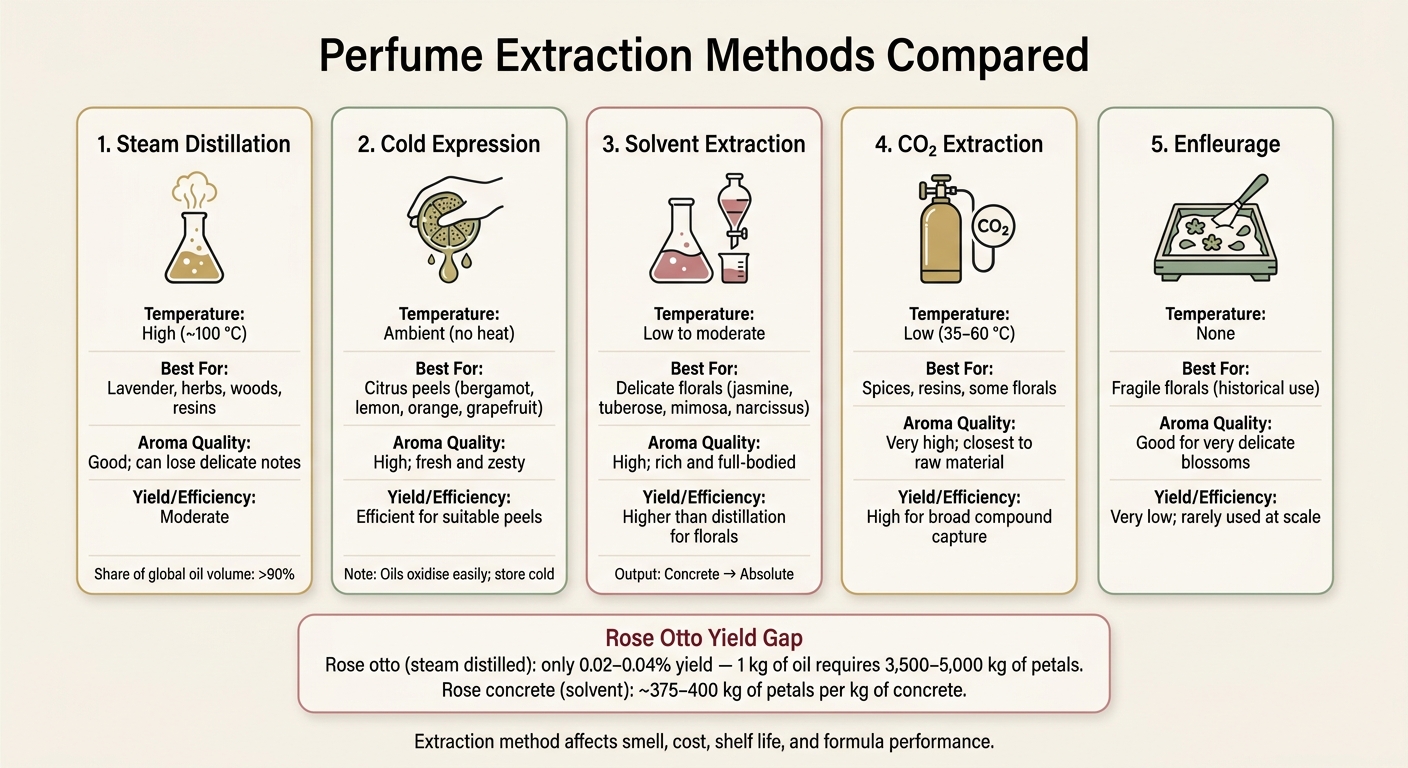
Perfume Extraction Methods Compared: Steam, Cold Press, Solvent & CO₂
Before you blend anything, it helps to know how the oil was made. Extraction changes the smell, shelf life, price, and even how the material behaves once it’s inside a formula.
Steam Distillation, Cold Expression, and Solvent Extraction
Steam distillation is still the main industrial method. It accounts for more than 90 % of global essential oil volume. In simple terms, plant material is exposed to steam, then the vapour is cooled so the oil can separate from the water. It works well for lavender, peppermint, eucalyptus, woods, herbs, and many resins.
There is one catch: heat changes things. Delicate top-note facets can soften or shift, so the final oil may smell a bit lighter or more airy than the living plant.
Cold expression is almost only used for citrus peels like bergamot, lemon, orange, and grapefruit. It’s a mechanical process. The peel is pricked and rasped in a rotating container, which breaks the oil glands. The oil-and-juice emulsion is then centrifuged to separate out the oil.
Because no heat is involved, citrus keeps its bright, sparkling profile. But there’s a downside here too. Expressed oils oxidise more easily, so they’re often stored cold and sometimes under nitrogen.
Solvent extraction is the go-to method for delicate florals that can’t handle steam distillation. That includes jasmine, tuberose, mimosa, narcissus, and orange blossom. A solvent such as hexane dissolves the aromatic compounds into a waxy material called a concrete. That concrete is then washed with alcohol to produce an absolute.
For perfumers, absolutes are often easier to work with because they’re more fluid and more concentrated than concretes. In fine fragrance, that makes dosing simpler.
Rose shows the yield gap very clearly. Distilling rose is famously inefficient: rose otto yields only 0,02–0,04 % of petal weight, so 1 kg of oil may need 3.500–5.000 kg of petals. Solvent extraction is far more efficient here. Rose concrete yields at around 375–400 kg of petals per kilogram of concrete. That huge difference helps explain why rose materials can vary so much in price and dosage.
CO2 Extraction and Enfleurage
CO₂ extraction uses supercritical carbon dioxide as a solvent at 35–60 °C. Since the process runs at a lower temperature, it can pull a broader range of aromatic compounds than steam distillation.
That makes it especially useful for spices, resins, herbs, and some florals. Many perfumers say CO₂ extracts smell closer to the fresh plant, with more depth and detail than the matching distilled oil. The drawback is cost. The equipment is complex, and the process costs more to run, so CO₂ extracts usually come in at a higher price point than steam-distilled materials.
Enfleurage is an older method, but it’s still worth knowing. Blossoms were placed on or in fat, which slowly absorbed their scent. It was very gentle, which made it suited to fragile flowers. Still, it was also slow and labour-heavy, so it’s rarely used at scale today.
Extraction Methods Compared
| Method | Temperature | Best For | Aroma Quality | Yield / Efficiency |
|---|---|---|---|---|
| Steam distillation | High (~100 °C) | Lavender, herbs, woods, resins | Good; can lose delicate notes | Moderate |
| Cold expression | Ambient | Citrus peels | High; fresh and zesty | Efficient for suitable peels |
| Solvent extraction | Low to moderate | Delicate florals, waxy materials | High; rich and full-bodied | Higher than distillation for florals |
| CO₂ extraction | Low (35–60 °C) | Spices, resins, some florals | Very high; close to the raw material | High for broad compound capture |
| Enfleurage | None | Fragile florals, historically | Good for very delicate blossoms | Very low |
In perfumery, extraction affects more than smell. It also shapes stability, cost, and formula performance. And yes, it can change where a material feels most at home in a perfume - top, heart, or base.
Your Personal Fragrance Expert Awaits
Take our quick scent quiz to discover authentic designer and niche fragrances matched to your taste — explore them as 2ml, 5ml, 8ml & 30ml decants and samples, so you can try each one before committing to a full bottle.
Find Your ScentEssential Oil Families, Notes, and Perfume Structure
Once extraction is clear, the next piece is note position: how an oil behaves inside a blend. That comes down to volatility, or how fast a material evaporates from skin.
Top, Heart, and Base Notes in Natural Perfume Building
Extraction shapes the smell. Volatility shapes how the perfume wears.
Perfumers often read a fragrance as an evaporation curve: intensity over time as each layer rises, shifts, and fades. Top, heart, and base notes don’t change over like stage lights flipping on and off. They overlap.
Top notes are the most volatile. They give the first impression, then disappear the fastest. Citrus oils such as bergamot, lemon, and grapefruit are classic top notes, along with light herbaceous materials like basil and peppermint. Top notes last 15 minutes to 2 hours; heart notes 1 to 5 hours; base notes 4 to 12 hours or longer.
Heart notes sit in the middle, with moderate volatility. This is usually where the main personality of the fragrance shows up after the opening settles. Florals, spices, and aromatic herbs often live here: rose, jasmine, neroli, ylang-ylang, lavender, cardamom, and geranium are common choices. In some formulas, heart materials can make up 50–80 % of the aromatic concentrate.
Base notes move the slowest. Woods, resins, and earthy oils like cedarwood, patchouli, vetiver, frankincense, and myrrh add depth, structure, and staying power. On skin, they can last 4 to 12 hours or more. On blotters, patchouli and vetiver may linger for days.
Note position isn’t fixed. Lavender, for example, is both herbaceous and floral, so it can sit between the top and heart depending on dose and formula style. Frankincense can do something similar between the heart and base. These bridge oils matter because they soften the handoff between layers and stretch the evaporation curve, so the fragrance feels smoother over time.
The Main Olfactory Families in Essential Oil Perfumery
Olfactory families group oils by their main scent profile. It’s a simple way to know what to reach for when building a formula, and these families line up neatly with the note structure above.
- Citrus oils are bright, tangy, and zesty, often tied to freshness and cleanliness.
- Floral oils can feel delicate or rich, with sweet, romantic, or powdery facets.
- Herbaceous oils smell green and aromatic, sometimes a little medicinal or apothecary-like.
- Spicy oils feel hot, pungent, and warm.
- Woody oils are deep, warm, or dry and often help anchor the base.
- Resinous/Balsamic oils are warm, sweet, and at times smoky or balsamic.
- Earthy oils feel grounding, rooty, damp-soil-like, and dark.
In practice, citrus lifts the opening, florals and herbs shape the body, and woody or resinous materials carry the drydown.
Essential Oils Mapped by Family and Note Position
The table below maps common essential oils to their olfactory family, note position, and role in a composition.
| Essential Oil | Family | Note Position | Role |
|---|---|---|---|
| Bergamot | Citrus | Top | Brightens the opening; softens other citrus notes |
| Lemon | Citrus | Top | Adds crisp freshness |
| Neroli | Floral / citrus-floral | Top–heart | Bridges freshness and floral elegance |
| Lavender | Herbaceous / aromatic | Top–heart | Links aromatic freshness to the heart |
| Rose | Floral | Heart | Defines the central floral character |
| Cardamom | Spicy | Heart–base | Adds warm spice that carries into the drydown |
| Frankincense | Resinous | Heart–base | Adds incense-like warmth and smooths the heart-to-base transition |
| Cedarwood | Woody | Base | Adds dry structure and fixative support |
| Patchouli | Woody / earthy | Base | Grounds the blend with earthy depth and strong tenacity |
| Vetiver | Woody / earthy | Base | Provides earthy dryness and excellent longevity |
| Myrrh | Resinous | Base | Adds heavy, balsamic depth and a meditative character |
With these note roles in place, the next step is balancing them into an accord.
How to Blend Essential Oils Into a Perfume
Now that the role of each note is clear, the next step is getting the strength right and keeping the blend in balance.
Working Concentrations for Alcohol- and Oil — Based Perfumes
Start with concentration. This is the share of essential oils in the finished perfume. Small shifts here can change how a formula smells and wears.
For alcohol-based perfumes, a solid starting range is 5–25 % essential oils in perfumer’s alcohol. Many eau de parfum-style blends land in the 15–20 % range. Lighter eau de toilette styles often sit around 8–12 %, while parfum or extrait can go up to 20–40 %.
For a 10 ml test batch at 20 %, the maths is simple: 2 ml essential oils and 8 ml alcohol. At 15 %, that becomes 1,5 ml oils and 8,5 ml alcohol.
Oil-based roll-ons behave a bit differently. Carrier oils like jojoba soften diffusion compared with alcohol, so richer oil perfumes often use 15–30 % essential oils. For a softer daily-use roller, 1–5 % is common and usually more comfortable for regular skin contact. A basic 10 ml roll-on at 5 % uses 0,5 ml of essential oil blend and 9,5 ml of carrier oil.
| Perfume Style | Concentration | 10 ml Batch Example |
|---|---|---|
| Parfum / Extrait | 20–40 % | 2–4 ml oils + 6–8 ml alcohol |
| Eau de Parfum | 15–20 % | 1,5–2 ml oils + 8–8,5 ml alcohol |
| Eau de Toilette | 8–12 % | 0,8–1,2 ml oils + 8,8–9,2 ml alcohol |
| Oil roller (daily use) | 1–5 % | 0,1–0,5 ml oils + 9,5–9,9 ml carrier oil |
Start with a 10 ml trial batch before moving up to 30 ml or more. It keeps waste low, and the calculations stay easy.
Once you’ve set the strength, you can start shaping the accord from the base upward.
Building Accords and Balancing Top, Middle, and Base Notes
Build from the base up: start with base notes, then add heart materials, then top notes.
A handy starting point is the 30/50/20 ratio. That means 30 % top notes, 50 % heart notes, and 20 % base notes within the fragrance part of the formula. In a 10 ml eau de parfum at 20 % concentration, that works out to about 0,6 ml top notes - for example, 0,3 ml bergamot + 0,3 ml lemon - 1,0 ml heart notes - for example, 0,5 ml rose absolute + 0,5 ml geranium - and 0,4 ml base notes - for example, 0,2 ml patchouli + 0,2 ml labdanum.
If you want more staying power, shift toward a base-led structure such as 55 % base / 20 % middle / 25 % top.
When a blend smells too sharp, cut back the top notes and round it out with a soft floral. If it feels flat or muddy, give the heart more weight and think about a bridge note like neroli to help the layers flow into each other. If it fades too quickly, strengthen the base with a fixative such as labdanum or benzyl benzoate. Change just one thing at a time and write down what happened. That part matters more than people think.
Testing, Maceration, and Learning from Finished Perfumes
Always test first on scent strips. Apply a small amount, label the strip with the date - for example, 14.08.2026 - and smell it right away, again after 30 minutes, and again after a few hours. That gives you a clean read on the top, heart, and drydown. If the blend still looks promising on paper, move to a skin test on the inner forearm and watch it for 24 hours before longer wear, especially for any irritation.
After blending, let the perfume rest. Give it at least 48 hours so the volatile top notes can settle and any rough edges can calm down. For a better sense of the full structure, leave it for 2 to 4 weeks. Complex naturals often shift during this time, and heavier base notes can soften as the whole blend comes together.
It also helps to smell your work next to polished finished perfumes. That kind of side-by-side testing trains your nose fast. You start to notice how a good formula opens, changes, and dries down on skin. For that kind of comparison, Scento offers designer and niche fragrances in 2 ml, 5 ml, and 8 ml decants.
Safety, Regulation, Sourcing, and Key Takeaways
Skin Safety, Dilution Limits, and EU Fragrance Rules
Once a blend smells right on skin and stays stable in the bottle, there’s still one big step left: safety, compliance, and sourcing. This is where a nice idea turns into something you can use with care.
Never apply essential oils neat. Concentrated oils can cause irritation, sensitisation, or allergic contact dermatitis, especially oils high in limonene, linalool, or citral. A patch test should always come first, using a sample that has already been diluted properly.
For leave-on products, a common rule of thumb is to keep total essential oil content around 0,5–1,0 % for facial products and 1–2 % for body products. Perfume needs a more exact check. The main reference point is each material’s IFRA limit. Alcohol-based perfumes sit under IFRA Category 4, and every essential oil has its own maximum level for that category.
This matters a lot with expressed citrus oils. Bergamot, lemon, and lime must stay within Category 4 limits, and they should not be used on sun-exposed skin above those limits. Citrus can smell bright and clean, but it can also cause trouble if the numbers are ignored.
Labelling has its own rules too. Under EU Regulation (EC) No 1223/2009, fragrance allergens must be listed by their exact INCI name when they go above 0,001 % in leave-on products or 0,01 % in rinse-off products. The EU has also expanded the list from the original 26 allergens to more than 80 reportable allergens.
In practice, this catches many common oils. Materials rich in limonene, like citrus oils, linalool, like lavender and coriander, or citral, like lemongrass and lemon myrtle, will often pass the declaration threshold even at low levels. Don’t guess here. Use supplier compositional data, not rough estimates.
Before using any material, ask for:
- COA
- IFRA Category 4 statement
- allergen declaration
- SDS
Safe use is only part of the picture. The oil also needs a clear, traceable path back to its source.
How to Source Quality Oils Responsibly
Natural doesn’t always mean well sourced. Some materials come with real pressure behind them. Sandalwood, vetiver, and resins like frankincense and myrrh need extra care because of overharvesting, habitat strain, and supply chains that can be hard to verify. A bottle may smell beautiful, but that doesn’t tell you much about how the raw material was obtained.
Sandalwood is a clear case. Several species have been hit hard by illegal logging, which has led to tighter trade controls. Frankincense has a different problem: over-tapping can weaken or even kill trees, which cuts regeneration across whole growing areas.
When checking a supplier, look for documented origin and species, proof of compliance with biodiversity and trade rules, and, if possible, third-party certification or audit results. Batch traceability, GC/MS verification, and clear origin data are the baseline worth aiming for. They help protect the formula and keep batch-to-batch performance steady.
Use the checklist below as the last filter before formulation.
Conclusion: A Working Framework for Using Oils in Perfume
The table below brings the guide into one working framework.
| Pillar | What It Covers | Practical Actions |
|---|---|---|
| Extraction | Steam distillation, cold expression, CO₂, solvent, enfleurage | Choose method, quality, and sustainability |
| Structure & Families | Top, heart, and base notes; olfactory families | Map oils by family and note |
| Blending & Maceration | Concentrations, accord building, testing, ageing | Test, age, and judge the blend |
| Safety & Sourcing | Dermal limits, IFRA Category 4, EU allergen rules, ethical procurement | Check IFRA, allergens, and traceability |
FAQs
How do I choose the best extract for a perfume?
Pick the extract based on two things: the botanical source and the scent profile you’re after. Delicate flowers like jasmine often need solvent extraction. Tougher plants like lavender and mint tend to work better with steam distillation.
If you want a scent that stays closer to the plant itself, supercritical CO2 extraction is often the better pick. It runs at 35–60 °C, helps protect fragile aromatic molecules, and delivers a clean result without solvent residue.
What makes an essential oil a top, heart, or base note?
In perfume formulation, it comes down to volatility and the way a scent shifts on skin over time.
- Top notes: the first impression, usually noticeable for 5 to 15 minutes
- Heart notes: the core character, coming through as the top notes fade and lasting several hours
- Base notes: the lasting foundation, often staying on skin for 6 to 24 hours or more
How can I check if my perfume blend is skin-safe?
Check that your formula and raw materials meet IFRA standards, including limits for allergens and phototoxic materials. It also helps to review ingredient labels for substances known to trigger sensitivity.
Next, do a patch test on your inner wrist and wait 24 hours. Watch for redness, itching, or irritation. If you want a fuller picture, test the blend on different skin types over a week to see how it behaves with body chemistry.

