

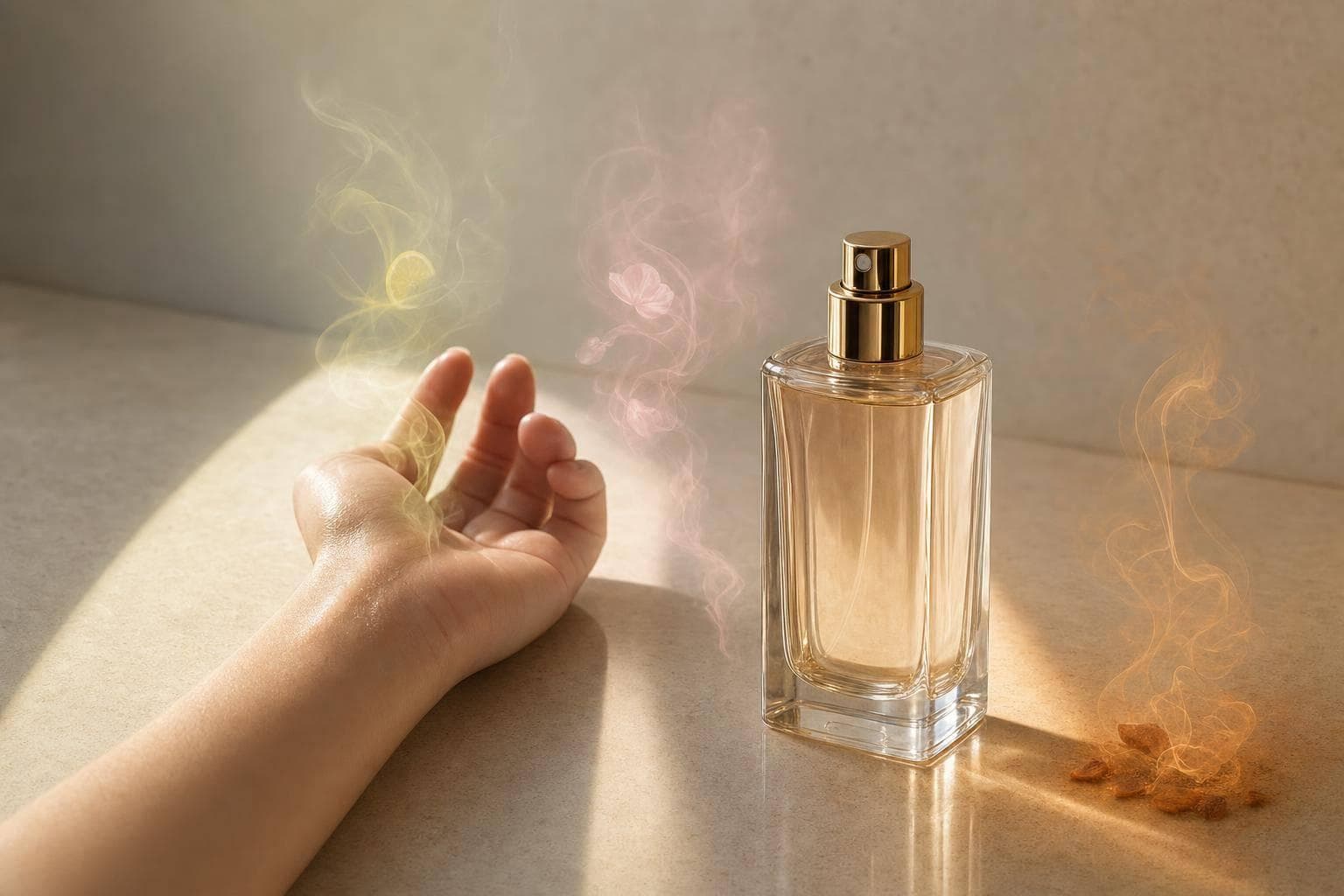
Perfume does not smell the same all day. On skin, the opening often lasts 5–30 minutes, the middle sits in for about 2–4 hours, and the drydown can stay 6–12+ hours. On fabric, scent may last 24 hours or more.
If I want to judge a fragrance well, I do not stop at the first spray. I pay attention to three things:
- Top notes: the first hit, often citrus, herbs, or light spice
- Heart notes: the main part of the scent after 15–30 minutes
- Base notes: woods, musk, resin, and vanilla that stay late into the day
A few simple facts matter most:
- Heat speeds up evaporation, so the opening leaves sooner
- Moisturised skin can help scent last longer than dry skin
- EdT, EdP, and Parfum move at different speeds because of oil concentration
- Skin testing beats blotter testing if I want to know how a perfume wears on me
| Stage | When I notice it | What it tells me |
|---|---|---|
| Top | 0–30 min | First impression |
| Heart | 30 min–4 hrs | Main character |
| Base | 4–12+ hrs | What stays with me |
The short version: if I only smell the opening, I miss most of the perfume. A full-day wear test gives me the part that matters.
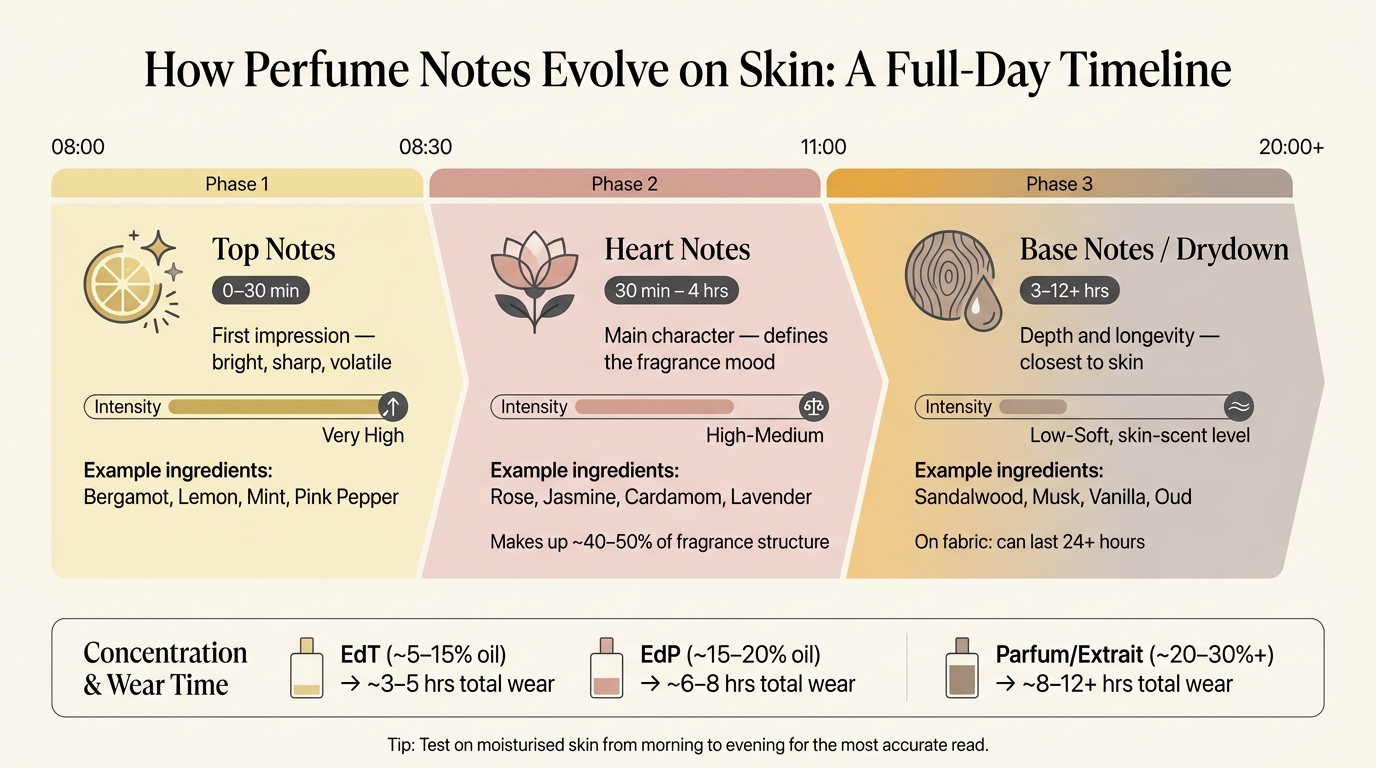
How Perfume Notes Evolve on Skin: A Full — Day Timeline
Why Perfume Smells Different Over Time | Top, Middle & Base Notes Explained | Episode 2
Top notes: what you smell in the first 5–30 minutes
Top notes are the first thing you notice. They give a fragrance its opening impression: that bright, quick burst that hits right away. This part fades the fastest, and that’s the point. Top notes are there to pull you in, not to tell the whole story.
Why the opening smells bright and fades fast
Top notes use lighter, smaller molecules with high volatility, which means they evaporate into the air fast. That’s why the opening often feels crisp and lively at first, then settles down not long after.
Citrus materials like bergamot, lemon, and grapefruit are classic examples. You’ll also often find mint, basil, rosemary, lavender accents, pink pepper, and cardamom in this layer. Citrus and aromatic materials lift off quickly, so the first impression can feel sharp and vivid, then soften within minutes.
| Top Note Category | Common Ingredients | Sensory Impact |
|---|---|---|
| Citrus | Bergamot, Lemon, Grapefruit, Mandarin | Bright, zesty, instantly recognisable |
| Herbs & Aromatics | Mint, Basil, Lavender, Rosemary | Sharp, cool, fresh |
| Light Spice | Pink Pepper, Cardamom, Fresh Ginger | Warm, energetic, slightly biting |
| Aquatic / Green | Green notes, aquatic notes, airy materials | Airy, clean, contemporary |
Once that first spark starts to fade, the heart notes begin to come forward. In simple terms: the top steps back, and the middle of the scent takes the lead.
How temperature and surface affect the opening
Temperature changes this stage a lot. Above 25 °C, top-note molecules evaporate faster, so the opening can feel stronger and more immediate, but it also disappears more quickly. In cooler air, evaporation slows, which softens projection and makes the move into the heart phase feel more gradual.
The surface matters too. A blotter lets you smell the opening more clearly, almost like hearing the first few notes of a song in isolation. Skin is different. Your body heat pushes the fragrance along faster, so the top notes tend to burn off sooner.
Both testing methods have their place:
- Blotter: better for judging the opening on its own
- Skin: better for seeing how the fragrance wears and changes through the day
If you want the most honest read on a perfume, skin wear tells you far more than the first spray ever can.
Heart notes: the main character that appears after the opening fades
Heart notes are the part of a fragrance that steps in once the opening calms down. This is the main body of the scent, and it usually starts to show after 15–30 minutes. From there, it tends to stay at the centre for around 2–4 hours.
This stage often tells you what the perfume is actually about. Is it floral, spicy, fresh, or plush? That mood is usually set by the heart.
Which notes typically shape the middle phase
Heart notes make up roughly 40–50 % of a fragrance’s overall structure. In plain terms, they do a lot of the heavy lifting. They connect the bright opening to the deeper drydown and give the scent its shape.
Most heart accords fall into a few familiar families:
| Heart Note Family | Typical Ingredients | Sensory Character |
|---|---|---|
| Florals | Rose, Jasmine, Ylang-ylang, Iris | Romantic, elegant, soft to voluptuous |
| Spices | Cardamom, Cinnamon, Black Pepper | Warm, dynamic, textured |
| Soft Fruits | Pear, Peach, Plum, Red Berries | Juicy, approachable, sometimes wine-like |
| Aromatics | Lavender, Geranium, Sage, Rosemary | Clean, structured, confident |
Florals can make the middle feel smooth and dressy. Spices add warmth and movement. Soft fruits bring a juicy, easy charm. Aromatics often give the scent a neat, tailored feel.
How concentration affects the heart note experience
Concentration changes both the clarity of the heart and how long you can follow it. Higher concentrations tend to use slower-evaporating materials, so the middle phase comes in more slowly, lasts longer, and has more presence.
| Fragrance Type | Approx. Concentration | Typical Wear Time | Impact on Heart Note Presence |
|---|---|---|---|
| Eau de Toilette (EdT) | ≈ 5–15 % | ≈ 3–5 hours | Heart feels lighter and more transparent; dominant for roughly 1–2 hours |
| Eau de Parfum (EdP) | ≈ 15–20 % | ≈ 6–8 hours | Fuller, more sustained heart; typically the main phase from T+30 min to T+4 hours |
| Parfum / Extrait | ≈ 20–30 % or more | ≈ 8–12+ hours | Denser, closer to skin and slower to fade |
That difference matters on skin. An EdT may move through the heart at a brisk pace, while an EdP gives the middle more room to unfold. A Parfum or Extrait often feels slower and more intimate, with the heart blending into the skin instead of pushing out hard.
As the heart starts to soften, the base notes begin to take over and shape the drydown.
Your Personal Fragrance Expert Awaits
Take our quick scent quiz to discover authentic designer and niche fragrances matched to your taste — explore them as 2–8ml decants and samples, so you can try each one before committing to a full bottle.
Find Your ScentBase notes and drydown: what stays on skin for the rest of the day
As the heart notes soften, the base takes over. This final stage is the drydown: the point where heavier molecules stay behind after faster materials fade, sitting closer to the skin and lasting much longer.
In a typical eau de parfum, the drydown is usually the part you notice most about 3–4 hours after application. From there, it can last 6–12+ hours, depending on the formula, your skin type, and body heat. That’s why a quick spray in store only tells you so much. If you want the full picture, you need a full-day wear test.
The materials behind depth and longevity
Base notes last because they’re built from larger, heavier molecules with low volatility. Put simply, they evaporate more slowly, so they stay on skin and fabric far longer than citrus notes or airy florals.
Here are the materials that usually do the heavy lifting:
- Sandalwood and cedar bring a soft woody structure, either creamy or dry. Both can stay noticeable for 8–12 hours or more on skin.
- Patchouli feels dense and earthy. Its heavier molecules can help other notes last longer while adding depth of its own.
- Vanilla, benzoin, and labdanum add a sweet, resinous warmth and often form the core of amber and oriental scents, clinging well to skin and fabric.
- Musk, especially modern synthetic white musks, is made for persistence. It creates that clean, skin-like halo that can still linger on clothing after a night’s sleep.
- Oud has very low volatility and can remain noticeable on fabric for 24 hours or more.
Perfumers don’t use these materials just because they smell good. They also work as fixatives, slowing the evaporation of lighter notes and helping the fragrance last longer overall.
How skin, fabric, weather, and daily routine affect drydown
Once the base settles, where you spray starts to matter a lot. Fabric usually holds scent longer than skin because it stays cooler and reacts less. There’s no sebum, no sweat, and less body heat pushing the fragrance to evaporate. By the afternoon, the drydown is often the part people notice most.
Moisturised skin also helps. Base notes tend to last longer on moisturised skin than on dry skin because the fragrance has more to cling to, without the need for extra sprays. Placement matters too. Spraying on the torso under clothing instead of directly on the neck or wrists usually keeps the drydown closer to you and steadier through the day.
This is where fragrance gets personal. Base notes react to your skin, your clothes, the weather, and the pace of your day. A scent that feels quiet at noon can turn warmer, softer, or deeper by evening. That slow change is exactly what makes wear-testing from morning to night so useful.
How to test a perfume over time and choose more confidently
A quick spray in a shop tells you very little. You get the opening, and that’s it. You don’t get the full wear, the shift in character, or the part that stays with you for hours. Once you understand how notes unfold, the next step is to test that change on your own skin.
Each stage fades at its own pace, so a full-day wear test gives you the real order of events. That’s what matters. The drydown, in particular, tells you how the fragrance actually wears on your skin. If you want to judge the full development, test it from morning to evening.
A simple wear test from 08:00 to 20:00
Apply 1–2 sprays to your inner forearm at 08:00 on clean, unscented, moisturised skin. Use the same fragrance on the same area each time. That makes the changes much easier to compare.
Then get on with your day and check in at four points. Keep your notes short: what you smell, how strong it feels, and whether you still like it.
| Time | Stage | Perceived intensity | What to note |
|---|---|---|---|
| 08:00 (0 min) | Opening | Very strong, sharp | First impression - does it feel like you? |
| 10:00 (2 hrs) | Heart | Moderate, well-rounded | This is the stage that matters most for fit |
| 14:00 (6 hrs) | Drydown | Soft to moderate | How does it feel after a full morning? |
| 18:00 (10 hrs) | Drydown | Very soft, skin scent | Does the drydown still feel worth it? |
Test one fragrance per day to avoid nose fatigue. At each checkpoint, step away from strong smells for a minute or two before you smell again.
Why smaller decants help you understand note changes better
One wear test gives you a starting point. But three or four days of wear gives you a far clearer picture. A scent that feels perfect on a cool day can turn heavy once the weather warms up. That’s why repeat wear matters so much.
If you want a better read, test the same scent across several days with smaller samples. Scento offers 2 ml, 5 ml, and 8 ml decants, which gives you enough juice to wear a fragrance a few times before you commit.
Conclusion: what to pay attention to as perfume notes evolve
Top notes open the scent, heart notes define it, and base notes finish it. If you want to know how a perfume will smell on you in daily life, a full-day wear test is the most reliable way to find out.
FAQs
Why does the same perfume smell different on my skin than on paper?
A fragrance often smells different on skin than on a paper blotter because your body chemistry interacts with the formula. Your skin pH, natural oils, and body temperature all play a part in how the top, heart, and base notes evaporate and settle.
Paper is a neutral surface. Your skin is not. Its warmth and oils can shift how the scent opens up and changes over time. That’s why the character, longevity, and projection can feel much more personal.
How can I make a perfume last longer on my skin?
Apply perfume to moisturised skin. Use an unscented moisturiser, jojoba oil, or a thin layer of petroleum jelly on your pulse points first. That extra layer gives the fragrance something to hold onto, so it stays on the skin instead of fading too fast.
Spray your pulse points, such as the wrists, neck, inner elbows, and behind the ears, then let the scent air-dry on its own. Don’t rub your wrists together. Doing that can break down the fragrance molecules and change how the scent develops. If you want longer wear, choose a higher concentration like Eau de Parfum or Parfum.
Which perfume stage should I judge before buying?
Don’t judge a perfume by the first spray alone. A fragrance shifts on your skin, so give it 30 to 60 minutes before you decide.
That short wait lets the top notes fade, so you can smell the heart and base notes that give the scent its true character. Testing with decants makes this much easier, because you get to wear the fragrance long enough to experience its full development before buying a full-sized bottle.