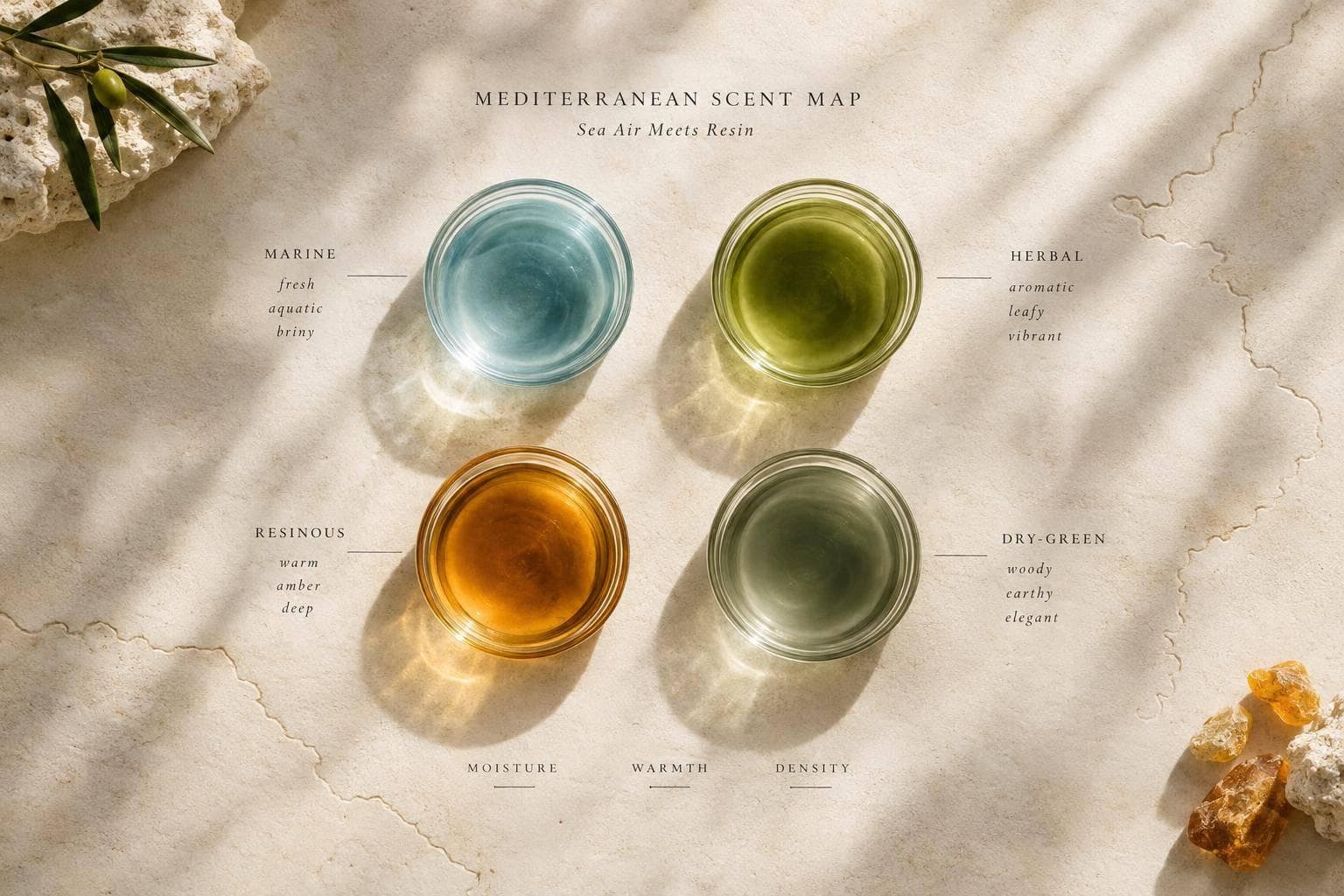
I compare Mediterranean perfumes by three things: moisture, warmth and density - not just the coastal name. For a useful skin test, check the scent after 5–15 minutes, then after 30 minutes to 2 hours, and again several hours later.
I use four scent effects as my guide:
- Marine: cool air, watery notes and salty stone. These are usually built with accords, not seawater extracts.
- Herbal: brisk rosemary, dusty sage and sharper thyme.
- Resinous: warm labdanum, greener mastic and pine sap, adding body and depth.
- Dry green: bitter stems, needles and dusty leaves rather than juicy foliage.
The same material can feel lighter or denser depending on the blend. And a regional name tells me little about sourcing unless the brand supplies details.
My rule? <u>Follow the balance from opening to dry-down.</u> I test equal amounts without rubbing, then compare indoors and outdoors on another day. Lasting close to the skin is not the same as projecting across a room.
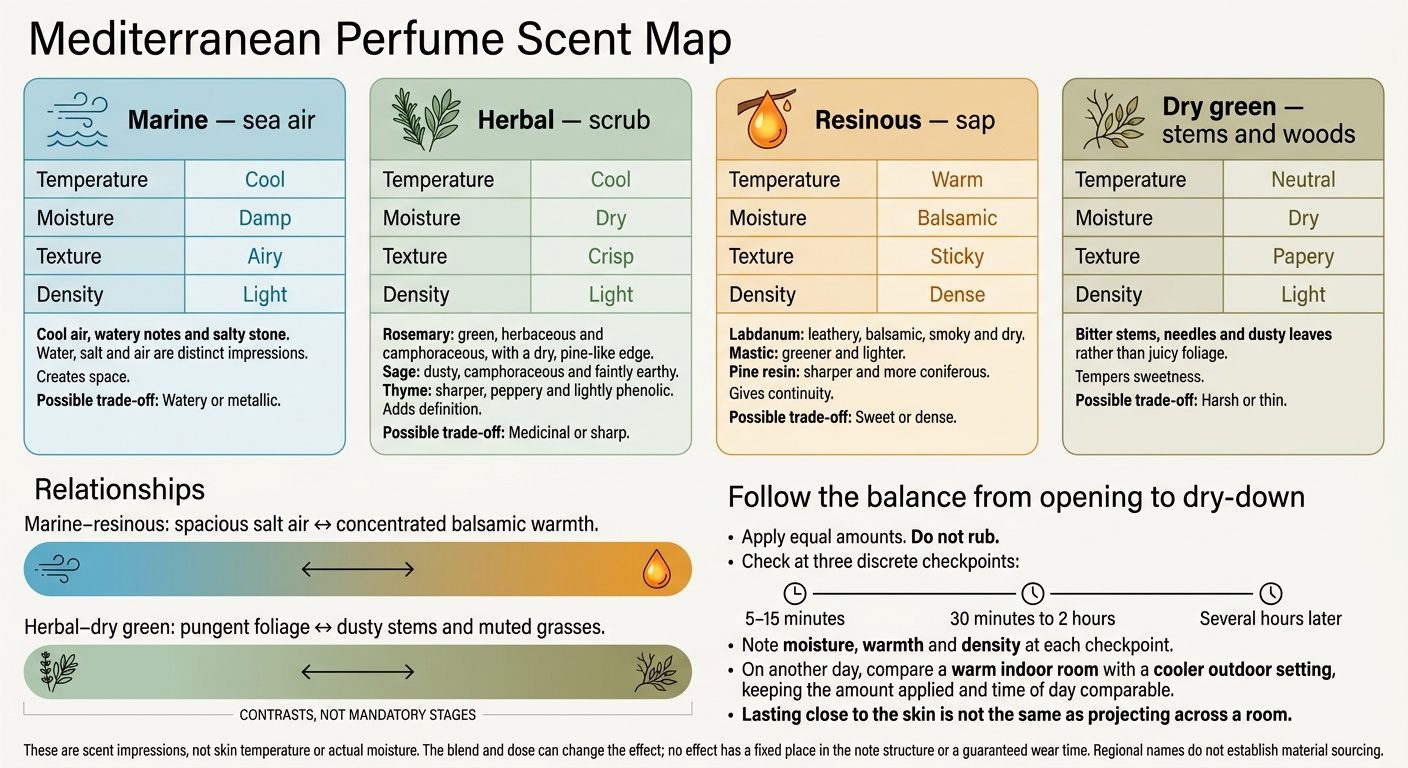
Mediterranean Perfume Scent Map
1. Marine Effects
Coastal Origins
Sheltered Mediterranean coves suggest softer, wetter scents. Exposed shores feel saltier, stonier and more mineral, while wind over open water adds a sense of space. These landscape differences shape three impressions: water, salt and air.
How It Smells
Aquatic notes feel dewy and smooth, sometimes with a melon-like scent. Salty-mineral notes suggest stone and brine, occasionally with a metallic edge. Ozonic airiness evokes moving air rather than wetness. A perfume can blend all three, but one usually leads.
Calone often supplies that dewy aquatic lift. At higher doses, its melon, metallic or shell-like facets come forward.
These notes also give other materials room to breathe, adding space around them rather than standing alone.
Role in Perfume
Helional adds watery lift; Floralozone brings more airiness. Paired with cedar, incense or amber, they create a coastal contrast: damp air against sun-heated surfaces.
This cool frame sets up the move from marine brightness to the herbal, resinous and dry green notes that follow.
2. Herbal Effects
Scrubland Origins
After the sea-air opening, the scent moves inland towards scrub and crushed herbs. Rosemary, sage and thyme bring to mind sun-exposed coastal scrubland. Rocky soils, fast drainage, heat and drought keep these shrubs compact and aromatic. Their oils suggest wind-brushed shrubs, dusty silvery foliage and dry stems. In perfume, these notes turn hot, windswept shorelines into scent.
How It Smells
Rosemary smells green, herbaceous and camphoraceous, with a dry, pine-like edge. Sage is dusty, camphoraceous and faintly earthy. Thyme is sharper, peppery and lightly phenolic.
The difference comes down to temperature and texture: camphoraceous notes feel brisk, while peppery notes feel dry and biting. Here, herbal means stems, leaves and crushed foliage - not cooking herbs on a plate.
Role in Perfume
These herbs usually appear in the top notes and carry into the heart, moving from a bright opening to a more textured feel. Rosemary sharpens citrus and woods; sage gives incense and musks a dry texture; thyme adds bite alongside citrus, pepper and resins. Thyme’s pungency can overwhelm delicate notes, whereas rosemary usually feels more transparent. Beside marine notes, herbs feel less airy and more tactile.
Test a small amount on skin or a blotter. During the first few minutes, look for a cooling lift. Return after 30–60 minutes to assess the herbal texture: do the herbs soften into woods, resins or musks, and does the scent stay cool or turn warm?
3. Resinous Effects
Plant Origins
In the hot Mediterranean scrub, shrubs release resin. Labdanum is the sticky resin of the rockrose shrub Cistus ladaniferus, which grows in the hot, dry western Mediterranean.
Mastic comes from Pistacia lentiscus. On Chios, collectors gather its resin as crystallised tears. Pine resin brings the sharper, coniferous scent of coastal woods.
How It Smells
Labdanum smells leathery, balsamic, smoky and dry, sometimes with a faint animalic edge. Mastic is greener and lighter, while pine resin is sharper and more coniferous. Together, these materials span dense, rounded warmth and lighter, sap-like textures.
Role in Perfume
Labdanum gives base notes body, linking bright marine or herbal openings to woody, mossy or ambered drydowns. In chypres and ambers, it moves between balsamic sweetness, leather and smoke. Mastic keeps resin accords light; pine adds sap-like woodiness.
Compare resin samples on a blotter, then on skin at 15 minutes, 2 hours and 6 hours. Record sweetness, smokiness, projection, texture and persistence. Treat longevity and projection separately: a resin can stay perceptible close to the skin long after its outward reach fades. Notice whether labdanum keeps the opening bright or rounds it into a denser ambered drydown.
As resins dry down, their scent can lean towards sun-baked wood and brittle green stems. Once the resin feels less sticky and more sun-bleached, it starts to overlap with dry green notes.
4. Dry Green Effects
Vegetation Origins and Smell
As resin loses its gloss, its scent moves towards dry green. Think drought-hardened vegetation, rather than tender new growth. Mediterranean scrub tends to be low, woody and evergreen. Its small, hard leaves limit water loss during hot summers. Sun-warmed herbs and needle greens smell dry, dusty and aromatic.
Lush green feels juicy; dry green feels brittle. Heated foliage has a slightly dusty scent, while needles smell sharper and airier. Crushed stems bring bitter sap, and shrubs add a darker, more austere character. Galbanum is a useful reference for this dry-green effect.
This is the coast’s hard edge: scrub, needles and sun-bleached stems.
Role in Perfume
Dry green adds stem-like bitterness to herbal accords. In marine accords, conifer facets make salt-air effects feel less watery. Against resinous accords, it stops warm bases from feeling too sweet or dense. These describe scent effects, not ingredient lists.
When comparing samples, smell them just after application, after 30 minutes, and later in the dry-down. Note whether the green character feels juicy or dry, leafy or needle-like, cool or sun-warmed. Even when a green opening turns woody, it can leave a bitter, dry trace in the base.
Your Personal Fragrance Expert Awaits
Take our quick scent quiz to discover authentic designer and niche fragrances matched to your taste — explore them as 2ml, 5ml, 8ml & 30ml decants and samples, so you can try each one before committing to a full bottle.
Find Your ScentCoastal Landscapes and Perfume Materials
Coastal materials shape a fragrance’s balance of brightness, warmth and dryness. Resin, mastic, pine and scrub each pull the blend in a different direction.
Labdanum comes from rockrose resin, chiefly Cistus ladanifer and Cistus creticus. But a cistus name alone doesn’t tell you which material a perfume uses.
| Landscape or region | Key materials | Scent and function in a formula |
|---|---|---|
| Crete and the eastern Mediterranean | Cistus creticus; labdanum | Warm, balsamic and lightly leathery; adds amber-like depth, persistence and an incense nuance. |
| Spain and the western Mediterranean | Cistus ladanifer; labdanum | Dry, resinous, ambery and sometimes smoky; adds warmth, persistence and density to the base. |
| Southern Chios | Pistacia lentiscus var. chia; mastic, with a long history of regulated local cultivation and trade. | Bright, resinous, green and lightly terpenic; adds lift and links citrus, herbs and woods. |
| Cyprus and neighbouring eastern Mediterranean coasts | Pine resin, turpentine oil, wood tar and other resins | Piney, balsamic, woody and sometimes tar-like; adds forest warmth, dryness and smoky depth. |
Cretan collectors brushed resin from rockrose leaves with cloth strips. On Chios, growers cut the trunk or branches, then let the resin tears harden before collecting them.
In a perfume worn on skin, these materials shape brightness, depth and staying power. Origin alone doesn’t tell you how a blend will smell: Chios resin can add brightness, while labdanum brings weight. Read the blend’s materials together, rather than relying only on where they come from.
How the Effects Smell and Work
Comparing moisture, warmth and density side by side makes these scent effects easier to understand.
Moisture, Warmth and Texture
A perfume can suggest one effect while its accord delivers another. Sea air, scrub, resin and dry woods act as reference points. Here, cool, warm and moist describe scent impressions, not skin temperature or actual moisture.
| Effect | Temperature | Moisture | Texture | Density |
|---|---|---|---|---|
| Marine - sea air | Cool | Damp | Airy | Light |
| Herbal - scrub | Cool | Dry | Crisp | Light |
| Resinous - sap | Warm | Balsamic | Sticky | Dense |
| Dry green - stems and woods | Neutral | Dry | Papery | Light |
The marine–resinous axis moves from spacious salt air to concentrated balsamic warmth. Herbal–dry green runs from pungent foliage to dusty stems and muted grasses - not wet garden leaves. The cool–warm and airy–dense axes overlap, but neither sets a fixed ranking.
The same material can smell different depending on its dose and the formula’s structure. Extraction methods and surrounding notes also shape the result.
| Related resin material | Behaviour in a formula |
|---|---|
| Labdanum | Adds weight and helps the base feel continuous |
| Mastic | Adds lift and links citrus, herbs and woods |
| Pine resin | Gives woods clearer definition |
| Olibanum oil | Brings brighter lift |
| Olibanum resinoid | Adds body and depth |
Opening, Structure and Dry-Down
Calone adds watery lift; seaweed materials bring greener, brinier depth. Marine effects create space, herbs add definition, dry greens temper sweetness, and resins give continuity. None has a fixed place in the note structure or a guaranteed wear time.
| Effect | Initial brightness | Opening-to-dry-down role | Persistence | Possible trade-off |
|---|---|---|---|---|
| Marine | High | Opens space; can continue through musks and woods | Depends on supporting notes | Watery or metallic |
| Herbal | High | Defines transitions into woods and resins | Depends on the material | Medicinal or sharp |
| Resinous | Lower; olibanum can be brighter | Builds body and continuity | Often long-lasting | Sweet or dense |
| Dry green | Austere | Adds dry contrast and woody definition | Supported by woods or resins | Harsh or thin |
Read the balance, not just the note list.
Citrus or florals can soften medicinal herbs; dry woods can keep labdanum from feeling syrupy.
Try the scent on skin and follow it from opening to dry-down. An airy opening may give way to a denser base.
Conclusion: Choose by Moisture, Warmth and Density
Use moisture, warmth and density to compare samples on skin. Cool marine air feels open, herbs feel brisk, dry greens feel dusty, and resins add depth.
Treat regional names as inspiration unless the brand provides evidence of materials or sourcing.
Compare Small Samples on Skin
Start with small decants for a direct comparison. Scento offers curated designer and niche decants in 2 ml, 5 ml, 8 ml and 30 ml formats, plus an optional 8 ml monthly subscription to keep trying new scents.
Apply one scent to each wrist or inner forearm, using equal amounts. Do not rub. Note moisture, warmth and density at 5–15 minutes, 30 minutes to 2 hours, and again after several hours. These checkpoints let you compare the opening, heart and dry-down - not just the first impression.
On another day, repeat the test in a warm indoor room and a cooler outdoor setting. Keep the amount applied and the time of day comparable. Note changes in sweetness, projection or texture, and choose the scent whose balance holds in both settings.
FAQs
How can I find a coastal perfume without melon-like notes?
Look for mineral-driven or salt-based compositions that favour seaweed, ozone or dry woods over sweet, fruity accords. Many marine fragrances use Calone, a molecule linked to melon-like or watery-sweet notes.
Orto Parisi Megamare has a raw, mineral-driven coastal feel, with seaweed and salt air rather than sweetness or soapiness. Browse the Scento catalogue to try 2 ml or 5 ml decants before choosing a full bottle.
Will resinous perfumes feel too heavy in summer?
Heat and humidity can speed up evaporation, making dense base notes project more strongly. Resins add depth and help a fragrance last, but they often suit cooler weather better.
In summer, start with one or two sprays. Layering with lighter citrus or aquatic notes can help balance the scent. Test it in your local climate: skin chemistry and temperature both affect how a fragrance wears.
Why does the same perfume smell different on my skin and a blotter?
Perfume behaves differently on your skin than on a blotter. Skin chemistry, body heat and moisture levels all affect how it smells, while a blotter offers a neutral surface that reveals the scent’s structure.
Body heat speeds up evaporation, which can make the fragrance unfold faster or change the balance of its notes. Your skin’s hydration and pH can also bring some facets forward while letting others fade.

