
Middle Eastern perfumery has pushed oud, amber, saffron and rose accords into mainstream Western releases, along with higher concentrations and longer wear — a shift visible across both designer flankers and niche launches.
The global fragrance industry is moving towards richer, long-lasting scents inspired by Middle Eastern perfumery. Known for ingredients like oud, amber, and saffron, these fragrances are gaining popularity worldwide. Major Western brands like Tom Ford and Dior are now integrating these elements, while Middle Eastern brands such as Amouage and Arabian Oud continue to grow, with the regional market projected to double in value by 2032. Social media platforms, especially TikTok and Instagram, are amplifying trends like fragrance layering, making these scents more accessible and desirable. Whether through luxury or affordable options, Middle Eastern perfumes are reshaping global preferences with their depth and longevity.
Key figures on Middle Eastern perfumery, 2025–2034
Projected growth of the Middle Eastern fragrance market, 2025 to 2034
Scento analysis
Arabic fragrances’ share of the global perfume market
Scento analysis
Lattafa’s TikTok Shop sales, August 2024 to July 2025: over $63M, against $23.1M a year earlier
charm.io via WWD 1
Year-on-year rise in TikTok and Google search interest for “Arabian perfume”; “oud perfume” is up 20.5%
Spate via Business of Fashion 2
Growth in European demand for oud-centred fragrances over the past five years
Scento analysis
How Middle Eastern Fragrances Are Changing Global Markets
The impact of Middle Eastern fragrances on global markets is evident in the way ingredients, rituals, and product formats are evolving. Major Western luxury brands like Tom Ford, Dior, and Gucci have embraced traditional Middle Eastern elements such as oud, saffron, and frankincense in their collections. In fact, European demand for oud-based fragrances has soared by 47% over the last five years, reflecting a shift in how luxury is perceived on a global scale.
Layering, a hallmark of Middle Eastern scent rituals, has gained widespread popularity. This practice involves applying concentrated perfume oil to pulse points, followed by an Eau de Parfum spray, and finishing with a hair mist. Social media platforms like TikTok and Instagram have played a key role in popularizing these rituals, especially among Gen Z. Many young consumers are now blending Middle Eastern oils with Western designer scents to create unique, long-lasting fragrances. This enthusiasm for personalized scent rituals has pushed brands to innovate.
In response to changing preferences, companies are introducing new formats like 200 mL "macro bottles", specialized hair mists, and modernized bakhoor burners with sleek, architectural designs. The Eau de Parfum category has also grown significantly, now accounting for 38.7% of the Middle Eastern market. With its 15–20% concentration of aromatic compounds, this format delivers the intensity and 8–12+ hours of longevity that today’s consumers desire. As Rawya Catto, General Manager at CPL Aromas Middle East, explains:
"The world is in love with perfume, and the more intensity, punch, and character, the better".
Western perfumers are also reimagining their scent profiles. Instead of using oud solely as a heavy base note, they’re pairing it with unexpected ingredients like vanilla, green tea, or caramel to craft lighter, more approachable compositions. Maison Francis Kurkdjian’s decision to open a boutique in Riyadh in February 2025 reflects the growing demand for high-end layered fragrances in the region. This demonstrates that Middle Eastern markets are not just consumers but are actively shaping global trends.
The influence of Middle Eastern olfactory traditions extends beyond fine fragrances. Everyday products like deodorants, body washes, and laundry care are now incorporating these scent profiles. As Ravi Ramchandani of Messe Frankfurt puts it, regional brands are "no longer following trends - they are now setting them".
1. Middle Eastern Perfume Brands
Middle Eastern perfume houses have transformed from local artisans into global symbols of luxury. Renowned names like Amouage (Oman), Ajmal (UAE), Arabian Oud (Saudi Arabia), and Lattafa are celebrated for their use of signature ingredients such as oud (often referred to as "liquid gold"), amber, musk, sandalwood, saffron, frankincense, and Damask rose. These brands are not just preserving tradition - they’re redefining luxury perfumery with cutting-edge techniques.
A key distinction lies in their formulation methods. Unlike Western alcohol-based perfumes that typically last 4–6 hours, Middle Eastern oil-based attars offer impressive longevity, lasting 8–12 hours or more. Pure oud, in particular, can linger for up to 24 hours, making these scents a staple for those seeking enduring fragrances.
The global appeal of these brands is undeniable. The Middle Eastern fragrance market is on a steep upward trajectory, with projections indicating growth from $4.05 billion in 2025 to $7.52 billion by 2034. This surge reflects both a growing appreciation for the artistry behind these scents and the influence of digital platforms like TikTok and Instagram, which have introduced younger audiences to their rich, layered profiles.
Luxury houses such as Amouage and Arabian Oud cater to the ultra-premium segment, offering fragrances crafted from the finest ingredients and presented in opulent packaging. On the other hand, brands like Lattafa and Swiss Arabian provide more accessible options, delivering the intensity and longevity of Middle Eastern scents at prices that attract a broader audience.
Accessibility has also improved dramatically. While exclusive boutiques in cities like Dubai, Riyadh, London, and Paris remain key destinations, e-commerce has opened the door for global customers. In a notable move, Sephora Middle East launched an AI-powered perfume recommendation tool in July 2025. This app feature helps users discover personalized scents based on their mood and traditional layering techniques. By blending heritage with technology, Middle Eastern perfume brands are not only honoring their origins but also shaping the future of global fragrance trends.
Lattafa, one of the accessible houses above, is also the most-cited name in US sales data on affordable alternatives to designer perfume; our statistics on the perfume dupe market break that market down by brand and country.
2. Western Designer Perfumes with Middle Eastern Notes
Western luxury brands like Tom Ford, Dior, Gucci, and YSL are stepping into new territory by incorporating the richness of Middle Eastern ingredients into their fragrances. Moving beyond their usual citrus and floral creations, these brands are now embracing the depth of oud, amber, saffron, and musk. The result? A fusion of Eastern opulence with Western sensibilities.
Rather than replicating traditional Arabian perfume styles, Western perfumers are experimenting with unique combinations. For instance, oud is being paired with surprising notes like green tea, vanilla, or aquatic accords, making these bold ingredients more accessible to a broader audience. A standout example is the May 2024 launch of "Nomadic Dreams" by Dubai-based luxury brand Ghawali in collaboration with Sheikha Maitha Al Maktoum. This fragrance blends traditional oud with bergamot, orange, ginger, and cacao wood, specifically tailored to appeal to Western tastes. Forat Al Haider, Ghawali’s Director of Beauty Innovation, highlighted a key challenge:
"People have the notion that oriental perfumes are only for oriental people. I think that’s one of the misconceptions that you find."
The response from consumers has been overwhelmingly positive, reflecting a shift in preferences toward bold, layered scents with greater longevity and presence.
To meet this demand, many Western brands are increasing fragrance concentrations to 20% or more, mimicking oil-based formulations that last 8–12+ hours. This is a significant leap from the typical 4–6 hour lifespan of standard alcohol-based perfumes.
However, these reinterpretations haven’t been without criticism. Concerns about cultural appropriation have surfaced, as noted by pre-law student Sumaya:
"I’ve noticed that colonialism and appropriation are increasingly at play when it comes to Arabic perfumes... You’ll see major corporations and luxury designers releasing fragrances that smell nearly identical to traditional Arabic scents and profiting from them."
Despite these critiques, the trend continues to grow. Western luxury brands are expanding their Middle Eastern-inspired collections, creating dedicated lines that celebrate the blend of influences. This movement is echoed in Scento’s own range of Middle Eastern fragrance houses, marking a new chapter in the global fragrance industry.
Your Personal Fragrance Expert Awaits
Take our quick scent quiz to discover authentic designer and niche fragrances matched to your taste — explore them as 2ml, 5ml, 8ml & 30ml decants and samples, so you can try each one before committing to a full bottle.
Find Your Scent3. Scento‘s Middle Eastern Collection
Scento has taken a thoughtful approach to introducing Middle Eastern fragrance houses, offering an accessible way to explore this luxurious category through decant options. Through authentic decants of the houses’ own perfumes, Scento allows consumers to experience the allure of oud, amber, saffron, and musk without committing to the high cost of a full bottle. With prices for traditional oud-based perfumes often exceeding $300, Scento’s decants - available in 2 ml, 5 ml and 8 ml vials, and a 30 ml bottle decant on most perfumes - make these fragrances approachable for a wider audience.
The interest in oud-centered fragrances has surged, with demand in Europe growing by 47% over the past five years. In the U.S., this trend aligns with a global increase in search interest for "Arabian perfume", which saw a rise of over 60% in 2025. Scento’s offerings provide a practical entry point for curious consumers, allowing them to experience the depth and complexity of these scents without a significant financial commitment.
One of the standout features of these fragrances is their impressive longevity. This allows users to fully experience the scent’s evolution over time before deciding whether to invest in a larger size. For reference, an 8ml decant typically provides around 120 sprays, offering enough product for multiple uses across various occasions.
Scento is a perfume decant and sample retailer, and every product is available for one-time purchase without any subscription. Scento+ is Scento’s optional membership: the monthly fee comes back in full as store credit to spend on any perfume, members get 10% off, a free sample with every order, a free perfume every six months and a birthday gift. Buyers can explore Middle Eastern fragrance houses at their own pace, a perfect option for Gen Z and Millennials who value individuality and affordability in their scent choices. This approach also minimizes waste, as it avoids the accumulation of half-used bottles - a practical solution for fragrance enthusiasts.
To complement the experience, Scento offers four atomiser designs: Limone di Capri, Rosso Fiore, Le Moooo and Toile de Jouy. These compact atomizers are perfect for on-the-go use, and the high concentration of the fragrances ensures that just a few sprays are enough to make a lasting impression. Practical, economical, and travel-friendly, these atomizers enhance the overall experience for fragrance lovers.
Middle Eastern houses in Scento order data
In Scento order data from October 2025 to September 2026, four houses founded and based in the Gulf, Amouage, Kajal, Kayali and Widian, took 9% of the decants customers across Europe paid for.6 Their share moved from 8.5% in the fourth quarter of 2025 to 10% in the third quarter of 2026, an index of 118 with the fourth quarter of 2025 at 100. The index starts in October 2025, so this is a quarter-by-quarter trend rather than a year-on-year one.
Amouage alone took 8.5% of all decants, the second-largest share of any house. Its Guidance was the third most-bought perfume across Europe and the most-bought in Romania.6
Pros and Cons
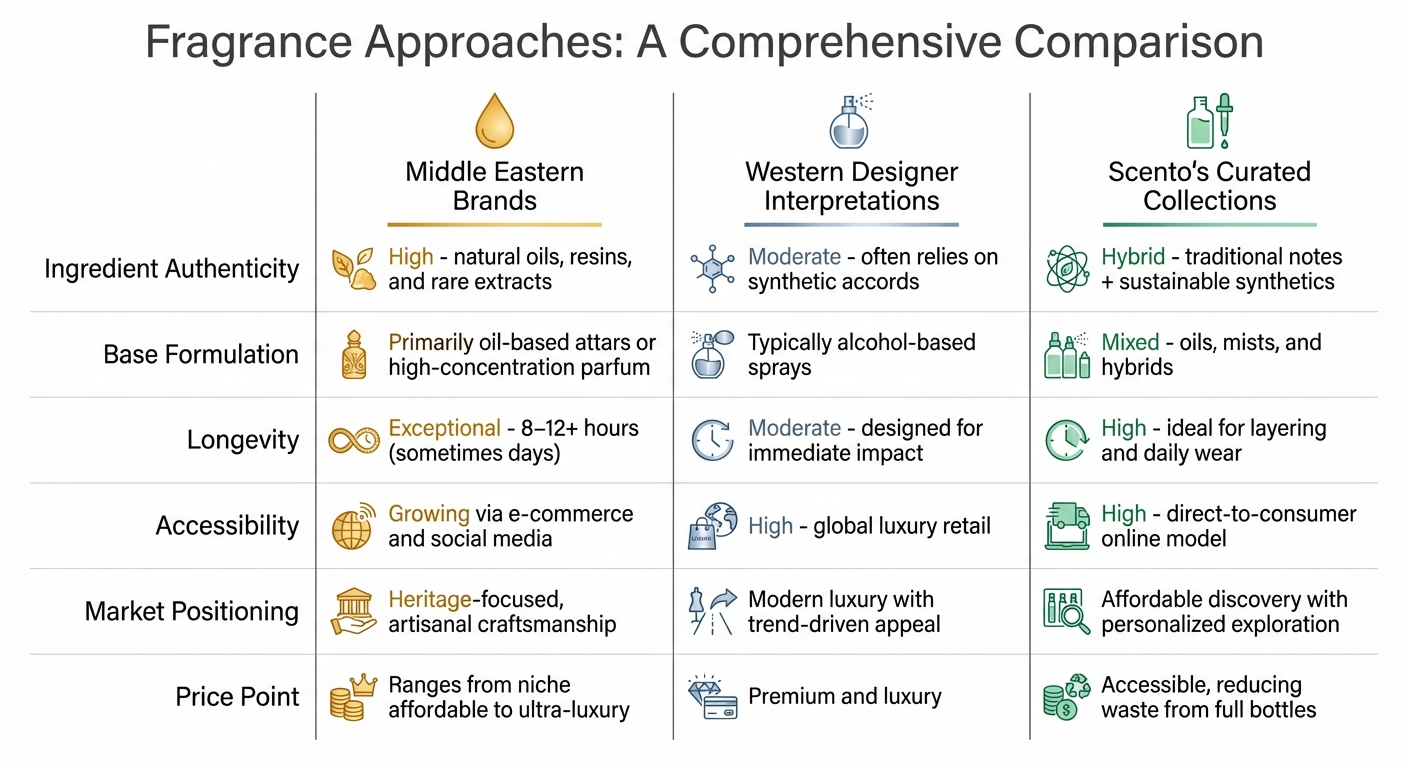
Middle Eastern vs Western Designer vs Scento Perfumes Comparison
Building on earlier insights, let’s dive into the specific strengths and challenges of Middle Eastern-inspired fragrances compared to Western designer interpretations and Scento’s curated offerings.
Middle Eastern fragrance brands stand out for their use of high-quality, authentic ingredients. Their oil-based formulations often feature natural oils, resins, and rare extracts like pure oud - a material so precious it can take decades to develop. These attars are celebrated for their exceptional longevity, often lasting 8–12 hours or even days on fabric. However, pricing varies widely, from niche options to ultra-luxury bottles where oud, sometimes referred to as "liquid gold", can cost thousands. While online platforms and social media have expanded accessibility, regional instability can still impact supply chains.
Western designer brands, on the other hand, excel in global reach and accessibility. They’ve introduced Middle Eastern notes like oud and amber to a broader audience, often blending them with popular floral or citrus accords to create modern, trend-driven fragrances. However, many rely on synthetic oud accords rather than natural ingredients. This often results in a "spray-then-fade" effect, where the initial burst of scent quickly dissipates compared to the lasting depth of traditional oils.
Scento bridges the gap by offering decants in 2 ml, 5 ml and 8 ml vials, and a 30 ml bottle decant on most perfumes. Each decant is filled from the house’s own authentic perfume, never blended or reformulated by Scento, so consumers can explore high-concentration Middle Eastern fragrances without committing to a full bottle. An 8ml decant, for example, provides approximately 120 sprays, making it ideal for sampling or layering without the waste or expense of a full-sized product.
Here’s a breakdown of how these categories compare across key features:
| Feature | Middle Eastern Brands | Western Designer Interpretations | Scento Decants |
|---|---|---|---|
| Ingredient Authenticity | High: natural oils, resins, and rare extracts | Moderate: often relies on synthetic accords | Authentic: decanted from the houses’ own perfumes |
| Base Formulation | Primarily oil-based attars or high-concentration parfum | Typically alcohol-based sprays | Unchanged: the original perfume, never reformulated |
| Longevity | Exceptional: 8–12+ hours (sometimes days) | Moderate: designed for immediate impact | High: ideal for layering and daily wear |
| Accessibility | Growing via e-commerce and social media | High: global luxury retail | High: direct-to-consumer online model |
| Market Positioning | Heritage-focused, artisanal craftsmanship | Modern luxury with trend-driven appeal | Affordable discovery with personalized exploration |
| Price Point | Ranges from niche affordable to ultra-luxury | Premium and luxury | Accessible, reducing waste from full bottles |
This comparison highlights the unique value each approach brings to the global fragrance market. Together, they reflect how Middle Eastern perfumery continues to shape and influence modern trends.
Conclusion
Middle Eastern perfumery has reshaped the global fragrance scene in profound ways. The numbers alone highlight a dynamic shift in the market. As Rawya Catto, General Manager at CPL Aromas, Middle East, points out:
"Regional brands are finally getting the global recognition they deserve, and rather than following trends, they are now setting them".
The region’s signature ingredients have elevated the concepts of longevity and personalization, delivering scents that last 8–14 hours and can be tailored to individual preferences. Western powerhouses like Dior, Tom Ford, and Gucci have embraced this influence by introducing dedicated oud collections, while more affordable names like Lattafa and Afnan provide high-quality alternatives priced between €20 and €40. These stand in stark contrast to Western designer fragrances, which often range from €120 to €250 or more. This shift underscores the growing global appeal of Middle Eastern fragrance traditions.
For those curious to explore these scents, discovery sets and decants - such as Scento’s 2 ml, 5 ml and 8 ml vials, and a 30 ml bottle decant on most perfumes - offer an excellent way to sample different intensities before committing to a full-sized bottle.
The transition from niche to mainstream is clear. Arabic fragrances now account for 6–7% of the global perfume market, with projections estimating a rise to 9–12% within the next decade. Whether you’re captivated by the artisanal charm of traditional attars or the innovative blends of East and West, Middle Eastern perfumery continues to set new global standards with its focus on richness, intensity, and lasting impression.
How we compiled this
Market figures on this page come from the research, panel data and company reports named in the sources list, checked on 8 October 2026. Growth rates are given as each source states them. Figures marked “Scento analysis” are Scento’s own reading of published research.
“Scento order data” means the Scento Fragrance Index: Scento’s own analysis of paid decant orders placed between October 2025 and September 2026 and shipped across Europe. It publishes shares, ranks and indices only, never order counts, unit counts or revenue.
- Each decant a customer paid for counts once, whatever its size.
- Cancelled, test, staff and free orders are excluded, as are full bottles, accessories and gift sets.
- “Middle Eastern houses” means houses founded and based in the Gulf that Scento sells: Amouage, Kajal, Kayali and Widian.
- Quarterly indices use the fourth quarter of 2025 as 100; a figure resting on too few orders to be stable is withheld.
More research like this is collected on our perfume industry statistics hub.
Sources
- Why Lattafa, Kayali and Arab-inspired Fragrance Brands are Booming, WWD, 2025. wwd.com
- Arab-inspired Fragrance Brands Are Just Getting Started, Business of Fashion (reprinted by Charm), . charm.io
- YSL Beauty, Lattafa Lead Top-Growing Fragrance Brands in the US, Happi (Spate data), 2025. happi.com
- Luxury Is Ready for a New Era After Stabilizing in 2025, Bain & Company, 2025. bain.com
- 2025 Full Year Results, transcript, Givaudan, 2026. givaudan.com
- Scento Fragrance Index, October 2025 to September 2026, Scento order data, 2026.
Your questions, answered
- Is Scento legit?
- Yes. Scento is operated by Scento International LTD, a registered Cyprus company (HE 477410) trading from Paris, founded by Sebastian Dobrincu, whose columns run in Forbes and Entrepreneur. Every bottle it decants passes a 12-point intake authentication — more than 50,000 bottles received and verified since 2021 — and orders ship tracked to 26 European countries with a published returns policy.
- Are Scento decants authentic?
- Yes. Every decant is hand-poured from an original full-sized bottle sourced through authorised European retailers — never a clone, dupe or inspired-by version. The manufacturer's batch code stays with that original bottle and is not printed on Scento decant vials, so a vial without a code is expected.
- How is Scento different from Scentbird or subscription boxes?
- Scentbird's own terms state it delivers only within the United States, Canada or the United Kingdom, and term plans cannot be cancelled before the term ends. Scento ships to 26 European countries and every decant is a one-time purchase; the Scento+ membership is optional.
- What are the perfume trends in the Middle East?
- Oud, amber, saffron and rose lead, with higher concentrations and scents lasting 8–14 hours. Middle Eastern markets also anchor luxury growth: Bain named the Middle East a regional highlight of 2025, and Givaudan says its South Asia, Middle East and Africa fine fragrance business equals North and Latin America combined.
- Which Middle Eastern fragrance houses are trending globally?
- Amouage, Ajmal, Arabian Oud and Lattafa lead, and Swiss Arabian covers accessible prices. Lattafa is the breakout: Spate measured it up 105.3% across search and social in 2025, and its TikTok Shop sales passed $63 million between August 2024 and July 2025.
- How big is the Middle Eastern fragrance market?
- The page's projection is growth from $4.05 billion in 2025 to $7.52 billion by 2034. Arabic fragrances already account for 6–7% of the global perfume market, with projections of 9–12% within the next decade, according to Scento analysis.
- Is interest in oud perfume still growing?
- Yes. Spate data shows search and TikTok interest in "oud perfume" up 20.5% year on year and "Arabian perfume" up about 63%, as reported in March 2026. In Europe, demand for oud-centred fragrances has grown 47% over the past five years, according to Scento analysis.
- How can I sample Middle Eastern perfumes before buying?
- Start with small decants from a few Gulf houses, such as Amouage, Kajal, Kayali and Widian. Layer gradually: one spray of an oud or amber base under a lighter scent shows how long it lasts on your skin before you commit to a bottle.
- How do I start layering Middle Eastern fragrances without overdoing it?
Start with a small dab of one fragrance on pulse points like your wrists or neck. Let it settle and reveal its character before adding another scent. Choose fragrances with complementary notes - like pairing light florals or citrus with deeper elements such as oud - to create a balanced and refined blend. Apply gradually, allowing each layer a few minutes to unfold, ensuring the final result is harmonious and not overpowering.
- How can I tell real oud from “oud-style” accords?
Real oud comes from the resin of Aquilaria trees infected by a specific mold, creating a scent that’s deep, smoky, and layered with complex woody tones. On the other hand, “oud-style” accords are synthetic or blended recreations that often miss the authentic depth and richness of true oud. To tell them apart, pay attention to the ingredient’s origin and quality - it makes all the difference.
- How can I sample oud or amber scents before buying a full bottle?
If you’re curious about oud or amber scents but hesitant to invest in a full bottle, smaller fragrance decants or samples (like 2ml or 8ml sizes) are a great option. They let you explore the scent at a fraction of the cost. Many brands and retailers also offer curated discovery kits or sample sets. These kits allow you to try multiple fragrances over time, giving you the chance to see how they evolve on your skin and align with your personal style.
Cite this page
Scento (2026). Middle Eastern Perfumes Shaping Global Trends. Updated October 8, 2026. https://www.scento.com/blog/middle-eastern-perfumes-global-trends

