Perfume quality starts in the soil, not the bottle. If rose, vanilla, lavender, vetiver, or sugar beet are grown in weak soil under price pressure, you often get lower yields, uneven scent profiles, and more reformulations.
Here’s the short version:
- Natural perfume ingredients are farm products.
- Conventional farming can damage soil, strain water use, and reduce biodiversity.
- That puts supply, scent quality, and bottle prices under pressure.
- Regenerative farming aims to rebuild soil, improve water retention, and support farm income.
- For you, that can mean more stable naturals, clearer sourcing, and fewer blind full-bottle buys at €150 to €300+.
A few numbers make the point fast:
- Around 4.500 kg of rose petals can yield only 450 g of rose otto.
- Vanilla prices have moved from about €18/kg to over €550/kg in just a few years.
- A 1% rise in soil organic matter can help soil hold 20.000 to 27.000 litres of water per hectare.
Quick comparison
| Topic | Conventional sourcing | Regenerative sourcing |
|---|---|---|
| Soil | Loses strength over time | Builds soil matter and structure |
| Water | Lower water-holding capacity | Better moisture retention |
| Crop system | Often monoculture | More mixed planting and cover crops |
| Supply | More exposed to drought and price swings | More stable over time |
| Farmer income | Often short-term and volatile | More long-term support in some projects |
| Perfume impact | More risk of reformulation | More steady ingredient supply |
If I care about perfume as a long-term ritual, not just a purchase, then farming methods matter. This piece shows why the future of fine fragrance depends as much on land use as on perfumery itself.
What goes wrong in conventional perfume ingredient sourcing
That pressure is where conventional sourcing starts to crack.
Soil depletion, monoculture, and weaker harvests
As demand for natural fragrance materials grows, many farmers get pushed toward monoculture: big single-crop fields of rose, lavender, or jasmine, often supported by synthetic inputs. Over time, that strips away soil biodiversity and reduces water retention. The result is simple: crops become more exposed to drought, pests, and disease. And when farms become less resilient, fragrance quality and supply start to slip too.
The first warning sign usually appears in the soil itself. Producing about 4.500 kilograms of rose petals yields only 450 grams of rose otto. That kind of ratio puts pressure on growers to irrigate heavily and use more land, which adds strain to both soil health and local water supplies.
Climate shocks, overharvesting, and price volatility
Vanilla is a clear example of how fast a supply chain can wobble. Its market price has swung from about €18 per kilogram to more than €550 per kilogram within just a few years. Much of that swings with cyclones in Madagascar and irregular rainfall. When prices jump, farmers often pick pods early to reduce the risk of theft. That may protect income in the short term, but it also lowers aromatic quality and creates uneven supply.
Sandalwood (Santalum album) tells a different but equally stark story. It is now described as critically endangered after decades of overharvesting. Scarcity has pushed prices up, fed illegal harvesting, and slowed recovery because the tree takes a long time to mature.
Pressure on growers and local expertise
Behind all of this are farming communities trying to make a living from fragile crops. In vanilla-growing regions, about 75% of farmers - including roughly 60.000 smallholders - live below the World Bank’s extreme poverty line of US$ 1.90 per day. When prices swing wildly and buying relationships stay short-term, there’s little room to invest in better farming methods.
Long and tangled supply chains make things worse. As ingredients move through multiple intermediaries, growers end up with only a small share of the final value and very little say in decisions. Younger farmers look at labour-heavy crops like vanilla or vetiver and often decide the work just isn’t worth it. That weakens the consistency perfumers depend on and slowly erodes the local know-how behind these materials.
These problems tend to cluster around certain ingredients:
| Ingredient | Main sourcing issue | Result |
|---|---|---|
| Rose | Monoculture, high water use, soil depletion | Weaker yields, greater supply instability |
| Vanilla | Price volatility, climate shocks, poverty | Quality inconsistency, premature harvesting |
| Sandalwood | Decades of overharvesting | Critically endangered, inflated prices |
| Lavender | Pesticide dependence, drought exposure | Crop vulnerability, weaker harvests |
| Vetiver | Weak farm income, knowledge loss | Declining cultivation expertise |
These pressures help explain why the way an ingredient is farmed now matters almost as much as the ingredient itself.
How regenerative farming addresses these problems
Depleted soils, volatile prices, and weaker farming communities point back to one place: the farm itself. If the source is under strain, the rest of the fragrance chain feels it too. That’s why healthier farming systems matter so much here. The goal isn’t just to protect supply. It’s to rebuild the land that makes perfume ingredients possible in the first place.
What regenerative agriculture means in perfumery
Regenerative farming goes further than simply avoiding synthetic inputs. It focuses on rebuilding soil structure, microbial life, water retention, and biodiversity. In perfumery, that means a lavender field or a vanilla plantation is managed as a long-term ecosystem, not a short-term output machine.
That shift matters across Europe, where certifications such as Regenerative Organic Certified (ROC) and regenagri are being used more often to verify these practices for cosmetic and fragrance raw materials. As a result, regenerative sourcing is becoming more relevant across European fragrance supply chains.
In practical terms, this comes down to field methods that affect soil, water, and yield in direct ways.
The farming practices that matter for fragrance crops
The ideas are straightforward. The hard part is doing them well, season after season.
Cover crops and flower strips grow between or around the main crop. They help protect soil from erosion, fix nitrogen, and support pollinators. In beetroot systems used for perfume alcohol, strong plant cover can cut synthetic nitrogen inputs without reducing yield.
Crop rotation also plays a big part. Alternating aromatic crops with grains or legumes helps break pest cycles and balance nutrient use, which lowers reliance on pesticides and mineral fertilisers. Reduced tillage supports soil structure and protects the microbial communities that aromatic plants rely on.
For ingredients that come from trees and roots, agroforestry stands out. Adding shade trees to vanilla or vetiver systems can increase carbon stocks, soften the local microclimate, and give farmers more than one income source. French fragrance houses are already working with regenerative sugar beet sourcing through cooperatives such as Cristal Union. These programmes aim for hundreds of hectares of restored land by 2030 and around 45% of certain brands’ alcohol needs to meet regenerative criteria.
How healthier farms can support better ingredient quality
The connection between soil health and scent quality is closer than it may sound at first. Each 1% increase in soil organic matter can improve water-holding capacity by 20.000 to 27.000 litres per hectare. For fragrance crops dealing with drought stress, that extra buffer can make a big difference.
Soils with stronger biological activity support steadier plant growth, which helps keep consistent aromatic profiles from one harvest to the next. When soil health, water cycles, and biodiversity are more stable, year-to-year shifts in aromatic profiles can fall as well. That gives perfumers ingredients they can rely on more easily and helps keep supply chains more predictable.
Some brands already report more stable and more distinct aromatic profiles from regenerative systems.
That farm-level resilience is what later shows up in supply stability, pricing, and provenance.
Your Personal Fragrance Expert Awaits
Take our quick scent quiz to discover authentic designer and niche fragrances matched to your taste — explore them as 2–8ml decants and samples, so you can try each one before committing to a full bottle.
Find Your ScentWhat regenerative sourcing changes for perfumes and consumers
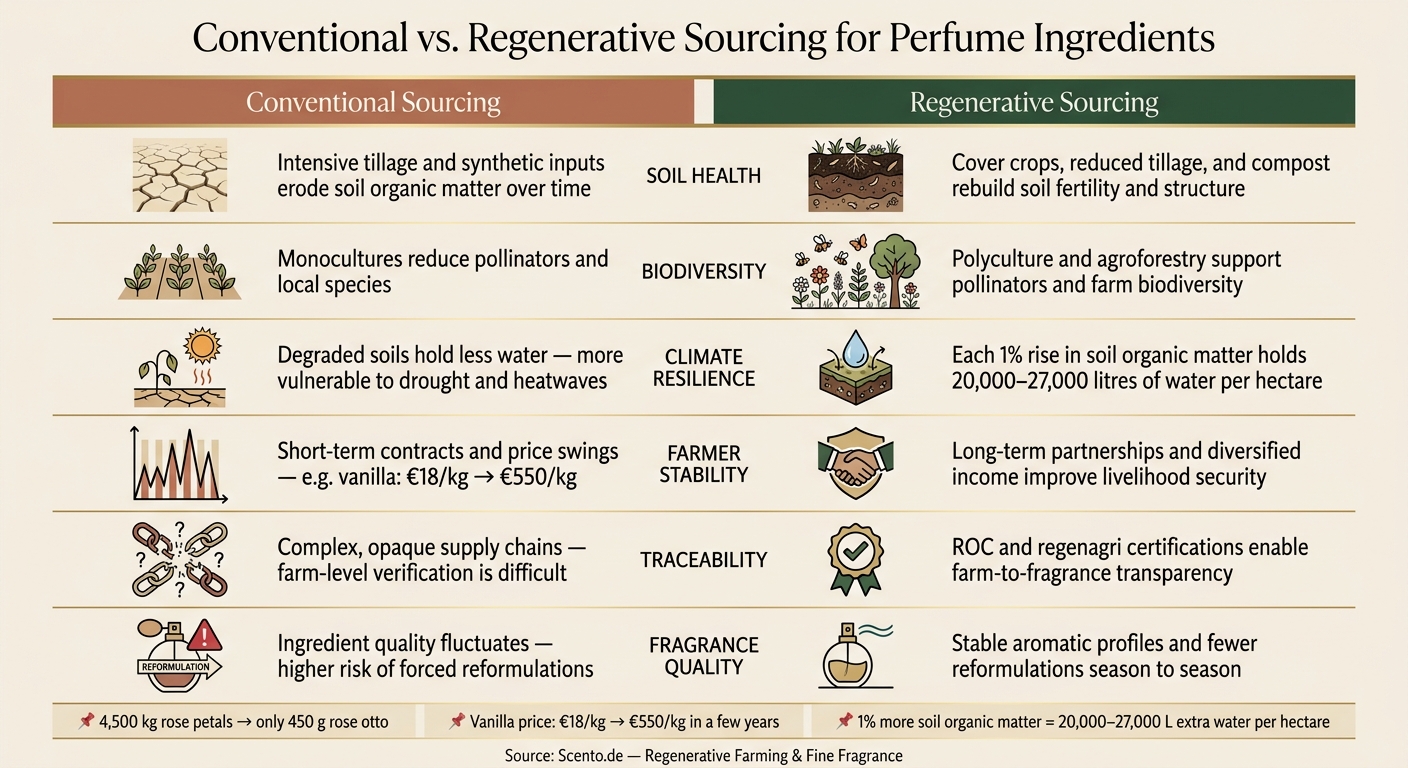
Conventional vs. Regenerative Farming for Perfume Ingredients
Those gains on the farm matter for a simple reason: they shape whether a perfume can be produced with the same quality, season after season.
More resilient supply chains for natural notes
What happens at farm level affects supply, quality, and price once the ingredient reaches the bottle. Fragrances built around natural materials like rose, jasmine, lavender, or vetiver are the most exposed to climate shocks, drought, and soil decline. Regenerative farming helps improve water retention, soil condition, and crop diversity. That can lower the risk of shortages and cut the chances of forced reformulation.
Big fragrance and beauty groups already treat this as a supply chain decision, not just a green message. LVMH has set a target that by 2026, 100 % of its strategic raw materials - including perfume ingredients and alcohol bases - will comply with its environmental standards, with dedicated regenerative programmes covering beet, palm, and iconic fragrance ingredients. Kenzo fragrances already use French sugar beet grown under regenerative principles, with LVMH co-financing farmers’ transition costs by covering all alcohol volumes used in Kenzo’s range.
For shoppers in Germany who come back to a favourite natural perfume throughout the year, that kind of backing can help keep a scent available and smelling the way they expect.
Clearer sourcing stories and more responsible buying
Regenerative projects also tend to come with better documentation than standard sourcing. Since these farming methods often need to be checked through frameworks like Regenerative Organic Certified (ROC) or regenagri, farms usually track measured indicators such as soil organic carbon trends, biodiversity data, and farmer income metrics. In plain terms, there’s a paper trail. And that’s something many standard supply chains still lack.
In Germany, plenty of shoppers already look closely at ingredients and care about sustainability in beauty. So when a brand can point to a certified regenerative farm, a named region, and third-party verification instead of a vague "sustainably sourced" line, people have something solid to assess.
Chanel explicitly describes regenerative agriculture as a way to "restore nature and climate". For a German consumer used to detailed labelling and certification systems, that level of clarity makes it easier to tell the difference between a sales line and a sourcing claim that can be checked.
Platforms like Scento can make this easier to grasp at the discovery stage. By tagging fragrances that use ingredients from regenerative or certified projects, and offering them in 2 ml, 5 ml, and 8 ml decants, shoppers can try sustainability-linked scents without going straight to a full bottle.
Conventional sourcing vs regenerative sourcing: a direct comparison
The difference becomes easier to see when both models sit side by side.
| Aspect | Conventional sourcing | Regenerative sourcing |
|---|---|---|
| Soil health | Intensive tillage and synthetic inputs can lead over time to erosion and declining soil organic matter. | Cover crops, reduced tillage, and compost help rebuild soil fertility and structure. |
| Biodiversity | Monocultures and simplified landscapes reduce pollinators and local species. | Polyculture, agroforestry, and habitat features support pollinators and farm biodiversity. |
| Climate resilience | Degraded soils hold less water, making farms more vulnerable to drought, floods, and heatwaves. | Better water retention and diversified cropping reduce yield shocks under climate pressure. |
| Farmer stability | Short-term contracts and price pressure expose farmers to market volatility. | Long-term partnerships and diversified income streams improve livelihood security. |
| Traceability | Complex, opaque supply chains make farm-level verification difficult. | Structured traceability, certifications, and impact metrics enable farm-to-fragrance transparency. |
| Fragrance quality consistency | Ingredient quality fluctuates more with environmental stress and sourcing switches. | Stable access to specific regions and qualities supports consistent aromatic profiles and fewer forced reformulations. |
Conclusion: Why regenerative farming matters for the future of fragrance
The gap between conventional and regenerative sourcing does more than shape farming practice. It affects whether natural fragrance ingredients remain available, steady in quality, and able to hold up year after year.
Those pressures begin in the field. That’s exactly where regenerative farming has the biggest effect. Conventional sourcing leaves aromatic crops open to climate shocks, soil damage, and price swings. Much of that comes from fragile supply chains built around intensive monocultures and synthetic inputs. Regenerative farming tackles that problem at the root: healthier soils can lead to more dependable harvests for fragrance crops such as rose, jasmine, vetiver, and lavender.
It also matters well beyond the crop itself. For growers, regenerative sourcing can support farming communities through longer-term relationships and steadier income. That helps protect the local know-how behind these ingredients and keeps that craft in place.
Key takeaways for Scento readers

For fragrance buyers, sourcing becomes part of the scent story. In Germany and across Europe, where environmental awareness and careful spending often sit side by side, knowing how an ingredient was grown adds more weight to a fragrance choice.
For Scento readers, trying a fragrance in a 2 ml, 5 ml, or 8 ml decant offers a lower-waste way to explore scents shaped by better sourcing.
FAQs
How can regenerative farming affect how a perfume smells?
Regenerative farming can lift the quality of perfume ingredients because it supports healthy, biodiverse ecosystems. And with natural materials, that matters a lot. The scent of a rose, vetiver, or lavender doesn’t come from the plant alone. It also reflects the soil, the climate, and the condition of the land where it grows.
When that land is healthy, the result can be more layered, lively scent profiles. You often get botanicals with more nuance and depth, rather than something flat or dull.
The flip side is simple: when ecosystems are damaged, raw material quality can slip. Soil loses life. Plant stress changes how ingredients smell. Over time, perfumers may have fewer materials with the rich, intricate character they want.
Supporting regenerative agriculture helps perfumers source botanicals that carry the fuller expression of healthy plants and healthy land.
Does regenerative sourcing make perfume more expensive?
Yes, regenerative sourcing can increase perfume costs.
Why? Because these methods usually ask more from the supply chain. Brands may need to pay for traceability, fair wages for harvesters, and specialised farming methods that often use more land, water, and labour than standard approaches.
That extra work tends to show up in the final retail price.
At the same time, Scento can lower the upfront spend by offering curated decants instead of full-size bottles. So rather than committing to a bottle that may cost €150 or more, you can try a smaller format first and spend with more confidence.
How can I tell if a perfume ingredient is truly regenerative?
Look for brands that go a step further and actively support regenerative agriculture or Biodiversity Action Plans. Those signals matter because they point to work that aims to repair land, not just limit damage.
It also helps to give extra weight to products with UEBT certification. This certification reviews farming practices against environmental and social standards tied to biodiversity, so it offers a clearer view of how ingredients are grown and sourced.
Then dig into the brand’s proof. Useful signs include:
- transparent sourcing reports
- third-party farm audits
- full traceability from harvest site to final bottle
When those pieces are in place, it’s easier to see that the brand’s approach goes beyond harm reduction and moves toward restoring ecosystems.

