I see scent in art as a material - not just a pleasant smell. To understand a work, I pay attention to where the scent comes from, how it changes as I move, and whether I can choose my distance.
This guide covers seven overlapping forms:
- Installations: scent fills or divides a room.
- Sculptures and objects: materials hold and release scent.
- Performance and the body: skin, breath and clothing carry smell.
- Film and theatre: timed scent cues accompany the action.
- Gallery spaces: scent shapes the setting around other works.
- Fashion shows and clothing: fabric and movement carry scent trails.
- Mixed-media and participatory art: visitors encounter scent alongside images, sound, objects or actions.
My starting point: more scent does not mean a better experience. In a Rijksmuseum project with 148 questionnaires, scented tours scored 8,5, compared with 8,4 for non-scented tours - a small gap, not proof of a better visit.
Across all seven forms, I consider memory, meaning and physical comfort together. <u>Exposure should remain optional.</u> In Germany, I look for “Duftkunst” labels and check scent notices before entering.
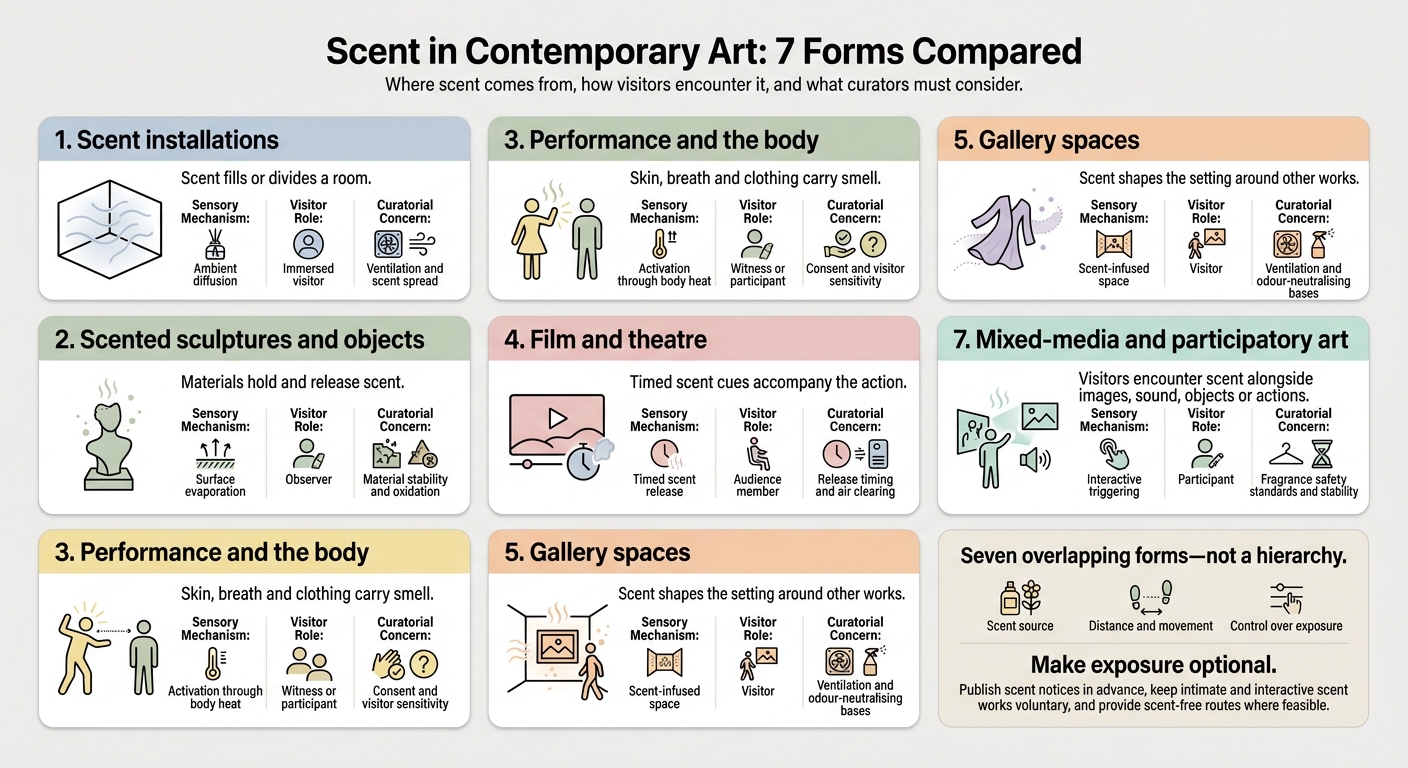
Scent in Contemporary Art: 7 Forms Compared
Fragrance, Odour and the Viewer
Fragrance is a deliberately composed scent. Odour means any smell - natural, bodily or industrial, pleasant or unpleasant. Artists may choose either, including unpleasant odours.
How viewers breathe, move and position themselves shapes their experience of scent-based work. The same aroma can feel intimate, overwhelming or unsettling depending on how close they are.
Exhibitions should clearly describe their scent content in advance, so visitors with sensitivities can decide whether to enter.
The first form to consider is the scent installation, where the space itself becomes part of the work.
1. Scent Installations
In installations, the room itself becomes the medium. A scent installation uses smell to immerse visitors in the artwork. Where and how the scent is released forms part of the work.
Diffusion is the main design choice. Continuous release surrounds the viewer, while motion-triggered release creates brief scent trails. Artists set the scent’s strength and duration to guide visitors’ attention and movement.
As you move through an installation, notice where the scent is strongest. Does it linger in the air or fade away? Consider how it connects to the room’s materials, colour and movement. Next, scent moves from the room to the object itself.
2. Scented Sculptures and Objects
Unlike installations, scented sculptures bring form and fragrance together in a single object. Notice whether the scent supports the shape or makes it feel unfamiliar.
Pay attention to the material that holds or releases the fragrance, and follow any display instructions. The scent may fade or be renewed - this change is often part of the work.
In performance, scent moves from the object to the body.
3. Scent in Performance and the Body
Scent moves from objects onto the live body, making breath, skin, and clothing part of the work. Perfume, sweat, and body odour turn the performer’s body into the medium. Consider what the scent tells you about the performer - and whether your response comes from personal taste or social expectations.
Distance matters, too. Does being close make the work feel more intimate? Does stepping back make it feel more detached?
If you have fragrance sensitivities, ask whether the work involves close contact and whether you can view it from farther away. Participation must not require touch or forced scent exposure.
4. Scent in Film and Theatre
In film and theatre, scent adds another layer to what viewers see and hear. Like a scene, it unfolds over time: a sharp opening, a deeper middle, then a lingering trace.
During screenings and live performances, a scent cue can make a scene feel intimate, tense or unresolved before it ends. The scent that remains can carry that feeling into the next moment.
In gallery spaces, control over scent becomes even more precise.
Your Personal Fragrance Expert Awaits
Take our quick scent quiz to discover authentic designer and niche fragrances matched to your taste — explore them as 2ml, 5ml, 8ml & 30ml decants and samples, so you can try each one before committing to a full bottle.
Find Your Scent5. Scent in Gallery Spaces
In galleries, scent supports the exhibition rather than taking centre stage. It adds atmosphere alongside paintings, drawings, or fashion retrospectives, shaping visitors’ pace, attention, and memory without overshadowing the work. From this controlled setting, scent moves onto the body and into dress.
Bruno Fazzolari’s Lampblack uses an India ink note to echo drawings in gallery settings.
A scent sequence along the visitor’s route can guide people between sections and shape their memories of each room. Localised scenting keeps fragrance near its source rather than filling the space. In fashion shows, that control changes again as scent follows garments and movement.
6. Scent in Fashion Shows and Clothing
Fabric moves close to the body, so scent works differently in fashion than in a static display. Treat fragrance as part of the collection’s story, rather than a brand signature. On the runway or in wearable art, it can shape how people read the clothes, adding atmosphere, tension, or a lingering impression.
Scent should extend the collection’s concept without overshadowing the clothes. Lasting power and audience comfort matter just as much as the idea behind it.
Beyond the runway, scent can become part of mixed-media works that involve the audience directly.
7. Scent in Mixed-Media and Participatory Art
Mixed-media and participatory works combine scent with images, objects, sound or movement. In participatory art, scent becomes something visitors engage with, not just a background sensation. Their responses help complete the work’s meaning.
Visitors bring their own memories and shared references, so the same scent can mean different things to different people. That personal connection makes scent an effective way to draw viewers into the work.
How the 7 Forms Engage Visitors
These seven forms differ mainly in distance: how close scent gets to the body, and how much control visitors have over exposure.
| Artistic form | Primary sensory mechanism | Visitor role | Main curatorial concern |
|---|---|---|---|
| 1. Scent installations | Ambient diffusion | Immersed visitor | Ventilation and scent spread |
| 2. Scented sculptures and objects | Surface evaporation | Observer | Material stability and oxidation |
| 3. Performance and the body | Activation through body heat | Witness or participant | Consent and visitor sensitivity |
| 4. Film and theatre | Timed scent release | Audience member | Release timing and air clearing |
| 5. Gallery spaces | Scent-infused space | Visitor | Ventilation and odour-neutralising bases |
| 6. Fashion shows and clothing | Fabric movement and scent trails | Spectator | Longevity and material compatibility |
| 7. Mixed-media and participatory art | Interactive triggering | Participant | Fragrance safety standards and stability |
For curators, the task across all seven is the same: control exposure without weakening the work.
Plan ventilation to limit scent spillover. In film and theatre, match releases to the action and clear the air between cues. Check scented objects for material stability and fabrics for fragrance compatibility.
Make exposure optional. Publish scent notices in advance, keep intimate and interactive scent works voluntary, and provide scent-free routes where feasible. These decisions shape how scent affects visitors’ mood, memory and comfort.
How Smell Shapes Mood, Memory and Meaning
Across these seven forms, scent shapes mood, memory and meaning in different ways. An odour may suggest comfort, threat, intimacy or unfamiliarity. The artist’s intent is only one layer. Each visitor’s experience, background, expectations and physical condition also shape their response. A familiar smell isn’t always a welcome one.
Recognising a smell and remembering through it aren’t the same thing. You might struggle to name an odour yet link it to a person, home or period of your life. Memories prompted by smell can feel especially emotional and clear, but that doesn’t make them more accurate. Some visitors recall nothing. Others make connections the artist couldn’t have predicted.
A small visitor study shows how limited scent’s effect can be.
At the Rijksmuseum Amsterdam, a scented-tour project running from 2015–2020 collected 148 questionnaires: 77 from scented tours and 71 from non-scented tours. Average appreciation scores were 8,5 versus 8,4 - a small difference, not evidence that adding scent reliably improves an exhibition.
Sensitivity, migraine, asthma and a reduced sense of smell can change the encounter. As you view a work, pay attention to your physical response alongside what you think the scent represents.
Time and movement change the experience, too. Scent travels, lingers and fades. An early visitor may meet a different atmosphere from someone arriving later. Move away from the source, and a dense cloud may become a faint trace. Compare what you notice as you enter, approach and leave: absence, overlap and lingering can matter as much as first contact.
Conclusion: Scent as an Art Material
Scent connects all seven forms. As an art material, it can shape a space or object within a narrative and turn visitors into participants.
This changes how visitors move through, remember and interpret the work. A smell’s source - and the way visitors are invited to encounter it - helps shape its meaning.
In Germany, look for “Duftkunst” labels. Before approaching scented works, follow instructions on participation, touch and proximity: how close you get is part of the experience.
Scent is not backdrop; it is material.
FAQs
How can museums preserve scent-based artworks?
Museums can draw on past storage practices that focused on keeping fragrances stable and protected. Blends were kept in glass, lead or alabaster containers in cool, shaded places to limit evaporation and preserve the scent.
Modern preservation also relies on high-quality packaging, including premium glass or crystal. These materials are chosen not only for their appearance, but also to help fragrances stay stable over time.
Can I experience scent art with a reduced sense of smell?
You can still engage with scent art if your sense of smell is reduced. Artists often work with fragrance through several senses, using visuals, touch and sound to express it. A scent might take the form of a texture, colour or shape.
You can also connect with a work through its story, the shapes it suggests, or the artist’s emotional and historical context - not just through what you can smell.
How can I tell artistic scent from ambient fragrance?
Artistic scent tells a story or expresses an idea through intent and craftsmanship. A perfumer builds it with top, heart, and base notes that unfold on the skin, stirring emotions or memories.
Ambient fragrance sets the mood in a space, such as a gallery or home. While artistic scent offers a personal experience that changes as you wear it, ambient fragrance stays part of the setting - a sensory backdrop.

