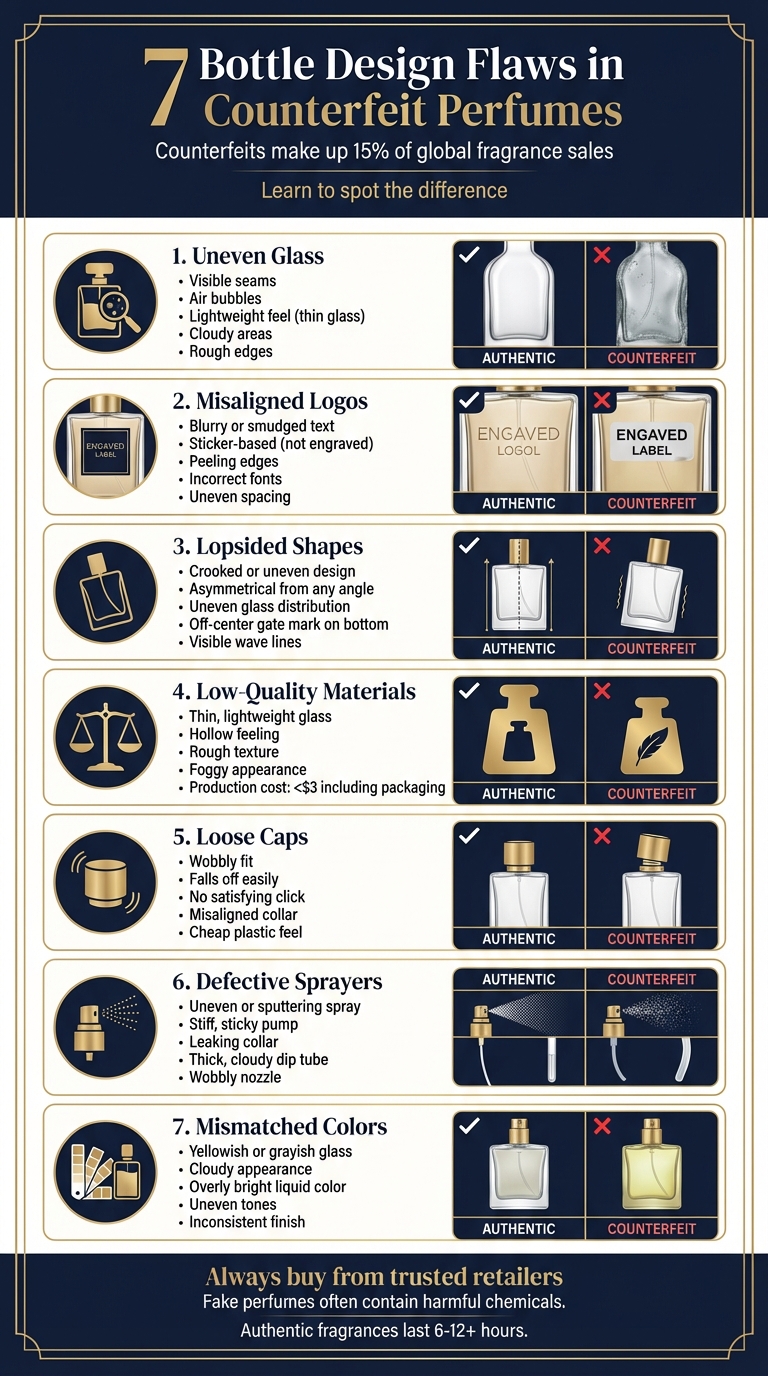
Counterfeit perfumes are everywhere, making up 15% of global fragrance sales. While they often look convincing, their bottles reveal flaws that give them away. These flaws include uneven glass, misaligned logos, cheap materials, and defective sprayers. Spotting these issues not only protects your wallet but also your health, as fake perfumes often contain harmful chemicals. Here’s a quick guide to identifying these design flaws:
- Uneven Glass: Visible seams, bubbles, or a lightweight feel.
- Misaligned Logos: Blurry, smudged, or sticker-based logos.
- Lopsided Shapes: Crooked or uneven bottle designs.
- Low — Quality Materials: Thin glass, rough edges, or hollow-feeling bottles.
- Loose Caps: Wobbly, poorly fitting caps that may fall off.
- Defective Sprayers: Uneven mist, stiff pumps, or leaking collars.
- Mismatched Colors: Cloudy or off-tone glass and overly bright liquid.
Carefully inspecting these details can help you avoid counterfeits and spot perfume clones to buy authentic scents that are safe and high-quality. Stick to trusted retailers to avoid the risks of fake products.
7 Bottle Design Flaws in Counterfeit Perfumes Visual Guide
1. Uneven Glass and Visible Seams
Craftsmanship Quality
Luxury perfume bottles are known for their precise construction, with seamless and flawless glass being a key indicator of their quality. These bottles are crafted using advanced molding techniques to ensure a smooth, uniform finish. On the other hand, counterfeit bottles - often produced for less than $3, including packaging costs - rely on cheaper molds that result in visible seams and imperfections.
To spot these flaws, hold the bottle up to a light source and examine it closely. Genuine bottles use high-grade glass that is crystal-clear and consistently thick. Counterfeit versions often reveal telltale signs like air bubbles, cloudy areas, or uneven surfaces, which distort reflections. These imperfections stem from the use of low-quality materials and rushed manufacturing processes.
The weight of the bottle also plays a significant role in determining its authenticity.
Material Authenticity
One of the easiest ways to differentiate an authentic bottle from a counterfeit is by its weight. Genuine luxury bottles are made from solid, heavy glass, giving them a premium and substantial feel. In contrast, counterfeit bottles feel lightweight and hollow, as they are made from thin, inferior glass.
Additionally, authentic bottles feature smooth, machine-finished edges. Counterfeit versions, however, often have rough or uneven edges, which further hint at their lower quality.
Precision in Design and Branding
Visible seams are another red flag when identifying counterfeit bottles. While modern counterfeiters have become more sophisticated - adding holographic seals and batch codes to mimic authenticity - they often fail to hide the seams. These seams are a clear sign of subpar craftsmanship and an easy way to spot a fake.
Your Personal Fragrance Expert Awaits
Take our quick scent quiz to discover authentic designer and niche fragrances matched to your taste — explore them as 2ml, 5ml, 8ml & 30ml decants and samples, so you can try each one before committing to a full bottle.
Find Your Scent2. Incorrect or Sticker — Based Logos
When determining if a perfume is authentic, the logo can reveal a lot. A closer look at its details often exposes counterfeits.
Craftsmanship Quality
Authentic perfume logos are all about precision. The text should be sharp, evenly printed, and completely free of flaws. Counterfeit bottles, on the other hand, often give themselves away with blurry lettering, uneven edges, or smudged ink. These imperfections highlight the lower production standards of fake products. A genuine logo will always maintain a crisp and clear appearance, while a counterfeit one may look sloppy.
Material Authenticity
The quality of the label can also be a dead giveaway. Real perfume labels are built to last - they are waterproof and scratch-resistant, ensuring they remain intact even with frequent use. Counterfeit labels, however, tend to show wear quickly. You might notice peeling edges or labels that feel flimsy due to poor adhesives and cheaper materials.
Pay attention to the logo’s surface. Luxury brands often add raised or metallic finishes to their labels, giving them a textured, premium feel. Counterfeiters usually skip these details, opting for flat, sticker-like logos instead. If the logo feels like a basic sticker that could easily peel off, it’s likely a fake.
Precision in Design and Branding
The font and design of the logo are equally important. Authentic brands go through strict quality control to ensure every detail, including the font, spacing, and alignment, is perfect. Counterfeits frequently miss the mark, using incorrect fonts, uneven spacing, or logos that are slightly crooked. These subtle flaws can make a big difference.
To verify authenticity, compare the font and logo placement with images from the brand’s official website. Look for inconsistencies, such as uneven batch codes. On genuine bottles, batch codes are typically etched directly into the glass or printed neatly on a separate label, not slapped onto a low-quality sticker. These small details can help you spot a fake.
3. Lopsided or Unbalanced Shapes
When evaluating a perfume bottle’s authenticity, symmetry can be a major clue. High-end luxury bottles are designed with flawless symmetry, reflecting their meticulous craftsmanship. If the bottle appears crooked, tilted, or uneven from any angle, it’s a strong sign that you might be holding a counterfeit or perfume clone.
Craftsmanship Quality
Creating authentic perfume bottles involves time-intensive and costly molding techniques to achieve precise, symmetrical designs. Counterfeit bottles, on the other hand, often skip these detailed processes, resulting in uneven shapes and poorly defined lines.
"Authentic perfume bottles are designed to be perfectly symmetrical. Hold the bottle up and look at it from every angle. If anything seems lopsided, crooked, or uneven, you’re almost certainly looking at a fake." — Fragrance Lord
Pay special attention to the vertical seam lines where the mold halves meet. Genuine bottles are polished so thoroughly that these seams are nearly invisible, while counterfeits often leave behind rough or uneven seams.
Material Authenticity
The base of the bottle can reveal a lot about its origin. Luxury bottles are crafted from thick, heavy glass to ensure stability and a premium feel. They also feature a precisely centered gate mark on the bottom. Counterfeit bottles, however, frequently display uneven glass distribution and off-center gate marks, which can cause them to sit unevenly. Genuine bottles, often made from high-quality "Super Flint Glass", have smooth surfaces with no visible seams. In contrast, counterfeit bottles tend to use lower-quality glass, which may show structural imperfections like wave lines or scissor marks. These differences in materials not only affect the bottle’s texture and weight but also its overall balance and symmetry.
Precision in Design and Branding
Take a moment to inspect the bottle from all angles. Authentic bottles are consistently balanced and symmetrical, while irregularities in shape or glass thickness are telltale signs of a fake. You can also compare the weight to a verified original - counterfeit bottles are often noticeably lighter due to the use of cheaper materials like industrial-grade glass or plastic substitutes.
4. Lightweight Feel and Low — Quality Materials
One of the easiest ways to spot a counterfeit perfume bottle is by its weight. Authentic bottles are crafted from premium, high-density glass, giving them a noticeable heft. Counterfeit bottles, on the other hand, tend to feel much lighter and cheaper in comparison.
Material Authenticity
Luxury perfume brands use high-quality materials like dense glass and durable components to achieve a solid, luxurious feel. In contrast, counterfeit manufacturers prioritize cutting costs, often sourcing low-grade materials. Many counterfeit operations in regions like Southeast Asia and Eastern Europe churn out thousands of bottles daily, often using packaging that mimics legitimate brands almost perfectly. However, these replicas fail to replicate the premium-grade glass and plastics used in authentic bottles. This results in counterfeit bottles that feel lighter, look foggy, and often display visible flaws. Authentic glass feels smooth and cool to the touch, while counterfeit glass tends to feel rough and may appear cloudy. Running your fingers over the bottle or simply holding it can reveal this difference.
Craftsmanship Quality
The overall craftsmanship of the bottle is another key indicator of authenticity. When you hold the bottle, assess its weight and balance. Does it feel substantial and well-made, or does it seem hollow and flimsy? Authentic bottles are designed with care, often resembling works of art, with a precise weight that complements their size. Counterfeit bottles, on the other hand, often lack this attention to detail, cutting corners that result in a less refined, less balanced feel. Paying attention to these tactile details can help you quickly determine whether a perfume bottle is genuine or fake.
5. Loose or Poorly Fitting Caps
The cap of a perfume bottle is more than just a functional piece - it’s a key indicator of the bottle’s authenticity. A genuine cap will either click securely into place or close with a smooth magnetic pull, offering a seamless and satisfying experience. In contrast, counterfeit caps often wobble, slide, or fail to sit flush, making them an immediate cause for concern.
Craftsmanship Quality
Luxury brands put significant effort into the design of their caps, ensuring they provide a precise and tactile closure. When a cap locks into place, you should hear a distinct click or feel the smooth pull of a magnet.
"A real cap is engineered perfectly. It clicks into place with a satisfying, snug fit or closes with a smooth magnetic pull." — Fragrance Lord
Counterfeit caps, on the other hand, often feel poorly made. They may require extra effort to secure or fit loosely. A simple test? Turn the bottle upside down. If the cap rattles or falls off, it’s a strong sign the product might not be authentic.
Material Authenticity
The materials used in authentic perfume caps are another telltale sign. Genuine caps are often made from high-quality materials like real metal or dense, high-grade resin, giving them a noticeable weight and sturdiness. In contrast, counterfeit caps usually feel light and hollow, often made from cheap plastic that lacks the heft of a genuine product.
Precision in Design and Branding
Take a close look at the sprayer collar - the ring where the cap meets the bottle’s neck. On authentic bottles, this collar is perfectly flush and seamlessly integrated into the design. Counterfeit bottles often fail in this area, with collars that appear misaligned or poorly attached. For magnetic caps, check that the magnet functions properly, securing the cap automatically and without hesitation.
Attention to these details can help you spot a fake before it makes its way onto your vanity.
6. Defective Sprayers and Atomizers
Beyond issues with bottle shape and cap fit, counterfeit perfumes often falter when it comes to the atomizer. A genuine sprayer is designed to deliver a fine, even mist with minimal effort, ensuring a seamless user experience.
"The atomizer - the part that does the spraying - is another detail that fakers frequently mess up. A genuine sprayer is designed to release a fine, even mist that beautifully disperses the scent." — Fragrance Lord
In contrast, counterfeit sprayers often feel cheap and poorly constructed. They may require extra force to activate or get stuck entirely. Some fake sprayers sputter, clog, or fail after just a few uses, making them unreliable and frustrating to use. These flaws in performance are clear indicators of counterfeit products and perfume clones.
Craftsmanship and Attention to Detail
Just like the bottle and cap, the sprayer’s construction reflects the overall quality of the perfume. On authentic bottles, the sprayer collar fits snugly against the neck of the bottle, with no gaps, wobbling, or signs of poor assembly. Counterfeit collars, however, often lack this precision. They may appear as separate, poorly attached pieces, sometimes even leaking around the edges.
Testing the sprayer can reveal a lot. A single spray should produce a smooth, even mist. Additionally, examine the dip tube inside the bottle - it should be almost invisible, perfectly straight, and properly aligned. In counterfeit bottles, the dip tube is often thicker, cloudy, or bent, further highlighting the lack of quality.
Here’s a quick comparison to help identify authentic versus counterfeit sprayers:
| Feature | Authentic Sprayer/Atomizer | Counterfeit Sprayer/Atomizer |
|---|---|---|
| Spray Pattern | Fine, consistent mist | Uneven or sputtering |
| Pump Feel | Smooth, effortless press | Stiff and sticks |
| Dip Tube | Nearly invisible, perfectly straight | Thick, cloudy, or bent |
| Collar | Sits flush with the bottle neck | Gaps present; poorly attached |
| Nozzle | Stable and centered | Wobbly or misaligned |
These details make it easier to spot counterfeits and ensure you’re getting the quality expected from a genuine luxury fragrance.
7. Mismatched Colors and Off — Tone Glass
Counterfeit perfumes often fail in the finer details, especially when it comes to the glass used for their bottles. One clear red flag is mismatched or inconsistent glass color. Authentic perfume bottles are crafted from high-quality glass with a uniform tone, while counterfeit bottles often use lower-grade materials that can appear yellowish, grayish, or even cloudy. This uneven, off-tone finish is a strong indicator of a fake.
Material Authenticity
Authentic bottles are made from premium glass that feels solid and weighty in your hand. The glass is durable and perfectly clear unless a specific tint is part of the design. Unlike counterfeit versions, which often show uneven coloring or cloudiness, genuine bottles maintain consistency in both material and color. Just as rough glass edges and misaligned logos can expose a fake, mismatched tones in the glass further highlight the lack of quality in counterfeit production.
"Luxury brands pour immense resources into creating bottles that are works of art, and counterfeiters just can’t match that quality." — Fragrance Lord
The liquid inside the bottle can also serve as a clue. High-quality perfumes tend to have a pale or nearly colorless appearance, thanks to the premium ingredients used. On the other hand, counterfeit fragrances may display overly bright or saturated colors, which is a clear sign of inferior production.
"If you notice a deep or overly saturated color patch while purchasing a perfume, be clear at that moment that you are grabbing a fake one. Because pure perfumes often have pale or very minimal color for using all genuine ingredients." — La Pink
Precision in Design and Branding
Take a close look at the bottle in natural light and feel its surface. Authentic bottles are smooth and evenly finished, while counterfeit ones may feel rough or show uneven thickness. Comparing the glass tone to official brand photos is another effective way to check. Any color difference, whether in the bottle itself or between the cap and the bottle, points to poor craftsmanship and is a likely sign of a counterfeit product.
Conclusion
Understanding the key design flaws in counterfeit perfumes equips you to make smarter purchasing decisions. Issues like uneven glass, misaligned logos, lopsided shapes, lightweight materials, loose caps, defective sprayers, and incorrect colors are all red flags that can help you identify fakes. These flaws not only signal counterfeits but also hint at the compromised scent quality and reduced longevity they often bring.
For peace of mind, stick to verified sources when exploring designer fragrances. This is a crucial step when building a fragrance collection that you can trust. Platforms like Scento ensure you receive authentic products by operating from an ISO-certified facility and offering a 100% authenticity guarantee. Each fragrance undergoes rigorous checks before it reaches you, eliminating the risks associated with unverified sellers.
Instead of committing to a full-sized bottle from uncertain sources, Scento provides decants in 2 ml, 5 ml and 8 ml vials, and a 30 ml bottle decant on most perfumes. This allows you to experience the full evolution of a scent and enjoy its lasting performance - authentic fragrances often last 6 to 12+ hours - without the financial strain of a full bottle. Plus, every purchase includes a 30-day satisfaction guarantee and adheres to strict safety standards, such as the UK Cosmetics Regulation and IFRA amendments, ensuring both quality and safety.
FAQs
What’s the fastest way to check a perfume bottle for fakes in-store?
The fastest way to identify a fake perfume bottle while shopping is to focus on common design mistakes. Look for uneven glasswork, logos that are off, or colors that don’t match the original branding. These small but noticeable flaws are often giveaways of counterfeit products and can make it easier to spot genuine ones.
Can a genuine perfume bottle have small flaws like seams or bubbles?
Yes, authentic perfume bottles can occasionally show minor imperfections, such as seams or small bubbles. These are usually the result of the manufacturing process and don’t automatically indicate that the product is counterfeit.
Are counterfeit perfumes dangerous to use on skin?
Counterfeit perfumes are not just a threat to authenticity - they can be downright dangerous. Many of these fake fragrances are laced with harmful substances, such as heavy metals and toxic chemicals, that can pose serious health risks. Users may experience allergic reactions, skin irritation, or even burns. To protect yourself, it’s essential to be vigilant and ensure you’re buying from trusted sources.

