The fragrance industry is evolving faster than ever, thanks to advancements in AI, biotechnology, and smart home systems. These innovations are not just speeding up perfume creation but are also addressing consumer demands for personalization, sustainability, and efficiency. Here’s what’s changing:
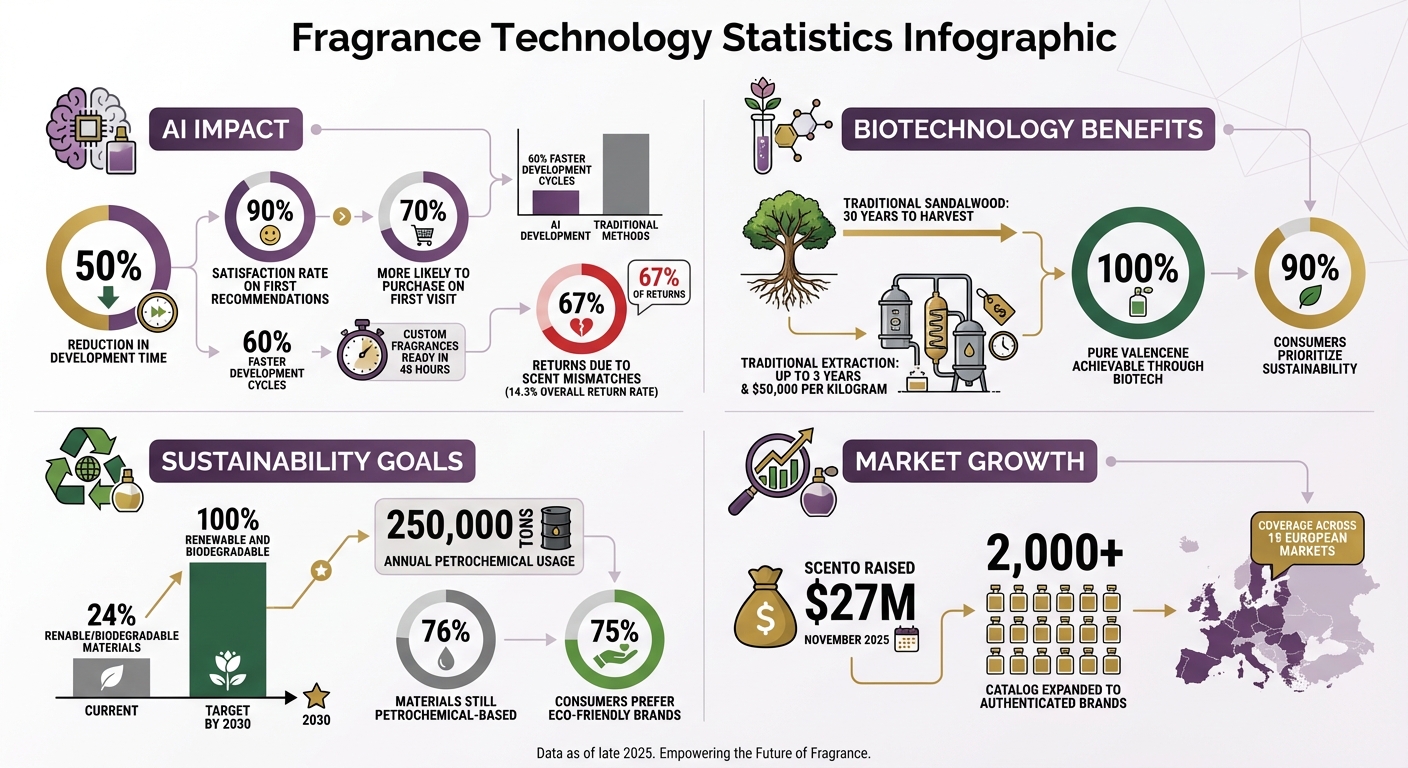
- AI in Fragrance Creation: Tools like Givaudan’s Carto and Scentalytics’ AI Perfume Creator 2.0 allow perfumers to design scents faster by analyzing preferences, emotions, and even photos. When comparing AI vs traditional perfumery, technology reduces development time by up to 50%, creating custom fragrances in hours instead of weeks.
- Biotechnology: Lab-grown molecules like santalol and bergamotene are replacing traditional plant-based ingredients, cutting costs and preserving natural resources. For example, sandalwood oil now comes from fermentation, eliminating the need to harvest 30-year-old trees.
- Smart Home Diffusers: Wi — Fi-enabled devices like AromaPro and ScentAir Whisper Pro let users control scents remotely, schedule releases, and even sync fragrances with lighting or music.
- Eco — Friendly Formulations: Companies are shifting to biodegradable, alcohol-free, and upcycled ingredients to reduce petrochemical use. By 2030, the goal is for 100% of materials to be renewable and biodegradable.
These tools are reshaping how perfumes are crafted, sold, and experienced. Whether it’s AI-driven personalization, lab-created molecules, or smarter home systems, the future of fragrance is all about blending technology with artistry.
Future of Fragrance Technology: Key Statistics and Impact Metrics
This AI Machine Turns Memories Into Perfume | SCIRCLE Explained
Your Personal Fragrance Expert Awaits
Take our quick scent quiz to discover authentic designer and niche fragrances matched to your taste — explore them as 2–8ml decants and samples, so you can try each one before committing to a full bottle.
Find Your ScentAI — Powered Fragrance Customization
AI is reshaping the fragrance world by tailoring scents to individual preferences. By analyzing inputs like conversations and images, it deciphers abstract descriptions such as "cozy" or "nostalgic" and converts them into precise formulas. This data-driven approach has transformed how luxury perfume is made.
How AI Processes User Preferences
AI tools collect data through quizzes, purchase histories, and even images, translating this information into detailed scent profiles. These profiles are then matched against vast databases of chemical compositions and blending ratios to pinpoint ideal fragrances.
In July 2022, Swedish brand No Ordinary Scent introduced a tool that evaluates up to three images submitted by customers. The AI examines elements like colors, seasons, and themes (e.g., nature or people) to create a custom fragrance with up to 20 ingredients. One customer’s "bittersweet" memory photos inspired a blend of amber, tonka bean, roasted almonds, and metallic musk. Founder Sandra Kinnmark highlighted this user-driven approach:
"Everything is being co-created by the people who are actually using the scents rather than marketing strategists at big corporations".
This example illustrates how visual data can inspire deeply personal scent creations.
Natural language processing (NLP) allows users to describe their desired fragrance in emotional or situational terms rather than technical jargon. For instance, Jo Malone London launched an AI Scent Advisor in December 2025, powered by Google’s advanced language models. Customers could input phrases like "scent for a job interview", and the system would match their request to millions of data points, including chemical formulas and blending techniques. This innovative approach bridges emotional expressions and the science of fragrance, achieving up to 90% satisfaction on first recommendations. Additionally, customers using these tools are 70% more likely to make a purchase on their first visit .
Instant Fragrance Creation
AI isn’t just about recommendations - it now enables instant fragrance formulation. In October 2024, Scentalytics introduced the AI Perfume Creator 2.0, featuring a "Compose" module. Users could specify preferences such as accords, gender, season, or time of day, and the system would generate a detailed list of raw materials with precise measurements for crafting the fragrance. This tool relies on over 10 interconnected neural networks to predict and refine perfume characteristics.
Similarly, SCENTMATIC Inc. unveiled KAORIUM in March 2022, an AI-powered system that translates between scents and words. Partnering with KO — GU in Shinjuku, the device guides customers using descriptive keywords. By analyzing a customer’s "scent sensitivity" through iterative scent and word selections, KAORIUM generates a "Personalized Card" with tailored recommendations. President Toshiharu Kurisu explained:
"KAORIUM is an AI system that converts scent into words and vice versa... with its cutting-edge technology, KAORIUM can use words to visualize impressions and find scents associated with particular words".
This technology showcases how AI can seamlessly connect abstract preferences with tangible fragrance options.
The speed of AI-assisted fragrance creation is another game-changer. Development cycles are up to 60% faster compared to traditional methods, with some startups offering custom fragrance samples within 48 hours . This efficiency addresses a significant challenge in online fragrance sales - return rates hover around 14.3%, with scent mismatches accounting for 67% of those returns. These advancements highlight how AI is streamlining the journey to personalized, high-quality fragrances.
Biotechnology in Fragrance Development
Biotechnology is reshaping how fragrance molecules are made. Instead of depending on traditional methods like plant extraction or chemical synthesis, scientists now use "microbial cell factories" - organisms such as E. coli and yeast (S. cerevisiae) - to create complex aroma compounds through fermentation. This process, often called "white biotechnology," transforms renewable materials like sugar into high-purity fragrance ingredients under energy-efficient and gentle conditions.
As artificial intelligence personalizes scent profiles, biotechnology is revolutionizing the production of fragrance ingredients.
Lab — Created Aroma Molecules
By engineering microbes with plant-derived genes for scent-producing enzymes, scientists can produce molecules like patchoulol, santalol, and valencene through fermentation - similar to brewing a fine beverage. For example, in 2020, Isobionics (a BASF subsidiary) introduced a fermentation-based santalol that mimics sandalwood oil. CEO Toine Janssen highlighted its environmental impact:
"Producing sandalwood oil via fermentation preserves the woods since not a single gram of sandalwood tree is needed".
This innovation is critical because traditional sandalwood production requires trees to grow for 30 years before they can be harvested. In March 2023, Isobionics achieved another milestone with "Natural trans-alpha — Bergamotene 80," a molecule never before isolated in such pure form. It brings a mild, waxy citrus aroma to lime and lemon fragrances. Meanwhile, Future Society has used DNA sequencing to recreate scents from extinct flowers. Their "Invisible Woods" fragrance captures the essence of a vanished Indian mountain flower, lost to drought in 1917.
These developments highlight a shift toward more sustainable and innovative fragrance production.
Environmental and Cost Benefits
Biotechnology also tackles sustainability and cost challenges by introducing controlled, efficient production methods. Traditional plant extraction is often affected by climate events, seasonal changes, and geopolitical factors, which can lead to volatile prices and supply shortages. In contrast, biotech production occurs in bioreactors, unaffected by weather or land availability. Reinhard Zschoche, Ph.D., from BASF, explained the agricultural advantage:
"Biotechnology allows us to produce natural molecules that are difficult to synthesize chemically, and whose concentrations in plants are so low that comparatively large areas are needed to produce them agriculturally".
Purity is another key benefit. Biotechnology can produce 100% pure valencene, which natural citrus oils cannot achieve due to impurities. Traditional extraction methods can take up to three years and cost as much as $50,000 per kilogram. With 90% of consumers now prioritizing sustainability in beauty products, biotech-produced molecules align with both environmental goals and market demands. Zschoche emphasized the transformative potential:
"Changing a process from chemistry to biotech can be a fundamental game changer because it allows us to switch from fossil feedstocks to renewable ones".
These advancements illustrate how biotechnology is driving fragrance production toward sustainability, efficiency, and alignment with modern consumer priorities.
Smart Home Fragrance Systems
Smart home technology is reshaping how we experience fragrance at home. With smart diffusers, users can control scent intensity, switch between fragrances, and schedule releases - all through smartphones or voice assistants, without ever needing to touch the device.
App — Connected Fragrance Control
Modern smart diffusers come equipped with Wi — Fi and Bluetooth connectivity, allowing users to manage them remotely with ease. Through mobile apps, you can adjust fragrance strength with sliders, power devices on or off from anywhere, and even set automated schedules for specific times or days. High-end systems like the AromaPro BT HVAC (€935) can cover large areas ranging from 500 to 4,000 square feet and utilize app-based scheduling. On the more affordable side, options like the Sierra Modern Home diffuser are available starting at just €39.95.
The Aromini BT Plus stands out with a 9.5/10 rating for its cold-air nebulizing technology and adjustable intensity controls via the AromaTech app. Similarly, the ScentAir Whisper Pro earned an 8/10 rating in 2025 testing, praised for its Wi — Fi and Bluetooth capabilities, voice control compatibility with Alexa and Google Assistant, and coverage of up to 1,000 square feet. Many of these systems now also offer real-time monitoring, sending notifications when oil levels are low, so you never have to guess when it’s time to refill. However, network compatibility can vary, so it’s worth checking before purchasing.
These innovations are pushing the boundaries of how users interact with home fragrance systems.
User Interaction Features
Smart diffusers go beyond basic scent control by offering mood-based automation. Imagine waking up to energizing citrus in the morning, staying focused with peppermint during work hours, and winding down with lavender in the evening - all programmed to release at just the right times. Some advanced systems even synchronize scent diffusion with other smart home features like lighting, music, and climate control. For example, a "work mode" might combine peppermint diffusion with bright lighting, while an evening routine could dim the lights, play soothing music, and release a calming lavender mist.
Looking ahead, next-generation systems are expected to integrate biometric data for even greater personalization. Tom McNeilis, a writer for California Fresh Scent, predicts:
"Future versions will likely integrate with wearables (like smartwatches) to adjust fragrance according to stress levels, heart rate, or even sleep cycles".
Some current models already include grouping functions, enabling users to manage multiple diffusers across different rooms simultaneously. Meanwhile, car-based systems are getting smarter too, with accelerometer features that activate or deactivate diffusion based on vehicle movement. These advancements mark a shift from simple air freshening to creating personalized scent ecosystems, transforming homes into tailored olfactory experiences.
Eco — Friendly Fragrance Formulations
The fragrance industry is setting ambitious goals to transition to 100% renewable and biodegradable materials by 2030. Currently, only 24% of perfumery materials meet these criteria, leaving the majority - 76% - dependent on petrochemicals. This shift is driving innovation in how fragrances are formulated.
Alcohol — Free and Water — Based Technologies
Traditional fragrances rely heavily on synthetic solvents, contributing to an annual usage of 250,000 tons of petrochemicals. To address this, the industry is exploring alternatives that reduce environmental impact. In March 2025, Osmo, a fragrance tech startup, introduced three AI-designed molecules - Glossine, Fractaline, and Quasarine - that are non-toxic, biodegradable, and free of harmful pollutants. Alex Wiltschko, Osmo’s Founder and CEO, highlighted the significance of this approach:
"Faster discovery reduces waste through precision design of non-toxic, biodegradable molecules free from harmful allergens or pollutants".
Other companies are also making strides. By February 2024, suppliers like Symrise and Firmenich began producing Mandarin Aldehyde (2-dodecenal), a citrus note that is biodegradable and made up of over 50% renewable carbon. Additionally, water-based and alcohol-free systems are proving capable of maintaining fragrance performance while cutting down on petrochemical reliance. The industry has also embraced upcycling by repurposing byproducts like citrus oils from the beverage sector and turpentine from wood pulp waste to create renewable raw materials.
Consumer Demand for Green Products
These advancements align with growing consumer interest in sustainability. A reported 75% of consumers prefer brands that prioritize eco-friendly practices, and since 90% of household products include fragrances, this shift is essential for broader market sustainability. In April 2021, Unilever’s President of Home Care, Peter ter Kulve, launched the "Cleaning has Meaning" initiative, pledging to meet a 100/100 standard - 100% renewable and 100% biodegradable materials - by 2030. He remarked:
"The goal is to use only 100% renewable and 100% biodegradable materials by 2030, certainly the most stringent approach in the consumer industry".
Interestingly, natural essential oils, while often perceived as eco-friendly, can have a larger carbon footprint than modern synthetics due to low extraction yields (0.1–5%) and significant land and water requirements. Biodegradable synthetics are emerging as a more environmentally responsible option, challenging traditional notions of sustainability in fragrances.
Scento‘s Approach to Fragrance Discovery

Scento has reshaped how people explore fragrances by introducing personalized solutions and innovative decant formats. For many, finding the right scent can feel like a gamble - committing to a full-size bottle often leads to wasted money if the fragrance doesn’t suit them. Scento solves this problem by offering authenticated designer and niche fragrances in convenient sizes: 0.75 ml, 2 ml, and 8 ml. For those who enjoy regular variety, there’s also an 8 ml subscription option.
Designer Fragrance Decants
In November 2025, Scento secured a $27M investment to expand its digital perfumery across 19 European markets, growing its catalog to include over 2,000 authenticated designer and niche brands. Speaking about the company’s vision, Co — Founder and CEO Sebastian Dobrincu explained:
"The legacy perfume industry optimized for single-bottle loyalty and repeat purchases of the same fragrance. Modern consumers don’t live that way – our identities, preferences, and daily rituals are fluid."
This shift in consumer behavior has sparked a demand for what’s often called a “scent wardrobe” - a collection of fragrances tailored to different moods, occasions, and seasons. Scento’s decant model supports this trend, allowing users to explore luxury scents without the commitment or expense of full-size bottles. The platform takes it a step further with its proprietary machine learning, which analyzes individual skin chemistry and olfactory preferences across fragrance families. This technology helps users discover scents that align perfectly with their tastes, turning sampling into a seamless and enjoyable experience.
Building a Fragrance Collection
Scento’s vision extends beyond sampling. The company plans to introduce 30 ml and larger bottles, enabling users to transition from discovery to building a full-fledged fragrance collection. Travel-sized formats serve as an entry point, while larger bottles cater to those who’ve found their go-to scents. As Dobrincu pointed out:
"Discovery feels personal, intelligent, and effortless – customers return because our platform adapts to their evolving taste, not because we’ve locked them into rigid subscription models."
To ensure authenticity - a critical concern in the online fragrance market — Scento partners directly with prestigious Parisian maisons, Italian perfumers, and independent artisanal creators. This commitment not only guarantees quality but also builds trust in an industry often plagued by counterfeit products. By combining intelligent personalization with flexible sizing, Scento aligns with the evolving preferences of modern consumers. It transforms fragrance discovery from a risky and expensive process into a curated journey, empowering users to create scent collections that reflect their dynamic lifestyles.
The Evolving Fragrance Landscape
The fragrance world is changing rapidly, thanks to advances in AI, biotechnology, and sustainability. Where it once took up to three years and a hefty $50,000 per kilogram to develop raw perfume ingredients, modern tools like AI platforms and biotech innovations are rewriting the rules. For instance, AI systems such as Philyra can analyze over 3.5 million chemical formulas to uncover new scent possibilities. Meanwhile, biotech is stepping in to produce bioengineered molecules that not only safeguard biodiversity but also ensure consistent supply chains, even in the face of climate challenges.
This technological shift doesn’t replace creativity - it enhances it. By solving technical hurdles, these tools allow perfumers to focus on their artistry. Frank Voelkl, Principal Perfumer at DSM — Firmenich, highlighted this balance:
"The beauty of AI is that it manages regulatory concerns, issues around stability, phasing, performance... These tools are tremendously helpful in resolving technical issues so I can focus much more on the creative part."
At the same time, personalization and transparency are reshaping what consumers want from fragrances. People are curating scent wardrobes tailored to their moods and occasions. There’s also growing demand for eco-conscious formulations, making sustainability a non-negotiable priority for brands.
Interestingly, the divide between mass-market and niche perfumes is becoming more pronounced. AI tools make fragrance creation more accessible and efficient, reducing waste and opening the door to broader audiences. On the other hand, artisanal perfume houses continue to champion human expertise and the emotional storytelling that defines perfumery as an art. Both approaches have their place - one democratizes fragrance, while the other keeps its soul intact.
Looking ahead, the industry is poised to blend cutting-edge technology with timeless tradition. This marriage of innovation and artistry promises a future where fragrances are not only more personal and eco-conscious but also brimming with the emotional depth that has always made them special. The journey of scent is evolving, and it’s never been more exciting to be part of it.
FAQs
How accurate is AI at matching a scent to my preferences?
AI has made significant strides in aligning scents with individual preferences, thanks to advanced algorithms that analyze and predict scent profiles with remarkable precision. Platforms driven by AI employ neural networks to evaluate factors like personality, emotions, and personal tastes, delivering tailored fragrance recommendations. However, while these tools are highly sophisticated, they aren’t flawless. Their suggestions should be seen as insightful guidance rather than definitive answers. As technology continues to advance, the accuracy of these recommendations is likely to become even sharper.
Are lab-grown fragrance ingredients actually safer and more sustainable?
Lab-grown fragrance ingredients offer a safer and more resource-efficient alternative to traditional natural sourcing. By reducing dependence on natural resources, they help address problems like overharvesting and contamination. This approach also lessens the strain on the environment, aligning with goals for renewable practices and eco-conscious solutions. As the fragrance industry embraces lab-based ingredients, it moves toward a more ethical and environmentally mindful direction.
What should I look for when choosing a smart home diffuser?
When choosing a smart home diffuser, focus on features that match your lifestyle and preferences. AI-powered personalization can provide customized scent experiences, adapting to your mood or environment. Ensure compatibility with your existing smart home system for seamless integration. Look for user-friendly controls, whether through a touchscreen, an app, or voice commands, to make operation effortless. For a sustainable option, consider models that support refillable bottles. Some advanced diffusers also offer quick and responsive diffusion, adjusting scents dynamically. Select features that make your home more comfortable and convenient.